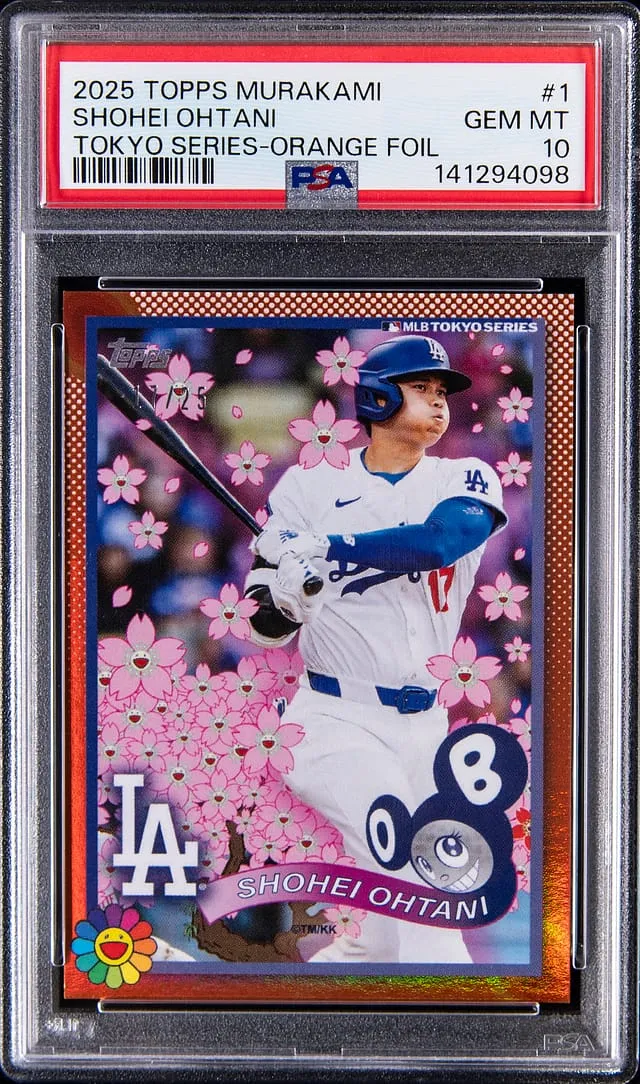
Ohtani 2025 Tokyo Series Orange Foil /25 Sells for $19K
Figoca looks at the $19,520 Goldin sale of a 2025 Topps Murakami Tokyo Series Orange Foil /25 Shohei Ohtani PSA 10 jersey-number card.
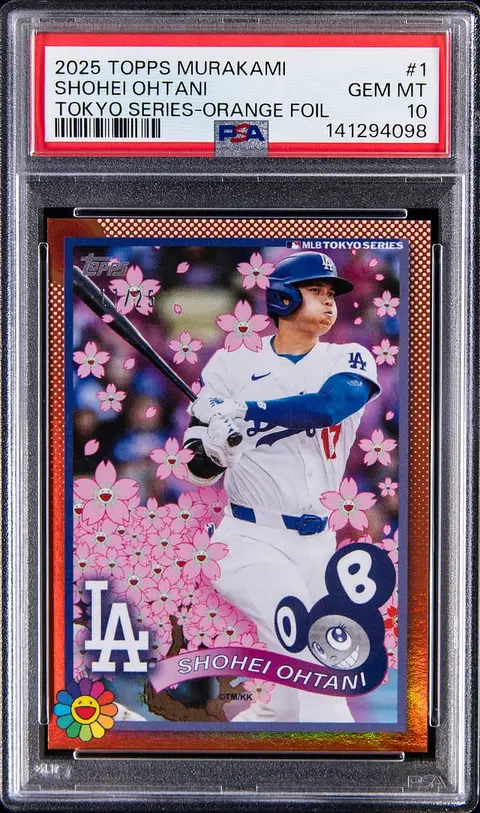
Sold Card
2025 Topps Murakami Tokyo Series Orange Foil #1 Shohei Ohtani (#17/25) - Jersey Number - PSA GEM MT 10 - Pop 3
Sale Price
Platform
Goldin2025 Topps Murakami Tokyo Series Orange Foil #1 Shohei Ohtani (#17/25) - Jersey Number - PSA GEM MT 10 - Pop 3
On April 3, 2026, Goldin closed a notable modern baseball sale: a 2025 Topps Murakami Tokyo Series Orange Foil #1 Shohei Ohtani, serial-numbered 17/25 and graded PSA GEM MT 10, realized $19,520. For a young, still‑developing issue, this result offers an early data point for how collectors are valuing Ohtani’s high‑end Japanese‑themed Topps cards.
Below, we’ll break down what this card is, why it matters to collectors, and how this sale fits into the early market context.
Card breakdown: what exactly sold?
Let’s start with the specifics in plain terms.
- Player: Shohei Ohtani
- Team context: Depicted in his Tokyo Series context (Topps Murakami Tokyo Series theme), tying into his Japanese baseball roots and global star status
- Year: 2025
- Set: 2025 Topps Murakami Tokyo Series
- Card number: #1
- Parallel: Orange Foil
- Serial numbering: 17/25 (only 25 copies printed, and this is #17)
- Special attribute: Jersey-number match (Ohtani wears #17), a detail many advanced collectors treat as a premium within a serial-numbered run
- Rookie status: Not a rookie card; this is an ultra-modern (recent) Ohtani issue
- Grading company: PSA (Professional Sports Authenticator)
- Grade: PSA GEM MT 10 (their highest standard grade for pack‑pulled cards)
- Population (“pop”): Pop 3 in PSA 10 at the time of sale, meaning only three copies of this exact card/parallel have earned a PSA 10 grade.
A few key terms for newer collectors:
- Parallel: A version of a base card with a different finish or color (here, Orange Foil) and often a specific print run (25 copies).
- Serial numbered: A card that has a stamped number like “17/25,” indicating its place out of a fixed print run.
- Jersey-number copy: When the serial number on the card (17) matches the player’s uniform number (17). Collectors often view these as more desirable.
- Pop report: A count published by a grading company showing how many copies of a card have been graded at each grade level.
Why the 2025 Topps Murakami Tokyo Series matters
While the 2025 Topps Murakami Tokyo Series is still a very new issue, several factors help explain why collectors are paying attention:
Japan-focused storytelling
The set leans into Tokyo and Japanese baseball themes, connecting Ohtani back to his NPB (Nippon Professional Baseball) roots and the broader Japanese baseball culture. For global collectors, this taps into the same appeal seen in earlier Japan‑themed Topps and NPB releases.Shohei Ohtani’s global profile
Ohtani is firmly established as one of the defining stars of the modern era. Dual‑threat pitching/hitting status, MVP awards, international success, and media attention have made his premium cards central to many modern baseball collections.Card #1 positioning
Being card #1 in a notable themed set often carries a subtle premium. It’s not the same as a rookie or a cornerstone flagship base, but it adds to the card’s perceived importance within the checklist.Ultra-modern scarcity and grading
Ultra-modern (roughly mid‑2010s to present) cards tend to be well-protected from pack to holder, which means high grades like PSA 10s are more common than in vintage. However, true scarcity comes from:- Low print runs (25 copies total)
- Tough, foil-based surfaces that can pick up print lines or edge wear
- Early low grading volume, as not every copy has been pulled or submitted yet
With a pop of only 3 in PSA 10 at the time of sale, this card sits at the intersection of manufactured scarcity (the /25 print run) and grading scarcity (only three perfect graded examples so far).
The significance of the jersey-number match (17/25)
Within any serial‑numbered run, certain numbers often command extra attention:
- Jersey number (17/25 here)
- Bookends (01/25, 25/25)
- Number 10 or 23 for broader hobby appeal, depending on sport
This copy being 17/25 and matching Ohtani’s jersey number is a detail seasoned collectors immediately notice. The hobby doesn’t have a universal surcharge chart for jersey-number copies, but they often:
- Draw more bids at auction
- Stay in collections longer (people hold them as “keepers”)
- Serve as conversation pieces when showing a collection
In a small print run like /25, the single jersey-number copy is a one‑of‑one within that specific constraint. That doesn’t mean it functions exactly like a true 1/1, but it sits at the top of the desirability hierarchy inside the /25 run.
Grading and population: why PSA 10 Pop 3 matters
PSA’s GEM MT 10 grade signals a card that is essentially pack-fresh in centering, corners, edges, and surface. With foil cards, surface quality can be particularly important.
At the time of this sale, PSA reported only three copies of this card in a PSA 10 holder (Pop 3). For context:
- There may be additional raw (ungraded) copies in collections or unopened product.
- Some graded copies may sit at PSA 9 or below if they picked up minor surface or edge issues.
- As more boxes are opened and more cards submitted, the pop report can change.
However, early low-pop GEM MT 10s can set the tone for how the market values the highest tier of condition for a new issue.
Price context: what does $19,520 tell us?
- Sale price: $19,520
- Auction house: Goldin
- Sale date: April 3, 2026 (UTC)
When analyzing sale prices, many collectors look for “comps” – comparable recent sales of the same card or closely related versions. Because this card is:
- A 2025 release (very recent)
- A low‑print Orange Foil /25 parallel
- A PSA 10 with jersey-number serial (17/25)
- Pop 3 at the time
…direct comps can be limited or scattered across platforms.
What we can say about the market context
Based on what is typically visible for new, scarce Ohtani issues:
- Early graded copies of low‑serial Ohtani parallels often show a wide price spread, depending on eye appeal, jersey-number status, and auction timing.
- Non‑jersey-number copies of similar Ohtani /25 parallels in PSA 10 often sell meaningfully below the standout examples, especially when those standout copies are:
- Jersey-numbered
- First PSA 10s to market
- Sold through a large auction house like Goldin that aggregates serious bidders
In that context, a $19,520 result suggests that:
- Collectors are willing to pay a noticeable premium for:
- The jersey-number match (17/25)
- The PSA 10 grade
- The early positioning of this card in the market for the Murakami Tokyo Series.
Because this is a new set, there isn’t a long trail of historical sales to anchor it. Instead, it functions more as an early benchmark: a data point that other sellers and buyers may look back to when pricing non‑jersey-number copies, lower grades, or other parallels from the same set.
How this fits into the broader Ohtani market
Ohtani’s card market is already built around a few pillars:
- True rookies and early MLB issues
- High-end autographs and patch cards
- Short-print and low-serial parallels from major Topps and Bowman releases
- Japan-themed or international cards that connect to his global story
This 2025 Topps Murakami Tokyo Series Orange Foil /25 slots into the last two categories:
- It’s a short‑printed, low-serial parallel from a notable Topps release.
- Its Tokyo/Japan theme plays into the same international narrative that has boosted other Ohtani cards with Japanese branding or imagery.
Recent seasons have kept Ohtani at the center of hobby discussion—both for his on-field performance and for major team and contract storylines. That background interest tends to support demand for his more distinctive, low‑print cards.
What collectors might take away from this sale
For newer or returning collectors, here are a few practical lessons from this sale:
Not all /25 cards are equal.
A /25 parallel of a depth player is not the same as /25 of a global superstar. Star power, set reputation, and design all matter.Details inside the /25 run can affect value.
Jersey-number copies (17/25 here) and, to a lesser extent, bookends (01/25, 25/25) often draw extra attention.Early graded copies can set the tone.
The first PSA 10s from a new set that reach major auction houses can establish rough price ranges, especially when they’re low‑serial and visually strong.Pop reports are moving targets.
A Pop 3 now doesn’t guarantee it stays that way. As more copies are submitted, the population can rise, sometimes narrowing the gap between early and later sales.Use comps as context, not guarantees.
This $19,520 sale is a piece of information, not a promise that every similar copy will sell at the same level. Timing, auction venue, card condition, and buyer competition all play a role.
Final thoughts
The 2025 Topps Murakami Tokyo Series Orange Foil #1 Shohei Ohtani (#17/25) PSA GEM MT 10 is an early example of how the hobby is valuing Ohtani’s newest, Japan‑themed premium parallels. At $19,520 in Goldin’s April 3, 2026 sale, it reflects a combination of:
- Global demand for Ohtani
- The appeal of a low‑serial /25 parallel in a themed Topps release
- The extra attention given to jersey-number copies
- Early scarcity at the PSA 10 level (Pop 3)
For collectors tracking Ohtani or building out modern international-focused baseball collections, this sale is a useful reference point—not as a prediction, but as a snapshot of how the market is currently responding to one of his more distinctive ultra-modern issues.