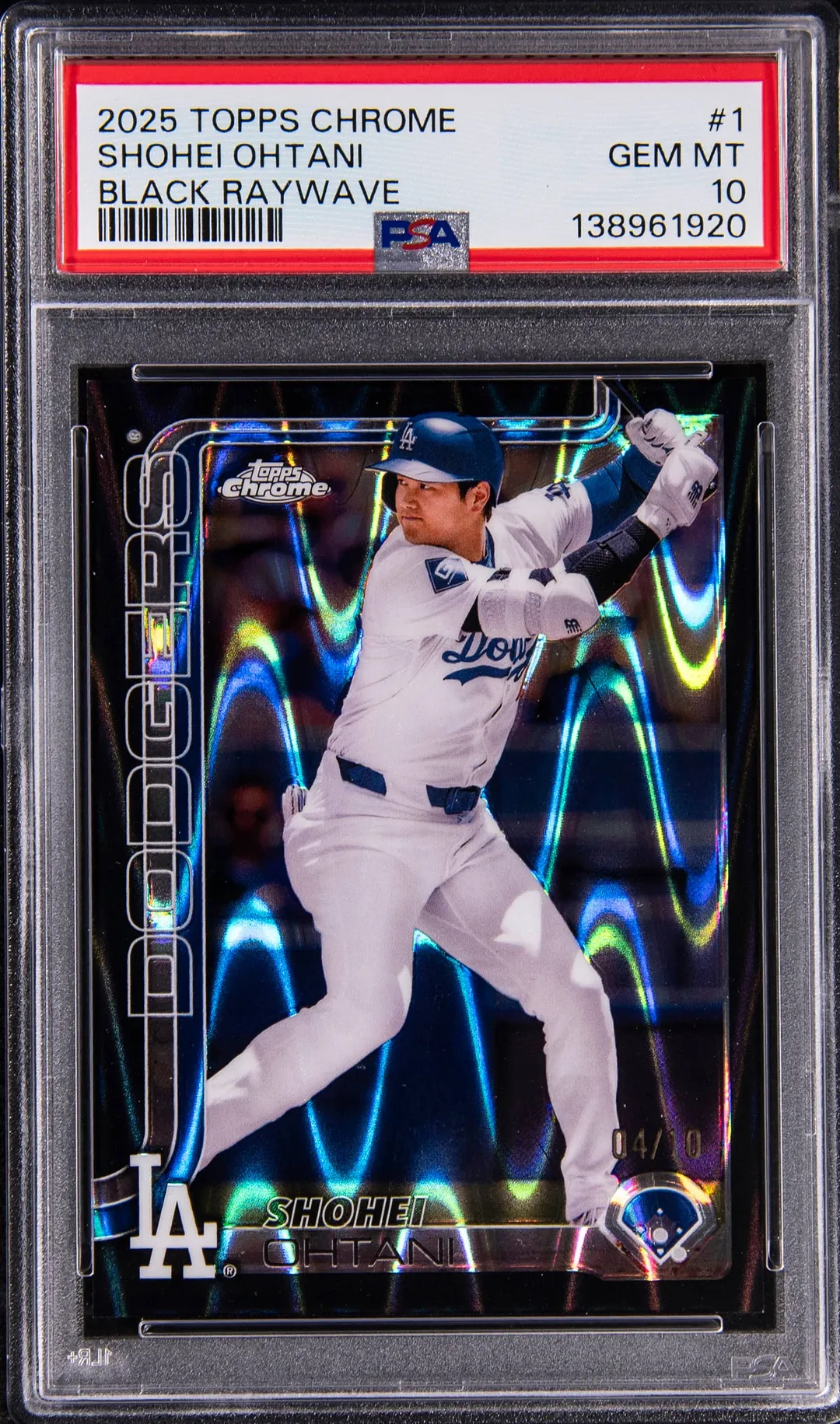
Ohtani 2025 Chrome Black RayWave /10 PSA 10 Sale
Figoca breaks down the $12,322 Goldin sale of the 2025 Topps Chrome Black RayWave /10 Shohei Ohtani PSA 10 and what it signals for collectors.
Sold Card
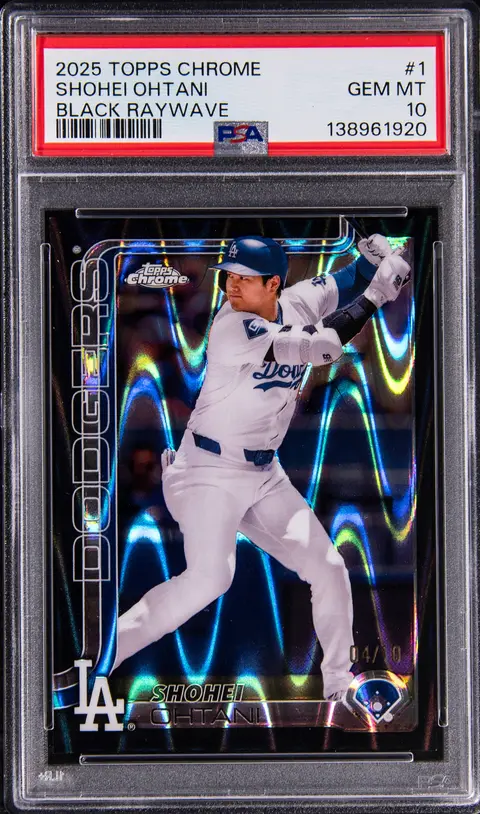
2025 Topps Chrome Black RayWave Refractor #1 Shohei Ohtani (#04/10) - PSA GEM MT 10 - Pop 1
Sale Price
Platform
GoldinA PSA 10 copy of one of Shohei Ohtani’s earliest Dodgers cards just quietly posted a notable result at Goldin.
On February 8, 2026 (UTC), Goldin sold a 2025 Topps Chrome Black RayWave Refractor #1 Shohei Ohtani, serial‑numbered 04/10 and graded PSA GEM MT 10, for $12,322. This is a population 1 card at PSA (often shortened to “pop 1”), meaning it is the only example to receive a PSA 10 grade so far.
The card at a glance
- Player: Shohei Ohtani
- Team: Los Angeles Dodgers
- Year: 2025
- Set: Topps Chrome Black
- Card number: #1
- Parallel: RayWave Refractor, serial‑numbered 04/10
- Grading: PSA GEM MT 10 (PSA 10), pop 1 at the time of sale
- Attributes: Ultra‑low print run (/10), non‑auto, non‑patch, high‑end chromium finish
This is not a rookie card. Instead, it is an early‑run Dodgers issue from a premium chromium line. For player collectors and Ohtani “rainbow” builders (collectors who chase every parallel of a card), it sits in the high‑end tier of his non‑autographed, low‑serial Dodgers cards.
Where 2025 Topps Chrome Black fits in the hobby
Topps Chrome Black has established itself as a modern, higher‑end chromium brand. Boxes are shorter on base cards and heavier on refractors, autos, and low‑serial parallels than standard Topps or Topps Chrome.
A few key things about this release:
- Modern / ultra‑modern era: 2025 products are part of the current ultra‑modern cycle, where parallels and serial‑numbered cards drive most of the scarcity.
- Parallel hierarchy: Within Chrome‑style sets, colors and patterns like gold, orange, red, and exotic refractors (such as RayWave) tend to be more limited and more targeted by player collectors.
- Key Ohtani transition period: Ohtani’s move to the Los Angeles Dodgers created a clear dividing line in his card catalog—Angels issues vs. Dodgers issues. First‑wave Dodgers cards, especially in premium sets, have been closely watched.
Within that context, a /10 RayWave Refractor of Ohtani at PSA 10 is an example of how the market is valuing non‑auto, non‑rookie, but very scarce Dodgers parallels.
Market context and price positioning
This Goldin sale closed at $12,322. To put that into context, it helps to look at three layers of comparison: the exact card, close variations, and Ohtani’s broader high‑end market.
Exact card and close variants
Because this is a new‑issue, /10, pop‑1 parallel, there are only a handful of potential comparison points:
- Same card, different grades: At the time of writing, there is very limited public sales data for lower‑graded copies of this exact 2025 Topps Chrome Black RayWave Refractor #1 /10. That is typical for fresh ultra‑modern, low‑serial cards—most copies are still raw, in PCs (personal collections), or just starting to hit grading queues.
- Same card, different parallels: Public sales for other 2025 Topps Chrome Black Ohtani Dodgers parallels (for example, /99, /75, or /50 non‑auto refractors) have generally landed at clearly lower levels than this $12K result, which is consistent with the much higher scarcity of a /10 parallel in a PSA 10 holder.
Because the RayWave /10 is both very scarce and newly graded, early auction results like this tend to set the first “anchor” in the price history. Later sales—especially if more PSA 10s emerge—will help clarify whether this sits at the top of a range or closer to the middle.
Comparing to other high‑end Ohtani cards
To understand whether $12,322 is out of line or roughly in step with Ohtani’s premium market, collectors often look at:
- Rookie‑year parallels: Flagship‑style Ohtani rookies and early Chrome refractors, especially in rare colors and on‑card autos, have posted some of his strongest prices. Those cards typically sit above non‑rookie, non‑auto modern parallels.
- Other ultra‑low serial non‑rookies: High‑end, low‑serial Dodgers Ohtani cards from other 2024–2025 products have shown a range that can move several thousand dollars either way, depending on brand, serial number, and whether there’s an autograph.
Placed against that backdrop, a PSA 10, /10 Chrome Black parallel landing in the low five‑figure range feels directionally consistent with how the market has treated similar non‑rookie, non‑auto Ohtani scarcity.
Because public data on this exact card is still thin, the safest way to use this comp (short for “comparable sale,” i.e., a past sale used as a reference point) is as a data point, not a prediction. It signals what at least two determined bidders were willing to pay at a specific moment, in a specific auction environment.
Why collectors care about this card
Several factors combine to make this a notable piece:
Ohtani’s unique profile
Ohtani’s two‑way ability and awards history have put him in a category of his own. That tends to pull both rookie cards and premium later‑career cards into a different demand bracket than most active players.Early Dodgers imagery
First‑wave Dodgers issues have added a new chapter to Ohtani collecting. Many player collectors like to anchor each major career phase with a small group of standout cards. A low‑serial, high‑grade Chrome Black parallel checks a lot of those boxes for the Dodgers era.Set and parallel aesthetics
Topps Chrome Black is known for darker, minimalist card designs that make refractor patterns stand out. The RayWave pattern on a black‑themed card appeals to collectors who prioritize visual appeal as much as scarcity.Low serial number and pop 1 grade
A /10 serial number already places this in a very tight print run. Layering on a PSA 10 grade—and the fact that it’s the only one at PSA at the time of sale—sharply limits supply for anyone trying to build a high‑end Ohtani Dodgers run.Grading dynamics in ultra‑modern
Ultra‑modern chromium cards can look clean but are often sensitive to surface scratches and print lines. Not every copy of a /10 parallel will achieve a gem‑mint grade. That makes the pop report (the grading population report, which tracks how many copies exist at each grade) an important part of the story.
Reading this sale without overreacting
For newer or returning collectors, it can be tempting to see a five‑figure result and assume it sets a permanent baseline. In reality, ultra‑modern, low‑serial cards like this often go through a few phases:
- Discovery phase: The first graded copies hit major auction houses like Goldin, and early results establish initial expectations.
- Adjustment phase: As more copies surface—sometimes in different grades or across multiple marketplaces—prices can move up or down while supply and demand find balance.
- Stabilization phase: Over time, especially once a card’s graded population settles, a tighter value range tends to emerge from repeated comps.
This Goldin result is best viewed as an early, high‑visibility data point for a pop‑1, /10 Ohtani Dodgers parallel from a respected premium Chrome brand. Collectors can watch for:
- Future sales of this exact RayWave /10 parallel in any grade.
- Results for other 2025 Topps Chrome Black Ohtani parallels, especially /25 and /50 tiers.
- How this slot compares over time to Ohtani’s core rookie and autograph market.
Takeaways for collectors and small sellers
- For player collectors: If you focus on Ohtani or on Dodgers‑era stars, this sale underscores how competitive /10 and similar ultra‑low serial cards can be, even without an autograph.
- For set and parallel collectors: 2025 Topps Chrome Black parallels are already drawing focused attention, particularly at the top of the rarity ladder. A RayWave /10 PSA 10 result like this helps map the upper end of that structure.
- For small sellers: Treat this as a reference point, not a target. Condition, timing, auction platform, and marketing all matter. A strong pop‑1 result is relevant context when you’re deciding whether to grade, when to sell, or how to describe your own Ohtani Chrome Black cards.
As more 2025 Topps Chrome Black Ohtani cards get graded and come to market, we’ll have clearer lines between tiers—raw vs. graded, mid‑serial vs. ultra‑low serial, and non‑auto vs. auto. For now, this $12,322 Goldin sale on February 8, 2026 stands as an early marker for what collectors are willing to pay for one of the rarest non‑auto Dodgers‑era Ohtani parallels in gem‑mint condition.