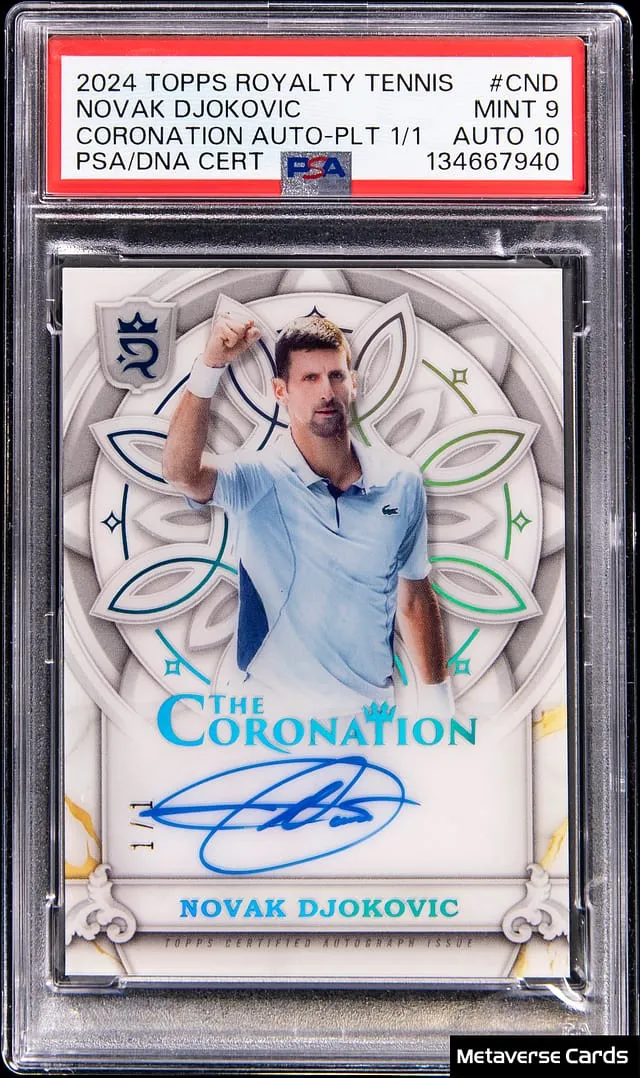
Novak Djokovic 1/1 2024 Topps Royalty Sale
A detailed look at the $43,920 Goldin sale of the 2024 Topps Royalty Tennis Novak Djokovic 1/1 Coronation Autograph Platinum, PSA 9 with a PSA 10 auto.
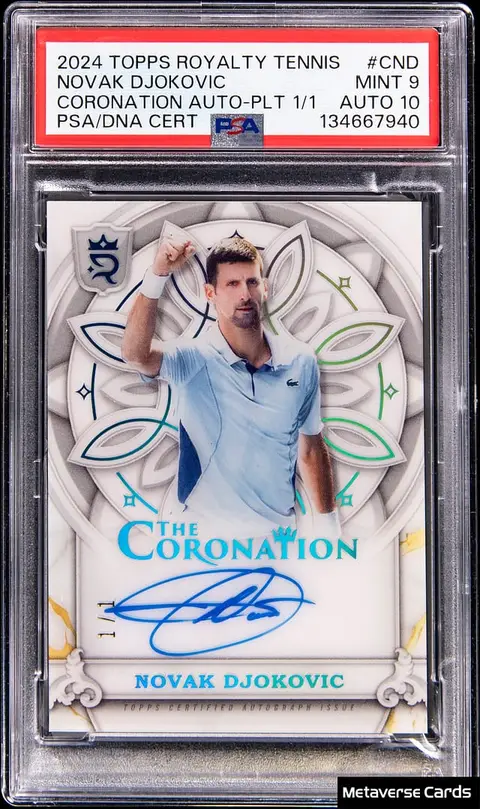
Sold Card
2024 Topps Royalty Tennis Coronation Autograph Platinum #C-ND Novak Djokovic Signed Card (#1/1) - PSA MINT 9, PSA/DNA GEM MT 10
Sale Price
Platform
Goldin2024 Topps Royalty Tennis Coronation Autograph Platinum #C‑ND Novak Djokovic Signed Card (#1/1) – PSA MINT 9, PSA/DNA GEM MT 10 Sells for $43,920
On June 7, 2026, Goldin sold a true modern tennis centerpiece: a 2024 Topps Royalty Tennis Coronation Autograph Platinum #C‑ND Novak Djokovic, serial‑numbered 1/1, graded PSA MINT 9 with a PSA/DNA GEM MT 10 autograph, for $43,920.
For tennis collectors who have been watching the slow but steady rise of the category, this sale is a useful data point in how the market is treating ultra‑premium, pack‑pulled Djokovic autographs from a major modern brand.
The card at a glance
Let’s break down exactly what this card is:
- Player: Novak Djokovic
- Year: 2024
- Set: Topps Royalty Tennis
- Insert / subset: Coronation Autograph
- Parallel: Platinum
- Card number: #C‑ND
- Serial number: 1/1 (one‑of‑one)
- Autograph: On‑card signed
- Grading company: PSA
- Card grade: PSA MINT 9
- Autograph grade: PSA/DNA GEM MT 10
- Era: Ultra‑modern tennis
Because it is a 1/1 Platinum parallel, this is the only copy of this exact version that exists. The combination of a low‑population modern autograph, a high card grade, and a perfect autograph grade is what puts it into the top tier of Djokovic’s modern pack‑pulled cards.
This is not a rookie card—Djokovic’s key early issues go back to the mid‑2000s—but it is a key ultra‑modern issue: a one‑of‑one, on‑card autograph from a premium Topps tennis release, created during the period where his legacy in the GOAT conversation is already well established.
About 2024 Topps Royalty Tennis and Coronation Autographs
Topps Royalty Tennis is part of the broader trend of major card manufacturers giving individual sports like tennis their own dedicated premium sets, rather than relying on multi‑sport products. For collectors used to chasing soccer or F1, the structure will feel familiar:
- A base set featuring top players
- Short‑printed and low‑serial parallels
- Autograph and memorabilia (patch) cards
- Ultra‑short‑printed chase cards, including 1/1s
The Coronation Autograph subset focuses on top‑tier names and is positioned as a premium autograph chase. The Platinum parallel being a 1/1 places it at the very top of that chase hierarchy.
For collectors new to tennis cards:
- Short print (SP) / serial‑numbered means the card’s production run is limited and stamped with an individual serial number (e.g., 1/99).
- 1/1 (one‑of‑one) means there is only one copy produced.
- On‑card autograph means Djokovic signed directly on the card itself, not on a sticker later applied to the card.
Why this card matters for Djokovic and tennis collectors
Novak Djokovic is already widely discussed as one of the greatest men’s tennis players of all time. That status shapes how collectors view his cards:
- He’s an established legend, not a prospect. That shifts the focus from speculative rookie chasing to targeting historically significant or truly scarce pieces—1/1s, low‑serial autos, and important early issues.
- Ultra‑modern, but legacy‑driven. By 2024, Djokovic’s resume of Grand Slams and records was largely built out. New high‑end cards like this are more about commemorating an already cemented legacy than betting on future performance.
- Autographs carry weight. Tennis does not have the same volume of licensed, pack‑pulled autographs as sports like basketball or American football. A high‑profile, on‑card Djokovic auto from a major manufacturer has a different scarcity profile than many star autos in more saturated sports.
This particular card layers multiple forms of scarcity and quality:
- Only one Platinum 1/1 exists.
- It’s graded PSA 9, which is a strong grade for a premium, thick‑stock modern auto card.
- The autograph received PSA/DNA’s top grade, GEM MT 10, indicating a clean, bold signature with excellent presentation.
For Djokovic collectors building a focused PC (personal collection), this type of card functions as a centerpiece rather than a filler. For broader tennis collectors, it’s a marker for how the market prices the very top of modern Djokovic content.
Market context and price positioning
This card sold at Goldin on June 7, 2026 for $43,920.
In the modern hobby, “comps” (short for comparables) usually refers to recent sale prices of the same or closely similar cards, used as context for evaluating a new sale. With 1/1s, direct comps are often hard or impossible to find because each piece is unique.
A realistic way to think about price context here is:
Compare across Djokovic’s high‑end modern autos
You can look at:- Other 1/1 Djokovic autographs from licensed products
- Low‑serial (e.g., /5, /10) on‑card autograph parallels
- Premium patch autos from key sets
Public auction results show that, historically, Djokovic’s top 1/1 or very low‑serial, high‑grade autographs can reach into the tens of thousands of dollars, depending on brand, imagery, and timing relative to big wins or milestones. A sale in the $40,000+ range fits into the upper band of that type of material, especially for a visually strong, graded example.
Consider set and brand positioning
2024 Topps Royalty Tennis is part of a newer wave of tennis products. That means it doesn’t yet have the long historical track record of, say, iconic 1980s or 1990s tennis issues, but it does have the advantage of modern design, licensing, and hobby attention. Collectors often pay a premium for:- Clean designs that showcase the autograph
- Strong photography
- Clear, prominent 1/1 stamping and parallel naming
Understand that 1/1s trade more on “want” than on strict charts
Even with comps, two Djokovic 1/1 autos can behave very differently in the market, depending on:- The specific buyer pool active in that auction
- Preferences for brand (Topps vs. other manufacturers)
- Autograph quality and card condition
- Timing around majors or records
Because of that, it’s more accurate to see this $43,920 sale as one clear, documented data point in the upper tier of Djokovic’s modern autograph market, rather than a hard anchor that all similar 1/1s will match.
Grading: PSA 9 with PSA/DNA 10 auto
For newer collectors, a quick breakdown:
- PSA is a leading third‑party grading company. They evaluate card condition (corners, edges, surface, centering) on a 1–10 scale.
- PSA MINT 9 means a high‑grade card with only minor flaws under close inspection.
- PSA/DNA GEM MT 10 autograph means PSA examined the signature and determined it is genuine and in virtually flawless condition—bold, well‑placed, with no significant smearing, fading, or breaks.
For on‑card autos on thicker or premium foil stock, a PSA 9 / 10 auto combination is often considered a very strong outcome. Many ultra‑modern autos suffer from surface or edge issues right out of the pack.
In high‑end modern, collectors often differentiate value between:
- Raw (ungraded) cards
- Graded but no auto grade
- Graded with a 10 auto
So, the dual grade here likely contributed meaningfully to bidder confidence.
Where this sale fits in the broader tennis card trend
Tennis has been under‑represented in the hobby relative to its global following. Over the last several years, there has been a noticeable increase in:
- Dedicated tennis products from major brands
- Attention to early cards of legends (Djokovic, Federer, Nadal, Serena, etc.)
- Demand for modern, on‑card autographs and low‑serial parallels
Sales like this one at Goldin serve as reference points for where the very top of the market is currently willing to transact. They don’t dictate what every Djokovic card “should” be worth, but they help map out the upper end of the spectrum for:
- Pack‑pulled, licensed Djokovic 1/1 autographs
- High‑grade, visually strong ultra‑modern tennis chase cards
For small sellers or returning collectors, this doesn’t mean that any Djokovic auto will approach these numbers. Instead, it underlines the importance of:
- Card tier: Flagship vs. lower‑tier, base vs. parallel.
- Scarcity: Serial number, print runs, and whether a card is truly a chase card.
- Condition and authentication: Professional grading and, for autos, a clear, trusted authentication.
Takeaways for collectors and small sellers
If you’re a collector or small seller looking at this Goldin sale as a reference, some practical points:
Differentiate between “cool Djokovic auto” and “true chase card.”
This Platinum 1/1 Coronation Autograph is clearly in the latter category. Most Djokovic autos are more accessible, but their value will scale with scarcity, set, and condition.Pay attention to the set architecture.
In modern products like 2024 Topps Royalty Tennis, understanding which inserts and parallels sit at the top of the ladder (like Platinum 1/1s) helps you prioritize what to chase or hold.Use sales like this as context, not a price guarantee.
The $43,920 result on June 7, 2026 shows what a specific, highly desirable 1/1 did in a well‑publicized auction. It’s one data point in a market that can move with player milestones, new releases, and collector interest.Grading and autograph presentation matter.
A strong PSA grade combined with a GEM MT 10 autograph gives buyers more confidence, especially at higher price levels.
Final thoughts
The 2024 Topps Royalty Tennis Coronation Autograph Platinum #C‑ND Novak Djokovic 1/1, graded PSA MINT 9 with a PSA/DNA GEM MT 10 autograph, landing at $43,920 in Goldin’s June 7, 2026 sale is a clear statement about where high‑end, ultra‑modern tennis cards can sit in today’s hobby.
For Djokovic specialists, it’s the kind of card that rarely comes up and anchors a collection. For broader tennis and modern collectors, it’s a useful marker: when brand, scarcity, condition, and a firmly established GOAT‑level resume line up, the market is willing to treat ultra‑modern tennis at a genuinely premium level.
As always, the best use of a sale like this is as context—another plotted point on the chart of how tennis cards are slowly catching up to the global stature of the sport itself.