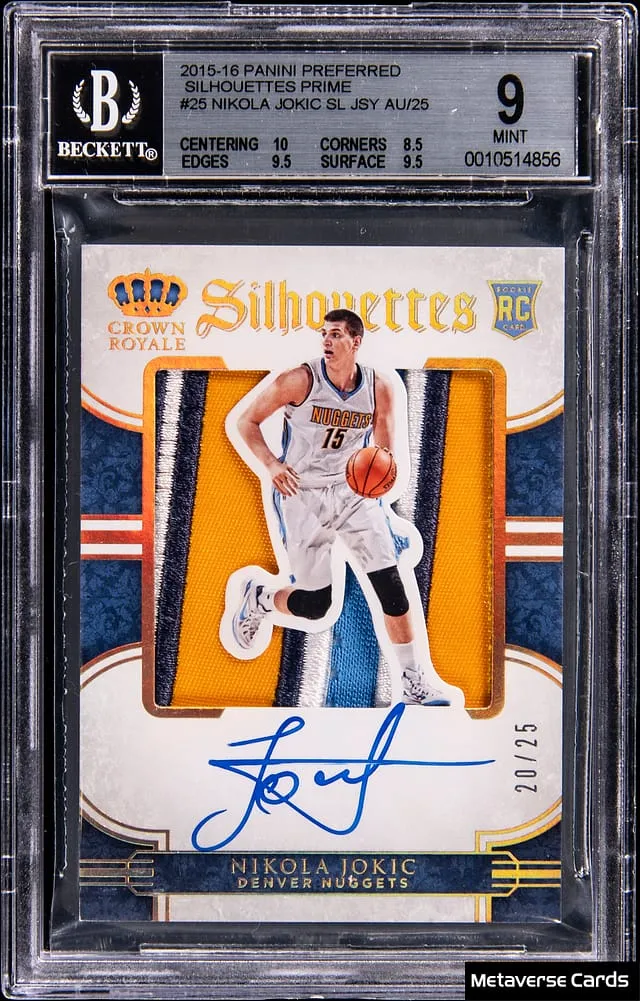
Nikola Jokic 2015 Preferred Silhouettes Rookie Sells
Goldin sold a 2015-16 Panini Preferred Silhouettes Prime Nikola Jokic rookie patch auto /25, BGS 9/10, for $427,000 on June 7, 2026. Here’s the context.
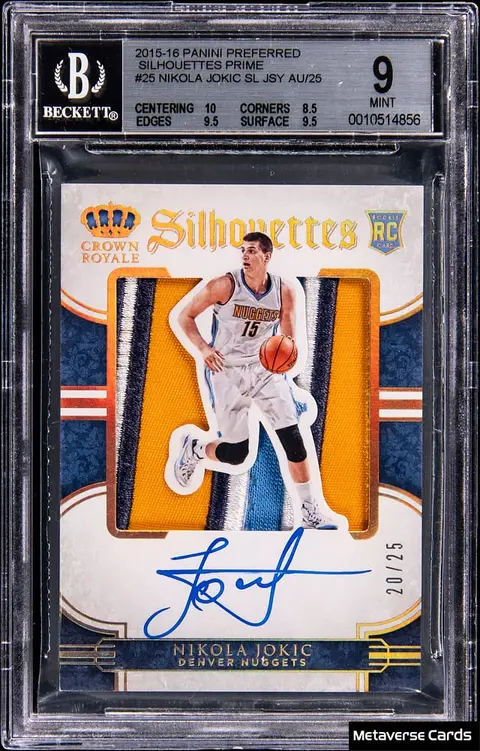
Sold Card
2015-16 Panini Preferred Silhouettes Prime Patch Autograph #25 Nikola Jokic Signed Patch Rookie Card (#20/25) - BGS MINT 9, Beckett 10 - Pop 4
Sale Price
Platform
Goldin2015-16 Panini Preferred Silhouettes Prime Patch Autograph #25 Nikola Jokic Signed Patch Rookie Card (#20/25) - BGS MINT 9, Beckett 10 - Pop 4
On June 7, 2026, Goldin sold a key Nikola Jokic rookie for $427,000: a 2015-16 Panini Preferred Silhouettes Prime Patch Autograph #25, serial numbered 20/25, graded BGS Mint 9 with a Beckett 10 autograph. With a population ("pop") of just 4 in this grade configuration, this is one of the more important ultra-modern Jokic rookies to change hands publicly.
Below, we’ll walk through what this card is, why collectors care about it, and how this sale fits into the broader Jokic and modern basketball market.
Card overview: what exactly sold?
Let’s break down the full description and why each piece matters:
- Year / Set: 2015-16 Panini Preferred
- Subset: Silhouettes Prime Patch Autograph
- Card number: #25
- Player: Nikola Jokic, Denver Nuggets
- Rookie status: Rookie card (from Jokic’s first NBA-licensed release year)
- Serial numbering: Hand-numbered 20/25 on the card
- Patch: Multi-color prime patch (a “prime” patch usually means multiple colors or a premium piece of the jersey)
- Autograph: On-card signature (signed directly on the card, not on a sticker)
- Grading company: Beckett Grading Services (BGS)
- Grade: BGS 9 (Mint) with 10 autograph
- Population: Pop 4 in this grade/auto combination
The Silhouettes line is known for its large die-cut player window over a jumbo jersey swatch, combined with an on-card autograph. Within 2010s basketball, Silhouettes Prime RPA-style (rookie patch autograph) cards are considered among the higher-end rookie options, especially for non-flagship releases.
Why this Jokic matters to collectors
1. A premium rookie patch autograph
For modern stars, a rookie patch autograph (often shortened to RPA) is one of the core “chase” cards—essentially, the premium rookie collectors gravitate to beyond basic base rookies.
While Jokic’s Prizm base rookie is the mainstream face of his rookie year, cards like this Preferred Silhouettes Prime sit in a more scarce, high-end lane:
- They combine a game-worn or player-worn jersey patch with a signature.
- They are numbered to 25, which is low even by modern standards.
- The on-card autograph gives it more appeal than a sticker auto to many advanced collectors.
For Jokic specifically—an MVP-level center with multiple deep playoff runs and a championship on his résumé—serious collectors often view these limited RPAs as long-term cornerstone pieces of a Jokic-focused collection.
2. Ultra-modern, but not mass-printed
2015-16 falls into what many call the “ultra-modern” era: post-2012, with strong demand, more products, and a more grading-aware hobby.
However, ultra-modern doesn’t automatically mean overprinted. High-end subsets like Silhouettes Prime /25 were never printed in mass quantities. The serial numbering to 25 and the small BGS pop confirm that real supply is thin:
- Only 25 copies exist by serial number.
- Of those, only a subset has been graded by BGS.
- Only 4 have reached the BGS 9 / 10 auto level at the time of this pop report.
In practice, it’s a card most collectors will only ever see in auction results or at major shows.
3. Jokic’s ongoing relevance
Recent hobby interest in Jokic has been supported by:
- Multiple MVP awards and top-3 finishes.
- A NBA championship and Finals MVP-level performances.
- A playing style that generates strong analytics, highlight reels, and crossover attention.
While pricing always reacts to short-term performance and macro hobby trends, Jokic has already crossed an important line for many collectors: he is broadly treated as a foundational modern superstar rather than a speculative name.
That status adds weight to high-end rookie sales like this Goldin result.
Market context: how does $427,000 fit in?
The card sold for $427,000 at Goldin on June 7, 2026.
To understand that number, collectors usually look at “comps”—recent comparable sales of the same card or highly similar cards on major marketplaces (Goldin, PWCC, Heritage, eBay, etc.).
Exact-card and near-card comps
Because this is a short-printed /25 card and a Pop 4 in this grade, public auction results are naturally limited. When researching, it’s helpful to look at:
- Other 2015-16 Preferred Silhouettes Jokic RPAs (Prime and non-Prime versions).
- Other Jokic RPA-style rookies from high-end brands (e.g., National Treasures, Immaculate, Flawless) in similar grade tiers.
- Private sale rumors or brokered deals can exist, but they are rarely fully verifiable and are best treated as anecdotal context.
Recent public results (for the broader Jokic RPA ecosystem) have shown:
- Top Jokic NT RPAs (National Treasures) with premium patches and strong grades reaching very high six-figure territory at peak market moments, then adjusting downward as the ultra-modern market cooled, then stabilizing around playoff runs or major awards.
- Preferred Silhouettes and similar “tier-two” high-end RPAs typically trading at a significant discount to NT, but still in the serious-investor, advanced-collector price band.
Within that framework, $427,000 for a BGS 9 / 10 auto, Pop 4 Preferred Silhouettes Prime /25 is clearly at the upper end for this specific card type but not out of line with the broader pattern for elite Jokic rookies. The figure aligns with a market that still treats high-end Jokic RPAs as premium blue-chip hobby pieces.
Because public data for this exact card is sparse, it’s more accurate to say this sale is a strong but plausible result in the context of Jokic’s top-tier rookies rather than a clearly anomalous outlier.
Population and grading details
The BGS label on this card reads:
- Grade: 9 (Mint)
- Autograph: 10
In BGS terms, Mint 9 is a high, but not gem-mint, grade. For thick, patch-based, on-card autograph cards, 9s are common because:
- Corners and edges on thick stock are harder to keep perfect.
- Surface issues can be more frequent around patch windows or foil.
The Pop 4 designation matters in context:
- It means that exactly four copies at the time of reporting have achieved this grade/auto combo with BGS.
- There may be higher grades (9.5s, 10s) or lower ones (8.5 and below), but in general, the total graded universe is small.
When collectors talk about “pop report”, they are referring to the grading companies’ public count of how many copies of a specific card have been graded at each grade level. For low-serial, on-card autos, those numbers tend to remain small, which can support long-term perceived scarcity.
How this sale fits within the Jokic market story
Viewed alongside other high-end Jokic rookies, this Goldin sale helps paint a broader picture:
- NT and Flawless remain the headline-makers, but Preferred Silhouettes Prime is firmly in the conversation of serious Jokic rookie targets.
- A realized price of $427,000 for a non-NT Jokic RPA signals that collector confidence in Jokic’s long-term relevance stays strong.
- Within the ultra-modern window, there’s increasing separation between truly scarce, high-quality rookie autos and the bulk of mid-tier parallels and inserts.
For collectors, a sale like this isn’t just about the number—it provides a reference point. When you see a Preferred Silhouettes Jokic in a lower grade or with a weaker patch, you can mentally anchor its value relative to a Mint 9 /10 Prime /25 result like this one.
Takeaways for collectors and small sellers
A few practical observations if you’re collecting or selling in this lane:
Patch and auto quality matter. On premium rookies, eye appeal—how the patch looks, auto placement, and centering—often drives differences even within the same grade.
Grade bands are important, but not everything. For thick RPAs, an 8.5, 9, or 9.5 can all be viable collector grades; the card itself (patch, serial, on-card auto) often carries as much weight as the numerical bump.
Know which sets are “core” for your player. For Jokic, the hobby has largely coalesced around a tiered view of rookies: Prizm for accessibility and liquidity, NT/Flawless/Immaculate/Preferred Silhouettes for higher-end, long-term cornerstone pieces.
Use comps carefully. With low-pop, /25 cards, there may be long gaps between public sales. In those cases, look broadly at similar cards and grades for the same player to frame expectations, rather than anchoring to a single old sale.
Auction house choice can influence visibility. A high-end Jokic RPA selling through a major platform like Goldin on June 7, 2026, benefits from concentrated attention from advanced buyers, which can affect realized prices.
Final thoughts
The $427,000 Goldin sale of the 2015-16 Panini Preferred Silhouettes Prime Patch Autograph #25 Nikola Jokic rookie—serial numbered 20/25 and graded BGS Mint 9 with a 10 auto, Pop 4—adds another data point to the growing track record of high-end Jokic rookie performance.
For Jokic collectors, it underscores the status of Silhouettes Prime as a serious, high-end alternative to the headline NT RPAs. For broader basketball collectors, it’s another reminder that, in the ultra-modern era, truly scarce, on-card, low-serial rookie autos still command a clear premium when the player’s career production supports it.
As always, this sale should be viewed as one piece of a larger puzzle—use it as context, not a promise, when you evaluate your own Jokic cards or consider entering this part of the market.