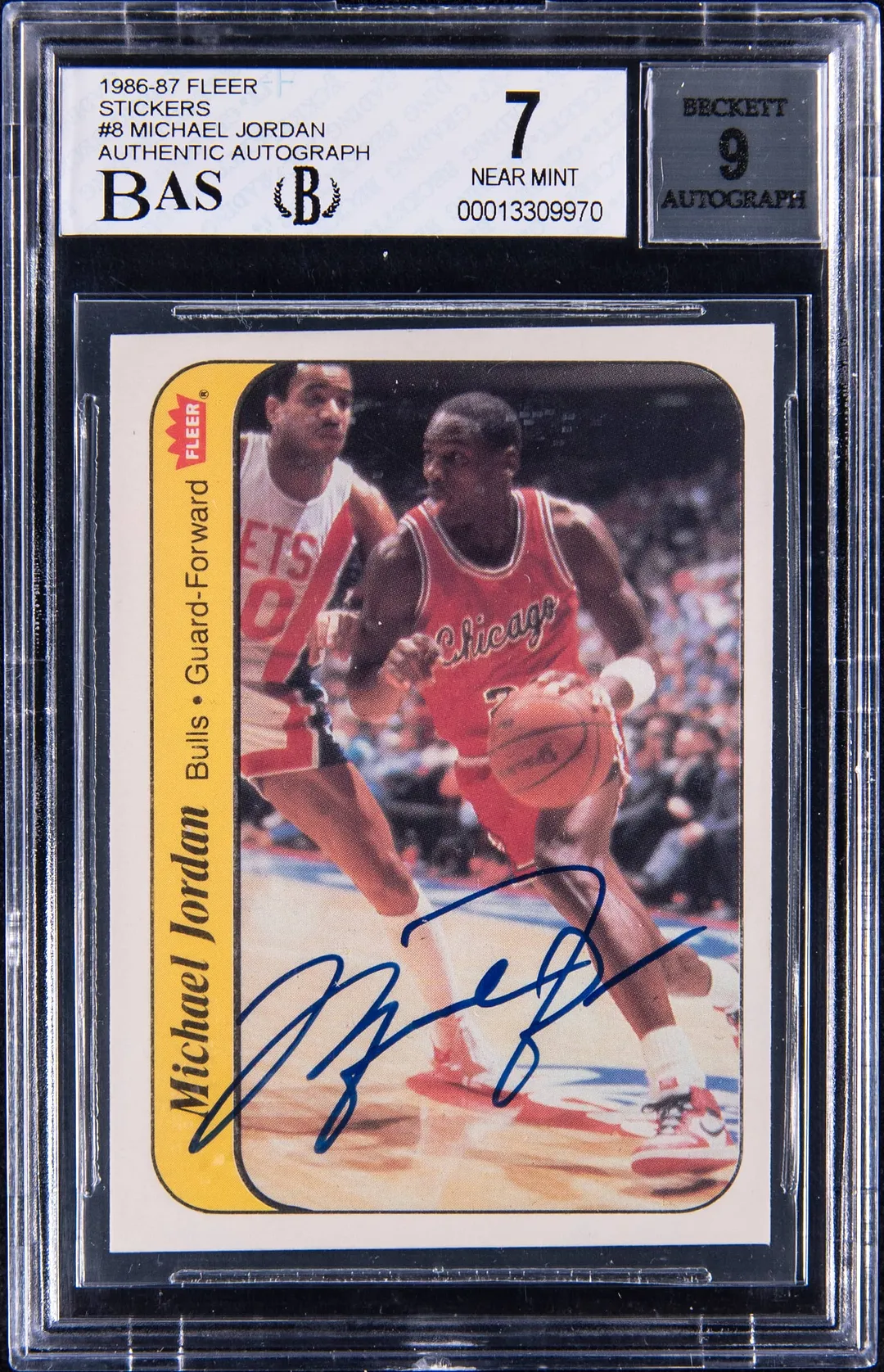
Michael Jordan 1986 Fleer Sticker Auto Rookie Sells for $34K
Goldin sold a BGS 7, Beckett 9, UDA 1986-87 Fleer Sticker #8 Michael Jordan signed rookie card for $34,160. Here’s how it fits the current market.
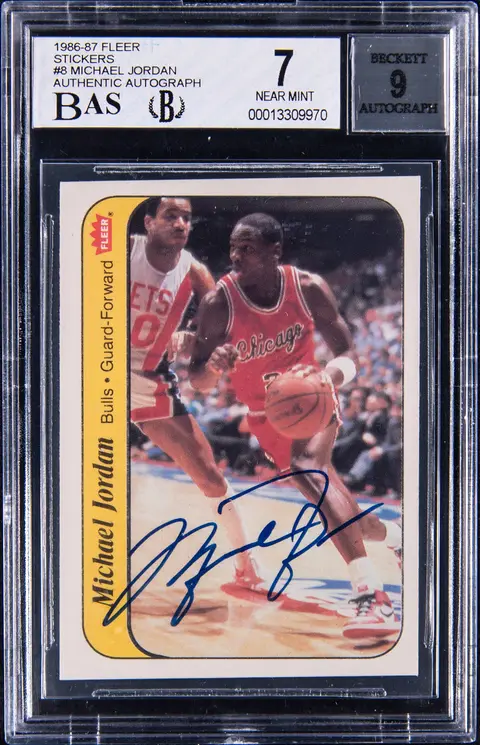
Sold Card
1986-87 Fleer Sticker #8 Michael Jordan Signed Rookie Card - BGS NM 7, Beckett 9, UDA
Sale Price
Platform
Goldin1986-87 Fleer Sticker #8 Michael Jordan Signed Rookie Card – BGS NM 7, Beckett 9, UDA
On February 8, 2026, Goldin sold a 1986-87 Fleer Sticker #8 Michael Jordan signed rookie card for $34,160. For many basketball collectors, this card sits at the intersection of three important lanes: the iconic 1986-87 Fleer release, Jordan’s true rookie-year content, and authenticated on-card autographs from Upper Deck.
In this post, we’ll break down what this specific card is, how the grade and autograph fit into the broader market, and what this sale might mean for collectors who track Jordan rookies and signed vintage.
What exactly sold at Goldin?
Key details of the card:
- Player: Michael Jordan
- Team: Chicago Bulls
- Year / Set: 1986-87 Fleer Sticker insert set
- Card number: #8
- Type: Rookie-year sticker (companion to the 1986-87 Fleer Jordan base rookie)
- Attributes: On-card autograph, Upper Deck Authenticated (UDA)
- Grading: Beckett Grading Services (BGS)
- Card grade: NM 7 (Near Mint)
- Autograph grade: 9 (from Beckett’s autograph grading)
The 1986-87 Fleer release is widely regarded as Michael Jordan’s flagship rookie set in basketball cards. The sticker subset, which includes Jordan at #8, was issued alongside the main base cards and is considered a rookie-year issue. While some collectors reserve the term “rookie card” for the main Fleer #57, many still treat this sticker as a key rookie companion that belongs in the same conversation.
What makes this particular example special is the combination of:
- Original 1986-87 Fleer Sticker (not a reprint),
- On-card signature from Jordan,
- Upper Deck Authenticated (UDA) provenance, which gives collectors confidence that the autograph originates from an authorized signing,
- BGS encapsulation with both a card grade (7) and a strong autograph grade (9).
Why the 1986-87 Fleer Jordan sticker matters
For someone new to the hobby, it’s easy to think only the Fleer #57 base rookie matters. But within Jordan’s early cardboard, the sticker plays a major role.
A few reasons:
Rookie-year status
The 1986-87 Fleer sticker is from the same release as Jordan’s main rookie card and the first widely distributed, licensed NBA set of the modern era. That “rookie-year” label carries weight, especially for basketball, where the 1986-87 Fleer run acts like a foundational set.Insert nature and condition difficulty
The stickers were inserts and were often peeled, stuck into albums, or handled more casually than base cards. The combination of centering issues, rough edges, and surface sensitivity makes high-grade copies of the Jordan sticker notably tougher than many base cards from the era.Fleer + Jordan = hobby cornerstone
The entire 1986-87 Fleer release has become shorthand for the start of the modern basketball card era. Jordan’s presence in both the base and sticker sets cements these issues as long-term reference points for collectors, price discussions, and hobby content.
When you add a clean, authenticated signature to a key rookie-year card, you get a hybrid piece: part vintage-era collectible, part modern autograph card.
Grading context: BGS 7 card grade, Beckett 9 autograph
Beckett Grading Services (BGS) scoring a card as NM 7 means you should expect visible but moderate flaws: edge wear, some corner touches, or surface issues. For a 1980s sticker that has survived almost 40 years, that is not surprising.
The autograph grade of 9 from Beckett indicates a strong signature with only minor issues (like a tiny streak, slight fading, or minor inconsistency). For many autograph-focused collectors, the auto grade is as important—or more important—than the card grade itself.
In this tier of Jordan pieces, it’s helpful to think in two dimensions:
- Card condition (centering, corners, edges, surface), and
- Signature quality (boldness, placement, completeness, and grading).
A BGS 7 / Auto 9 balances a respectable, presentable copy of a vintage sticker with a high-end autograph grade.
Why UDA matters for a Jordan autograph
Upper Deck Authenticated (UDA) is one of the most recognized names attached to Jordan signatures. For years, UDA handled Jordan’s autograph signings and applied a controlled, trackable system to verify authenticity.
In practice, that means:
- The autograph is tied back to an official signing session.
- The piece typically includes or originally included a matching hologram/cert.
- Collectors in the Jordan market often pay a premium for UDA-sourced autos compared with generic “in-person” signatures, because the provenance is clearer.
Pairing UDA with a Beckett-graded card and autograph gives three layers of comfort:
- The card is genuine and graded.
- The autograph is genuine and evaluated.
- The provenance routes back to UDA, a brand that’s strongly associated with Jordan’s signed memorabilia.
Market context and recent sales
This particular copy sold at Goldin on February 8, 2026 for $34,160.
When collectors talk about “comps,” they mean comparable recent sales of the same or very similar cards—usually filtered by player, year, set, variant, and grade. While exact, up-to-the-minute price data can shift, a few general patterns have held in the Jordan rookie and rookie-year auto market:
Unsigned 1986-87 Fleer Jordan stickers: In recent years, PSA 8s and 9s have typically commanded solid four-figure prices, with high-end grades stretching well into five figures at peak market points. Lower grades like PSA/BGS 6–7 usually trade meaningfully lower, reflecting condition sensitivity.
Signed 1986-87 Fleer Jordan rookies and stickers: When authenticated by UDA and encapsulated by a major grading company, these tend to occupy their own lane above unsigned copies. Higher-grade cards (and Gem Mint or Pristine autos) can reach well into the mid-to-high five figures or beyond, depending on timing and auction venue.
Card grade vs. auto grade: For autographed vintage or rookie-year pieces, collectors sometimes accept a lower card grade in exchange for a strong autograph grade and UDA provenance. That dynamic helps explain why a BGS 7 card with an Auto 9 can still command a strong five-figure result.
Relative to other Jordan rookie-year autographed pieces, a $34,160 sale for a BGS 7 / Auto 9 sits in what many collectors would view as the mid-to-upper part of the market for this specific configuration: not record-setting, but clearly in serious-collector territory.
It’s also worth noting that auction results can be influenced by:
- The specific auction house and marketing reach (in this case, Goldin),
- The timing of the sale (seasonality, broader market sentiment),
- The eye appeal of the individual copy (centering and autograph placement, even within the same numeric grade).
Because market conditions and comps move over time, newer sales may sit above or below this number. Still, this Goldin result helps anchor a reference point for BGS 7 / Auto 9, UDA-backed examples.
How this sale fits into Jordan’s broader card market
Michael Jordan’s card market is unusual in a few ways:
Cross-era demand
Jordan attracts interest from vintage collectors, 90s insert specialists, modern basketball fans, and even non-card sports memorabilia buyers. That multi-lane demand keeps his key issues in constant circulation.Layered "tiers" of importance
At the top, you’ll find the 1986-87 Fleer base rookie (#57) in high grade. Right behind it sit the sticker, key 90s inserts, and notable autographed issues. A signed, rookie-year Fleer sticker with strong authentication lives very close to that top tier.Stability relative to hype cycles
Compared to modern prospecting (buying cards of young players hoping they break out), Jordan’s market tends to move more gradually. Prices still fluctuate with broader economic conditions and hobby sentiment, but the underlying demand is anchored in decades of established interest.
A sale like this one demonstrates that collectors continue to treat signed rookie-year Jordan pieces as long-term reference points rather than short-term speculation.
What collectors can take away from this sale
A few practical observations for collectors, whether you are returning after a long break or building your first serious Jordan focus:
Rookie-year vs. strict rookie card
The 1986-87 Fleer sticker is a rookie-year issue and a staple for Jordan collectors, even if some reserve the strict “rookie card” label for the Fleer #57. Understanding that nuance can help you compare prices more accurately.Autograph provenance matters
UDA-backed Jordan autographs often occupy a different price tier than generic signed copies. If you’re browsing auction results, always note whether an auto is UDA, another major authenticator, or simply “signed.”Balance between card and autograph grades
For many collectors in this lane, an excellent autograph (9 or 10) can offset a mid-grade card. Visual appeal and the overall presentation sometimes matter more than the card grade alone.Auction venue and timing influence results
The same card can realize different prices at different auction houses, or in different market phases. This $34,160 sale at Goldin on February 8, 2026 is a strong comp, but it should be read alongside other recent results rather than in isolation.Use comps as context, not as guarantees
Recent sales offer guideposts, not promises. A comp can help you understand where a card has traded, but future prices can move up or down with market conditions.
Final thoughts
The 1986-87 Fleer Sticker #8 Michael Jordan signed rookie card that sold at Goldin for $34,160 on February 8, 2026 combines three pillars of Jordan collecting:
- A key rookie-year Fleer issue,
- A graded vintage card,
- A strong, authenticated autograph with UDA backing.
For collectors who care about Jordan’s early cardboard and signed heritage pieces, this result adds another data point to an already well-tracked segment of the market. Whether you collect raw stickers, graded rookies, or premium autos, keeping an eye on sales like this helps you understand how condition, authentication, and auction venue intersect to shape today’s prices.
As always, it’s worth approaching the data with patience: watch multiple auctions, compare grades and provenance carefully, and focus on copies whose condition and presentation you genuinely like. In a segment as established as Jordan’s, that combination of knowledge and selectivity tends to serve collectors well over the long run.