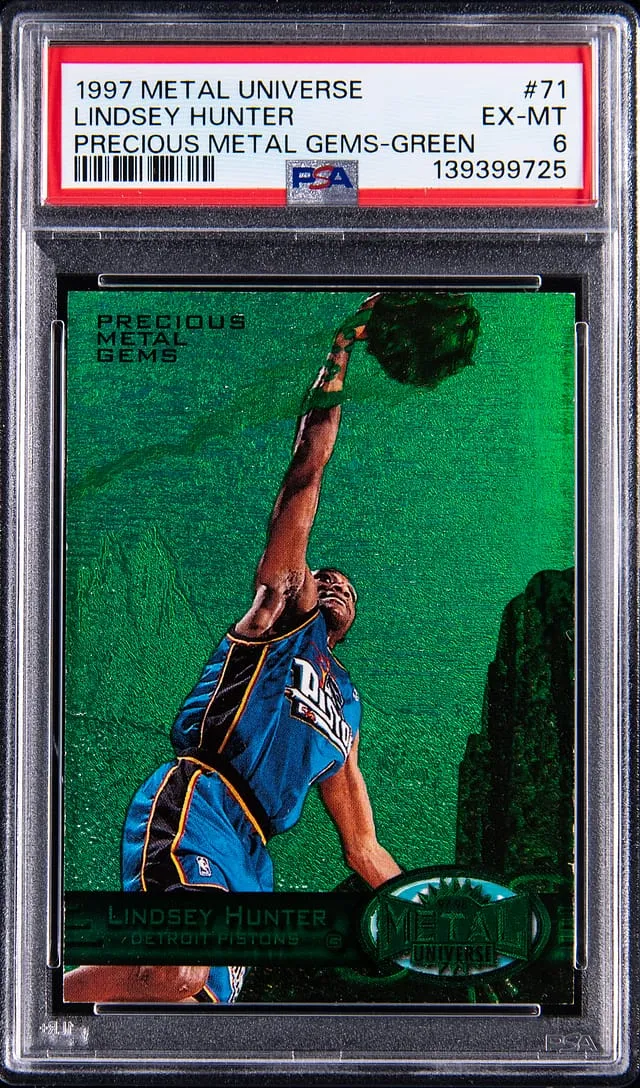
Lindsey Hunter 1997-98 PMG Green PSA 6 Sells for $20K
Goldin sold a 1997-98 Metal Universe PMG Green Lindsey Hunter PSA 6 for $20,740. See what this means for 90s basketball and PMG collectors.
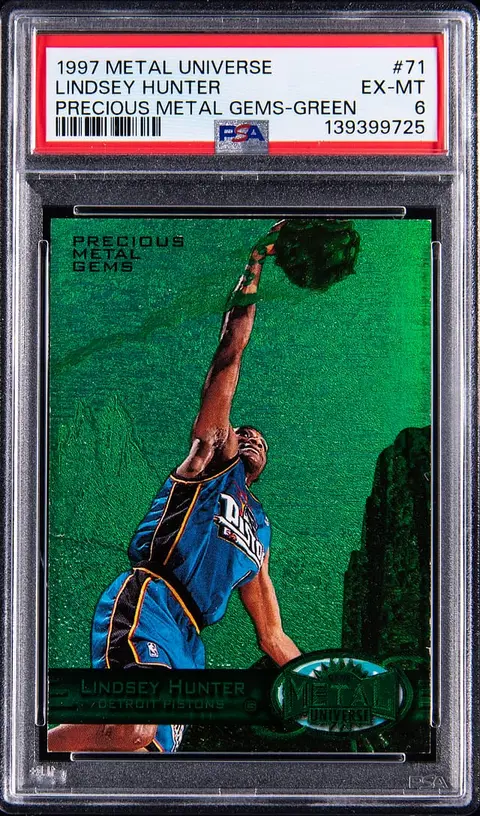
Sold Card
1997-98 SkyBox Metal Universe Precious Metal Gems (PMG) Green #71 Lindsey Hunter (#005/100) - PSA EX-MT 6
Sale Price
Platform
Goldin1997-98 SkyBox Metal Universe Precious Metal Gems (PMG) Green cards sit at the intersection of 90s basketball, true scarcity, and the rise of modern parallel chasing. A recent sale at goldin on 2026-03-15 put a spotlight on one of the more niche—but very real—lanes within that universe:
1997-98 SkyBox Metal Universe Precious Metal Gems (PMG) Green #71 Lindsey Hunter (#005/100) - PSA EX-MT 6
Final price: $20,740 Auction house: goldin Sale date: March 15, 2026 (UTC)
In this breakdown, we’ll look at what this card is, why PMG Greens matter to so many collectors, and how this sale fits into the broader 90s insert and parallel market.
Card overview: what exactly sold?
Let’s start with the basics.
- Player: Lindsey Hunter
- Team: Detroit Pistons
- Season: 1997-98
- Set: 1997-98 SkyBox Metal Universe
- Parallel: Precious Metal Gems (PMG) Green
- Card number: #71
- Serial number: 005/100 (stamped on the card)
- Grading company: PSA (Professional Sports Authenticator)
- Grade: EX-MT 6
- Attributes: iconic 90s premium parallel, serial-numbered, notoriously condition-sensitive
This is not a rookie card—Hunter’s rookie season was 1993-94—but within 90s basketball, PMG Greens are treated more like a standalone, key-issue parallel than a simple base variant.
A quick note on PMG Green vs Red numbering
For 1997-98 Metal Universe PMGs:
- The total production is 100 copies per player.
- The first 10 copies are Green.
- The remaining 90 copies are Red.
Even though this Hunter is stamped 005/100, it is understood in the hobby as one of the 10 Green copies, making it the scarcer and more desirable version compared with the Red PMG for the same player.
Why PMG Greens are such a big deal
Within 90s basketball, 1997-98 PMG Greens are one of the key reference points for:
- Early, true serial-numbered parallels – Not just inserts, but numbered cards with a fixed print run, which was still a relatively new concept for basketball in the late 90s.
- Design and condition difficulty – Foil-heavy surfaces, colored borders, and chipping make high grades extremely hard to achieve. Even mid-grades are often respected.
- Cross-collector demand – PMG Greens attract player collectors, team collectors, and set collectors, plus broader 90s insert enthusiasts. The design and scarcity pull in people who don’t necessarily PC (player-collect) the featured name.
The set is headlined by stars like Michael Jordan, Kobe Bryant, and Tim Duncan, but many collectors quietly (and sometimes not so quietly) chase role players, defensive standouts, and cult-favorite names from this checklist. Lindsey Hunter fits squarely in that lane: a tough guard, key contributor, and very much a 90s Pistons identity piece.
Market context: where does $20,740 fit?
The sale price here is $20,740. To understand that, it helps to think across a few dimensions:
- PMG Greens in general
- Non-superstar PMG Greens (role players, secondary stars)
- Grade and condition realities
1. PMG Greens overall
Across the board, PMG Greens from 1997-98 have:
- Extremely low population counts in grading company pop reports (population, or “pop,” is just the number of copies graded and logged).
- Strong results in auctions, especially for Hall of Famers and top-tier hobby names, where prices can be dramatically higher than this Hunter sale.
Because each player only has 10 Green copies, and many are either:
- still in collections,
- never graded, or
- lost/damaged over time,
any time a Green surfaces at a major house like goldin, it adds another useful data point for the market.
2. Non-superstar PMG Greens
Most of the headline PMG coverage focuses on names like Jordan, Kobe, and key rookies. But the underlying market for non-superstar Greens has quietly matured:
- Collectors build team rainbows (all versions of a player or team).
- Some chase complete PMG Green checklists, which automatically includes role players.
- Others collect purely by aesthetics and era; Hunter’s 90s Pistons context and guard play appeal to specific fans.
In that lane, a five-figure result for a non-headliner PMG Green is consistent with how much weight the hobby gives:
- Ultra-low print runs
- 90s nostalgia
- PMG branding and design
While exact, card-by-card comps (recent comparable sales) for this specific Lindsey Hunter Green /100 in PSA 6 are thin to non-existent, similar-tier role players and defensive guards in Green have produced results that fit within this general range once you account for player interest, team market size, and timing.
3. Grade: PSA EX-MT 6
For modern ultra-modern cards (roughly 2010s onward), a PSA 6 would usually be considered a low grade. PMGs are different.
- Surfaces and edges are extremely fragile.
- Chipping, edge wear, and print issues are common out of the pack.
- For 1997-98 PMG Greens, the baseline expectation is often mid-grade.
This makes a PSA 6 more acceptable for this card than for many other 1990s or 2000s issues. High grades (PSA 8 and up) are rare and command significant premiums. When collectors weigh price versus availability, they often accept 5s and 6s as very “collectible” grades for this run, especially for long-term PC (personal collection) pieces.
So while a PSA 6 is not top of the grading pyramid, it’s still considered a legitimate way to own this card’s design and historical position at a level well below the elite-grade premium.
How does this sale compare to related PMGs?
Exact card-for-card comps for this specific Hunter Green in PSA 6 are not plentiful, which is normal for a card with only 10 Green copies in existence. Instead, we can look at patterns:
- PMG Green vs PMG Red – Greens consistently outpace Reds because of the 10 vs 90 print difference and the color’s status as the “chase” parallel.
- Star vs role player – Player brand still matters. Big names often see multiples of this price, sometimes by a wide margin, but strong results for non-stars show that the set itself is driving a lot of demand.
- Mid-grade vs high-grade – Each bump in grade for PMG Greens tends to come with a steep pricing curve due to their condition rarity.
Within that context, a $20,740 result on goldin suggests:
- The market continues to respect PMG Greens beyond just the top names.
- Collectors are willing to invest in team-specific and 90s-era identity players when the parallel is this iconic.
- Supply remains extraordinarily thin; even if another Hunter Green surfaces, it may be in a different grade or raw (ungraded), making direct comps imperfect.
This sale does not necessarily set a public record for PMG Greens in general—far from it—but it does help define the price band for high-profile, non-superstar names within the set.
Collector significance: why this card matters
1. 90s Pistons and role-player nostalgia
For Detroit fans, Lindsey Hunter is part of the bridge between the Bad Boys era and the early 2000s Pistons teams. Strong on-ball defense, perimeter toughness, and classic 90s guard play make him a beloved name for collectors who lived through that period.
Owning one of the 10 PMG Greens of a player like Hunter is less about investor-style upside and more about identity:
- A piece of 90s Pistons history.
- An elite parallel from one of the most important 90s insert/parallels sets.
- A card that is rarely available in any form.
2. Set-building and niche lanes
For set builders, 1997-98 PMG Greens are often a long-haul project. Some collectors spend years trying to track down even a fraction of the checklist.
In that context, a card like this Hunter serves:
- As a key puzzle piece for someone pursuing a near-complete PMG Green run.
- As a team rainbow anchor for Pistons-focused collections.
- As a representative example of PMG design for collectors who want a Green but don’t want to pay superstar prices.
3. Era and scarcity
The late 90s sit in a unique spot:
- Not as widely overproduced as early 90s “junk wax.”
- Not yet in the modern ultra-limited, serial-numbered era we see today.
That makes 1997-98 PMG Greens a sort of pre-modern scarcity standard:
- Relatively low print runs by 90s standards.
- Tough to grade.
- Strong visual identity that separates them from base and other inserts.
What this sale signals for the PMG market
Without overreaching, a few grounded takeaways from the $20,740 goldin sale on March 15, 2026:
- Depth of demand – Interest in PMG Greens isn’t limited to the top 5–10 hobby names. Role players and team favorites can still generate strong, competitive bidding when a scarce example surfaces.
- Respect for mid-grades – A PSA 6 in this run is clearly treated as a serious collectible grade, not a placeholder. The market understands the set’s condition profile.
- Auction house influence – Major houses like goldin remain key venues for rare 90s parallels. When these cards show up there, the final prices often become the reference point for private and marketplace negotiations for months.
For collectors thinking about entering the PMG space—whether with stars or role players—this Hunter sale is a useful benchmark for how the market is currently valuing scarcity + era + design, even when the featured player isn’t a perennial All-Star.
Takeaways for collectors and small sellers
A few practical points, especially if you’re new or returning to the hobby:
- Comps will be thin. For ultra-rare 90s parallels, you may not find exact matches. Use related players, grades, and set results to build a range rather than a single number.
- Condition expectations are different. For PMG Greens, a 5, 6, or 7 can still be very desirable due to how fragile the cards are. Don’t compare grading standards directly to modern chrome or thick-stock cards.
- Story matters. Cards like this Hunter PMG Green appeal because of team history, era, and set identity, not just hard stats. When you list or trade pieces like this, include that context—you’re speaking to other collectors, not just spreadsheets.
- Be realistic, not speculative. Use sales like this goldin result as context, not as a guarantee of future performance. Markets can shift, and individual cards (centered vs off-center, eye appeal, color loss) can trade above or below headline prices.
For figoca users and other data-focused collectors, this sale is another important data point in the evolving picture of 90s basketball parallels. It reinforces that even niche-player PMG Greens can command serious attention when they surface—and that the combination of true scarcity, era nostalgia, and iconic design still carries real weight in today’s hobby.
Key facts at a glance
- Card: 1997-98 SkyBox Metal Universe PMG Green #71 Lindsey Hunter
- Serial number: 005/100 (one of 10 Greens)
- Grade: PSA EX-MT 6
- Auction house: goldin
- Sale date: March 15, 2026 (UTC)
- Final price: $20,740
For collectors who grew up watching the 90s Pistons grind out games on defense, this Lindsey Hunter PMG Green is more than just a sale result—it’s a rare, graded snapshot of that era, now firmly anchored in the public record through its goldin hammer price.