Lewis Hamilton 2025 Topps Dynasty F1 1/1 Gold Sale
Market breakdown of the 2025 Topps Dynasty F1 Lewis Hamilton 1/1 triple relic auto that sold for $100,040 at Goldin on March 8, 2026.
Sold Card
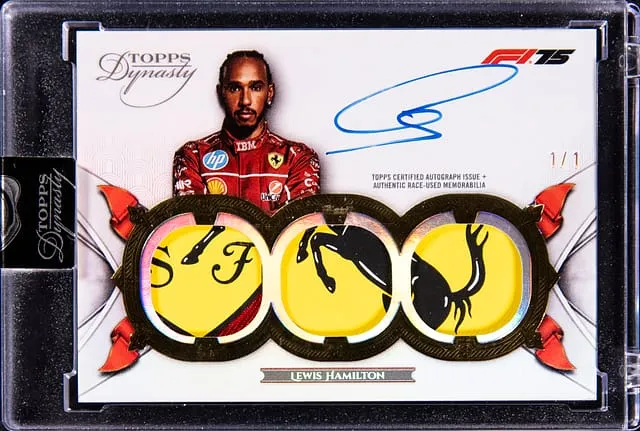
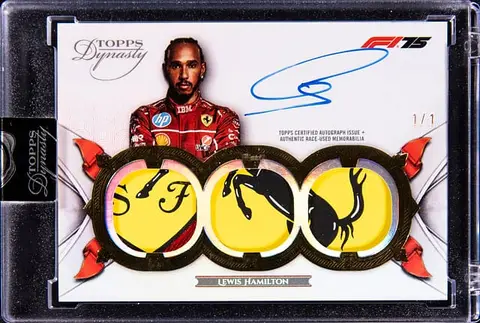
2025 Topps Dynasty F1 Triple Relic Autographs Gold #SDTRA-LHAI Lewis Hamilton Signed Race-Used Patch Card (#1/1) - Topps Encased
Sale Price
Platform
Goldin2025 Topps Dynasty F1 Triple Relic Autographs Gold #SDTRA-LHAI Lewis Hamilton Signed Race-Used Patch Card (#1/1) – Market Notes on a Modern Grail
On March 8, 2026, Goldin closed a notable modern Formula 1 sale: a 2025 Topps Dynasty F1 Triple Relic Autographs Gold #SDTRA-LHAI Lewis Hamilton signed race‑used patch card, serial‑numbered 1/1 and still in its original Topps factory case, sold for $100,040.
For a relatively new F1 trading card market, this is the kind of result that gets collectors’ attention—not because it is shocking on its own, but because it helps define the top end for ultra‑premium Hamilton pieces going into the 2026 season.
The card at a glance
Let’s break down exactly what this card is:
- Player: Lewis Hamilton (Mercedes‑AMG Petronas F1 Team)
- Year: 2025
- Product: Topps Dynasty Formula 1
- Card: Triple Relic Autographs Gold #SDTRA-LHAI
- Serial numbering: 1/1 (one‑of‑one)
- Autograph: On‑card (Hamilton signed directly on the card)
- Relics: Triple race‑used patch swatches
- Encapsulation: Topps encased (factory‑sealed plastic holder with Dynasty label)
This is not a rookie card. Instead, it’s a high‑end, low‑print‑run autograph patch from one of Topps’ flagship premium F1 products. Dynasty is positioned as a “super‑premium” line: very short print runs, thick stock, on‑card autos, and race‑used memorabilia.
Being a 1/1 gold triple relic auto places this Hamilton among the true top‑tier modern F1 cards. Within the 2025 Dynasty checklist, it is effectively a grail‑level item for Hamilton player collectors and high‑end F1 set builders.
Why collectors care about this card
Several factors converge here:
1. Lewis Hamilton’s place in F1 history
Hamilton is widely considered one of the greatest drivers in Formula 1 history, with:
- A record number of race wins,
- A share or lead in the all‑time World Drivers’ Championship tally,
- A long run as the face of the hybrid era of F1.
For collectors, that puts him into a tier similar to the very top names in other sports—think Jordan in basketball or Brady in football. Ultra‑premium Hamilton pieces often sit at the center of any serious modern F1 collection.
2. The Dynasty F1 brand
Topps Dynasty F1 has quickly become the go‑to high‑end F1 product, known for:
- Extremely limited print runs,
- On‑card autographs from drivers,
- Race‑used patches and multi‑relics,
- Strong visual design and consistent card quality.
In hobby terms, Dynasty is the “super‑premium” lane of modern F1: few cards per box, but each one intended to be a centerpiece.
3. One‑of‑one status and triple race‑used relics
A 1/1 (one‑of‑one) means that, by design, this is the only copy of this exact card that Topps produced. That matters more when the card is already high‑end: an on‑card auto, triple race‑used patches, and a key driver.
Race‑used relics are pieces of material (often suit, gloves, or car elements) that have actually been used in competition. For many F1 collectors, they provide a tangible connection to the track that simple jersey‑style memorabilia can’t match.
4. Factory Topps encasing
“Topps encased” means the card is sealed by the manufacturer in a tamper‑evident holder, typically right out of the box. This is not the same as being graded by a third‑party grading company, but it does:
- Confirm origin directly from the product,
- Help protect condition from pack to collection,
- Preserve the card in the exact state Topps released it.
Some collectors later crack these encased cards and send them to grading companies (like PSA, BGS, or SGC) if they believe the card is a strong candidate for a high grade. Others prefer to keep the original factory seal as part of the card’s story.
Market context and recent sales
For modern ultra‑premium F1 cards like this, “comps” (short for comparables—recently sold similar items used as price references) are limited. One‑of‑one cards are especially tricky: by definition there’s only one example of this exact card.
Instead of looking for identical copies, collectors and market watchers typically compare:
- Other Hamilton 1/1s from Dynasty (different years or relic layouts),
- Lower‑tier parallels from the same card (if any exist, such as /5 or /10 versions),
- High‑end Hamilton autos with race‑used patches from other F1 products.
Across major auction houses and marketplaces in 2024–2025, high‑end Hamilton Dynasty 1/1s and extremely low‑numbered patch autos have:
- Commonly landed well into the five‑figure range,
- Occasionally stretched higher when the design, patch quality, and timing all lined up.
Within that context, the $100,040 sale price achieved by Goldin on March 8, 2026 sits toward the upper end of the spectrum for modern Hamilton patch autos, but it’s not out of line with how collectors have been valuing top Dynasty 1/1s.
Because 2025 Dynasty is a newer release, long‑term price history is naturally limited. Early results like this help set initial expectations: they signal how the market is currently ranking 2025 Dynasty Hamiltons relative to earlier years’ issues and to other ultra‑modern F1 sets.
What this sale quietly suggests about the F1 card market
Without trying to predict future prices, we can pull a few reasonable observations from this result:
Dynasty remains the reference point for ultra‑premium F1. When big Hamilton or Verstappen cards from Dynasty hit the auction block at major houses like Goldin, they still command attention and strong bidding.
Hamilton’s high‑end market is holding a top tier. Even as more products and parallels arrive each season, collectors have been willing to pay for standout cards that combine on‑card ink, race‑used memorabilia, and true scarcity.
One‑of‑one Hamilton cards are treated as individual artworks. With 1/1s, the conversation tends to be less about strict price ladders and more about uniqueness: patch quality, layout, autograph placement, and aesthetic appeal all matter.
Modern F1 remains a targeted, not speculative, space. The buyers for a $100,000 Hamilton Dynasty 1/1 are usually long‑term F1 fans, Hamilton player collectors, or advanced modern card collectors—people who understand both the sport and the card’s position in the hobby.
How newer and returning collectors can read this sale
If you’re newer to F1 cards or coming back to the hobby, a six‑figure sale can seem distant from everyday collecting. But you can still use it as a reference point:
Think in tiers, not just headlines. This Hamilton is at the very top of the pyramid: 1/1, triple race‑used relic, on‑card auto, super‑premium brand. Most collectors build their collections in lower tiers (numbered autos, non‑auto parallels, inserts) that echo the same players and themes at more accessible levels.
Learn the product hierarchy.
- Dynasty = super‑premium, low volume, big hits.
- Other F1 products (Chrome, Flagship, Sapphire, etc.) sit in different lanes with different price expectations and print runs. Understanding where a card sits in that ecosystem helps you gauge why prices diverge so much.
Use comps as context, not as guarantees. For a 1/1, you won’t find an exact match. Instead, you look at neighboring cards—similar players, similar scarcity, similar product lines—to understand the general range the market has been comfortable with.
Separate player belief from product realities. You can love Lewis Hamilton as a driver and still be thoughtful about which cards you chase. High‑end Dynasty pieces are one expression of that fandom; numbered autos or parallels from other sets are another.
Where this card fits in a Hamilton or F1 PC
Many collectors talk about their “PC” (personal collection) as the core set of cards they plan to hold long term. For a serious Hamilton PC, this 2025 Topps Dynasty F1 Triple Relic Autographs Gold 1/1 is the kind of card that:
- Sits in a very small group of centerpiece items,
- Often becomes the visual and emotional anchor of a display,
- Can be paired with earlier or later Dynasty years to tell a story across Hamilton’s career.
Within a broader F1 collection, it functions as a proof of concept for modern high‑end F1: a single card that encapsulates the sport’s modern era (hybrid dominance, global audience growth, premium licensing) and the hobby’s modern era (super‑premium products, race‑used memorabilia, 1/1 chases).
Final thoughts
The $100,040 sale of the 2025 Topps Dynasty F1 Triple Relic Autographs Gold #SDTRA-LHAI Lewis Hamilton 1/1 at Goldin on March 8, 2026 doesn’t rewrite the rules of the F1 card market. Instead, it quietly confirms them.
- Ultra‑premium, on‑card, race‑used Hamilton pieces from Dynasty continue to command strong attention.
- One‑of‑one cards are judged individually, but they still orbit within a consistent value range defined by prior Dynasty and high‑end F1 sales.
- For collectors at every level, tracking these headline results is less about chasing the exact card and more about understanding how the hobby is ranking players, products, and print runs.
As 2025 and 2026 products continue to release, this sale will likely be a reference point whenever another marquee Hamilton 1/1 heads to auction—especially if it emerges from another Topps Dynasty F1 box, still sealed in that familiar Topps encased holder.