Lewis Hamilton 2025 Dynasty F1 Patch Auto /2 Sells Big
Goldin sold a 2025 Topps Dynasty F1 Lewis Hamilton Suit Nameplate Patch Autograph Red /2 for $863,630 on May 10, 2026. Here’s the market context.
Sold Card
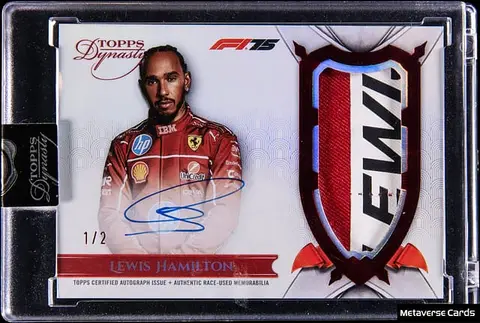
2025 Topps Dynasty F1 Suit Nameplate Patch Autograph Red #DAF-LHA Lewis Hamilton Signed Race-Used Patch Card (#1/2) - Topps Encased
Sale Price
Platform
Goldin2025 Topps Dynasty F1 Lewis Hamilton Suit Nameplate Patch Auto Red #1/2 Sells for $863,630
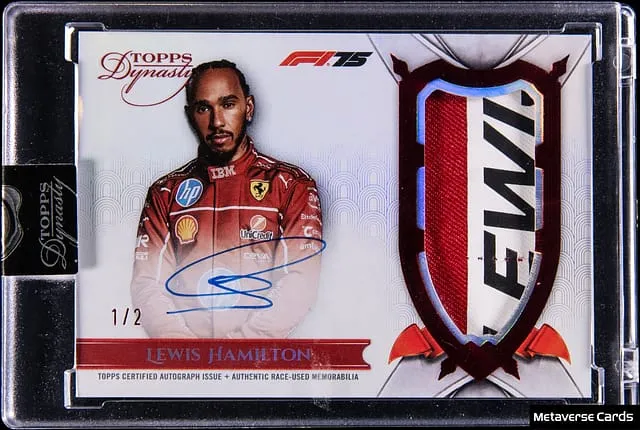
On May 10, 2026, Goldin closed a major modern Formula 1 sale: a 2025 Topps Dynasty F1 Suit Nameplate Patch Autograph Red #DAF-LHA Lewis Hamilton, serial-numbered 1/2, sold for $863,630. The card comes Topps-encased, features an on-card autograph, and includes a race-used suit nameplate patch.
For collectors who follow high-end F1, this result is another data point in the steady maturation of the Hamilton market and the Dynasty F1 line as a whole.
Card overview
Let’s break down exactly what this card is:
- Player: Lewis Hamilton
- Team (era): Mercedes-AMG Petronas Formula One Team
- Year: 2025
- Set: 2025 Topps Dynasty Formula 1
- Card: Suit Nameplate Patch Autograph
- Parallel: Red
- Serial numbering: 1/2 (two copies exist; this is card #1)
- Autograph: On-card (signed directly on the card)
- Memorabilia: Race-used suit nameplate patch
- Encapsulation: Topps factory encased (not third-party graded)
This is not a rookie card. Hamilton’s key rookies and first mainstream Formula 1 cards come from much earlier (notably during the 2006–2016 window, depending how narrowly you define “rookie”). Instead, this is a premium, ultra-modern, low-serial autograph-patch issue aimed at the very top of the F1 collector market.
Why the “Suit Nameplate Patch Autograph Red” matters
A few hobby terms in plain English:
- Patch card: A card that embeds a piece of game-used or race-used material, in this case part of Hamilton’s race-worn suit.
- Nameplate patch: A patch cut specifically from the nameplate section of the suit—visually distinctive and more limited than a generic fabric swatch.
- On-card autograph: The athlete signs directly on the card itself, as opposed to signing a sticker that is later applied. Many collectors see on-card autos as more desirable.
- Low serial-numbered card: Serial numbering shows how many copies exist. At /2, this is an extremely low print run.
Within Dynasty, the combination of (1) Hamilton, (2) race-used nameplate, (3) on-card auto, and (4) the Red parallel numbered to 2 puts this squarely in “grail” territory for modern F1.
Market context and comparables
To understand the $863,630 result, it helps to look at what’s been happening around Hamilton high-end cards and Topps Dynasty F1 more broadly.
Hamilton and high-end F1 cards
Across 2023–2026, Hamilton has consistently occupied the top tier of the F1 card market, along with Max Verstappen and, to a lesser extent, emerging stars. Key Hamilton cards that have shaped collector expectations include:
- Earlier Topps Dynasty F1 Hamilton patch autos from initial F1 Dynasty releases.
- Premium 1/1 (one-of-one) Hamilton autos and logo/nameplate patches from other high-end sets.
While exact, like-for-like comps (directly comparable sales) for this precise 2025 Dynasty Suit Nameplate Patch Autograph Red #/2 are limited—especially with the same serial number and patch piece—there are some patterns:
- Dynasty Hamilton 1/1s and exceptionally strong patches with on-card autos have historically drawn six-figure results at major auction houses when the patch, penmanship, and timing all line up.
- Very low-numbered Hamilton Dynasty autos (/5, /3, /2) have set a price floor well into the five-figure and low six-figure range, with particularly impressive patches and strong photography sometimes pushing above that, depending on market conditions.
This $863,630 sale sits in the upper band of what we’ve seen for ultra-premium modern F1 cards. While there may be isolated Hamilton or Verstappen 1/1s that have reached or exceeded this level, a /2 sale at this figure underlines just how seriously the market still takes Dynasty as the flagship premium F1 product.
Because the card is Topps-encased and not yet graded by PSA, BGS, SGC, or another third-party grading company, there’s no population report (“pop report”) to reference for condition scarcity. For a /2 card, though, print-run scarcity is really the key driver; condition matters, but there are only two copies to begin with.
How this sale fits into the broader F1 card landscape
Set significance: 2025 Topps Dynasty F1
Topps Dynasty F1 has established itself as the premium, low-print-run autograph and patch product for Formula 1 collectors. Each year’s release has reinforced a few expectations:
- Very small print runs, especially for top drivers.
- On-card signatures for many of the headline names.
- Bold, visually appealing patches: flags, team logos, suit logos, and nameplates.
By 2025, Dynasty F1 is not an untested concept; it is a known quantity with a track record. That history gives collectors a clearer frame of reference when bidding on pieces like this Hamilton.
Player narrative: why Hamilton still matters to collectors
Lewis Hamilton’s card market is driven by his career résumé and cultural impact:
- Multiple-time World Drivers’ Champion (tied or near the very top of all-time lists, depending on how you count different eras).
- A defining driver of the hybrid-turbo era with Mercedes.
- A global figure beyond racing, with a fan base that extends outside the traditional motorsport audience.
Collectors often gravitate to:
- Early career issues and rookies (for historical significance).
- Championship-era cards and autos (for narrative weight).
- Ultra-premium moderns like this card, which act as centerpiece items in high-end collections.
Even as newer stars emerge, Hamilton’s long-term place in the record books keeps interest in his key cards steady. That kind of profile is usually what supports large auction results in modern sports cards.
Ultra-modern, not vintage
This is an ultra-modern card—produced in 2025, well into the current era of serial-numbered parallels, on-card autos, and patch cards.
That has a couple of implications:
- Scarcity is created by design. With a print run of 2, the manufacturer deliberately made this card rare. That’s very different from vintage scarcity, where low surviving numbers are mostly accidental.
- Condition standards are high. Buyers often expect sharp corners, clean surfaces, and strong centering. Any grading decision later will likely factor in these expectations.
What collectors can take away from this sale
1. Dynasty F1 remains a key barometer for F1’s high end
When a Hamilton patch-auto /2 from Dynasty achieves $863,630 at a major house like Goldin, it signals that the set is still treated as a reference point for premium F1 cards. Collectors looking at other Dynasty F1 cards—whether Hamilton, Verstappen, or rising drivers—often use these headline sales as rough markers for how the market values the product line overall.
2. Patch quality and parallel tier really matter
Within premium products like Dynasty, not all autos or patches are treated equally:
- Nameplate patches tend to command stronger attention than standard fabrics because they are more visually distinctive and clearly identify the driver.
- Red /2 sits right below 1/1 territory for many collectors. At that level, each copy is almost a unique piece—especially once you factor in patch variation.
If you’re comparing prices across different Hamilton Dynasty cards, it’s important to account for both the parallel tier (e.g., /10 vs /5 vs /3 vs /2 vs 1/1) and the type of patch (solid fabric vs logo vs nameplate).
3. Market data, not guarantees
As with any single auction, this result is a data point, not a guarantee of future value. Factors such as:
- Timing of the auction
- Recent on-track performance
- Broader economic and hobby sentiment
- The specific bidders involved
…can all influence a final hammer price. For collectors, the most useful approach is to place this sale alongside other recent Hamilton and Dynasty F1 results rather than reading it as a stand-alone signal.
Practical tips for collectors watching this market
If you’re new to F1 cards or returning to the hobby and trying to understand sales like this one, here are a few practical steps:
- Track comps regularly. “Comps” are recent comparable sales—similar cards sold in the recent past. Look across multiple venues (marketplaces and auction houses) to get a fuller picture.
- Differentiate by tier. Separate:
- 1/1s
- Extremely low-numbered parallels (/2, /3, /5)
- Higher-numbered parallels and non-patch autos Treat each bucket as its own micro-market.
- Watch player narratives. Championship runs, team changes, retirements, or records broken can all affect attention on a player’s cards, even if not in a predictable way.
- Focus on what appeals to you. Whether or not you participate in this ultra-premium level, understanding the top of the market can help you make sense of more accessible cards you collect.
Summary
- Card: 2025 Topps Dynasty F1 Suit Nameplate Patch Autograph Red #DAF-LHA Lewis Hamilton, race-used patch, on-card auto, Topps-encased, serial-numbered 1/2.
- Auction house: Goldin
- Sale date (UTC): May 10, 2026
- Sale price: $863,630
This sale reinforces the position of Dynasty F1 as the flagship premium Formula 1 product and underlines the continued strength of Lewis Hamilton’s high-end market. For collectors, it offers another reference point when evaluating Hamilton, Dynasty parallels, and the evolving landscape of modern F1 cards.