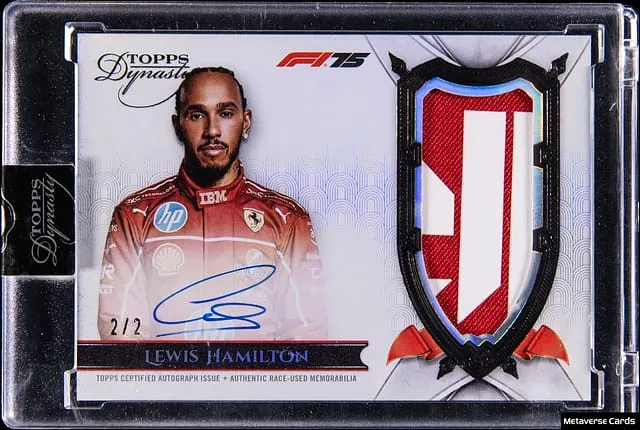
Lewis Hamilton 2025 Dynasty Black Patch Auto /2 Sale
Goldin sold a 2025 Topps Dynasty F1 Lewis Hamilton Black Autograph Patch #2/2 for $21,960. A key data point for modern high-end F1 collectors.
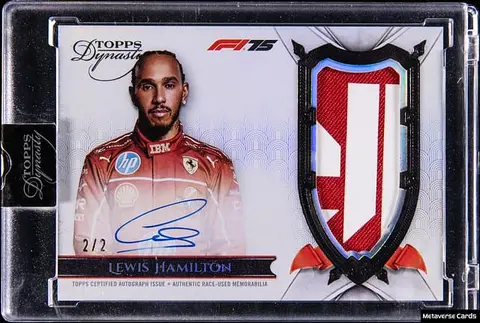
Sold Card
2025 Topps Dynasty F1 Autograph Patch Black #DAP-LHA Lewis Hamilton Signed Race-Used Patch Card (#2/2) - Topps Encased
Sale Price
Platform
Goldin2025 Topps Dynasty F1 Lewis Hamilton Black Patch Auto #2/2 Sells for $21,960
On May 10, 2026, Goldin closed a sale that quietly underlines how stable the top of the modern Formula 1 card market has become: a 2025 Topps Dynasty F1 Autograph Patch Black #DAP‑LHA Lewis Hamilton, serial‑numbered 2/2, sold for $21,960.
For collectors tracking high‑end F1, this is a useful data point. It isn’t a record breaker, but it helps frame where ultra‑scarce Hamilton patch autos are currently trading.
The card at a glance
Here’s what sold:
- Player: Lewis Hamilton (Mercedes-AMG Petronas F1 Team)
- Year: 2025
- Set: 2025 Topps Dynasty Formula 1
- Card: Autograph Patch Black #DAP‑LHA
- Serial number: 2/2 (only two copies exist for this parallel)
- Autograph: On-card signature
- Patch: Race-used memorabilia window
- Configuration: Topps factory‑encased
The listing notes “Topps Encased,” which typically means the card is in its original Topps sealed holder, rather than graded by a third‑party like PSA, BGS, or SGC. For ultra‑modern high‑end cards, many collectors are comfortable keeping them in this original manufacturer seal, especially if centering and surface look strong.
This is not a rookie card. Hamilton’s first F1 cards arrived years earlier, and his true rookies are in much earlier sets. Instead, this is a key premium issue: very low serial number, on‑card autograph, and a race‑used patch from a flagship premium brand.
Why Topps Dynasty matters in F1
Topps Dynasty sits in the same lane as Dynasty Baseball: it’s a high-end, low-print-run product built almost entirely around patch autographs and other premium hits. You’re not ripping Dynasty for base sets; you’re chasing one big card per box.
In F1 specifically, Dynasty has become one of the core destinations for:
- On‑card autos of top drivers
- Multi‑color race‑used patches and team logo patches
- Extremely limited parallels (like this Black /2)
For modern and ultra‑modern F1, Dynasty cards effectively play the role that Exquisite, National Treasures, or Flawless do in basketball and football – they’re often where a player’s most desirable non‑rookie patch autos live.
The Black /2 parallel
Topps keeps its parallel structure fairly consistent in Dynasty:
- Base patch autos are already low‑numbered
- Premium parallels step down in print runs (for example /10, /5)
- Black is among the most limited color parallels, here numbered to just two copies
With only two copies of this exact Black #DAP‑LHA Hamilton, the market for the card is almost entirely driven by timing and who is looking when it appears. “Comps” – hobby shorthand for comparable recent sales – are much harder to establish when there are only one or two examples and they rarely come to market.
What we can say about the market context
Because this is a newly issued 2025 card with a /2 print run, there is not yet a long track record of public sales for this exact Black #DAP‑LHA. Instead, the best way to understand the $21,960 result is to look at:
- Other 2025 Topps Dynasty Hamilton autos
- Recent high‑end Hamilton Dynasty patch autos from earlier years
- Price differences across parallels and numbering
Across auction houses and major marketplaces, the pattern for Hamilton’s Dynasty cards has generally looked like this:
- Lower‑tier patches or higher‑serial autos (for example /10, /15 with simple single‑color patches) typically sell for noticeably less than $21,960.
- Stronger patches and lower serial numbers (multi‑color, team logo, /3, /2, or 1/1) usually occupy the top of the Hamilton modern market besides his earliest key issues.
- When a card has all three pillars – on‑card auto, race‑used memorabilia, and very low numbering – it tends to trade at the upper end of the range for that year’s Dynasty.
Within that framework, a Black /2 race‑used patch auto at $21,960 sits where you’d expect a top‑tier, non‑1/1 Hamilton Dynasty to land in the current environment. It doesn’t push into all‑time record territory for Hamilton, but it also doesn’t represent a soft outlier. Instead, it reinforces a band of pricing that has been forming around his best modern patch autos.
Because population counts ("pop reports") from grading companies are not yet central for a Topps‑encased, ungraded copy like this, the real scarcity is tied to print run, player, and brand, not condition tiers like PSA 9 vs. PSA 10.
How this compares to earlier Hamilton high-end sales
Over the last few years, Hamilton has seen:
- Record sales from early key issues and unique 1/1s, especially as F1 cards first gained momentum and as his championship resume solidified
- Healthy but more measured results for later‑year premium patch autos, where collectors understand they’re buying a premium modern piece rather than a historic rookie
This 2025 Dynasty Black /2 fits into that second group:
- It’s ultra‑scarce and clearly a top card from its product year
- It’s not a first‑appearance or true rookie, so it’s priced below his most historically important cards
- It still commands a strong five‑figure result, confirming that demand for high‑end Hamilton hasn’t vanished, even as the F1 market has cooled off from its peak
In short, the sale lines up with what we’ve seen: the very top of the Hamilton market is more selective, but when the card is right – on‑card auto, race‑used, low serial – serious collectors still step in.
Why collectors care about this specific card
Several factors give this particular Hamilton card added weight:
Race‑used patch
This isn’t generic memorabilia. Race‑used material connects directly to Hamilton’s time in the car and on the track, which is a big reason Dynasty patches are treated differently from standard relics.On‑card autograph
With an on‑card auto, Hamilton signed directly on the card stock rather than on a sticker later applied to the card. Many collectors view on‑card signatures as more premium and more personal.Extremely low serial number (2/2)
When only two copies exist, the entire long‑term supply for this exact parallel is essentially fixed. If even one ends up locked in a long‑term collection, the other copy will control the visible market for years.Topps factory seal
The card remaining in the original Topps encasement keeps it close to how it left the pack. Some collectors prefer to crack and grade; others want that manufacturer seal intact. At high‑end auctions, both approaches appear with strong results.Hamilton’s career arc
Hamilton is already considered one of the greatest drivers in F1 history. As he continues hitting milestones, each new flagship set adds fresh, premium cards that document later stages of his career. This 2025 Dynasty Black /2 is one of those late‑career anchors.
Where this leaves Hamilton and 2025 Dynasty F1
For newcomers or returning collectors, a sale like this can be useful in setting expectations:
- Not all Hamilton cards are five figures. Lower‑tier inserts and base cards from mass‑produced products are far more accessible.
- Within the high‑end lane, brand and serial number matter a lot. A Dynasty Black /2 race‑used patch auto will naturally sit much higher than a standard auto from a wider‑print run set.
- This sale supports 2025 Dynasty’s position as one of the key destinations for modern Hamilton cards, alongside earlier Dynasty years and other premium autograph issues.
For small sellers and active hobbyists tracking the market:
- The $21,960 Goldin sale on May 10, 2026 is a strong, data‑rich reference point for future discussions about high‑end Hamilton pricing.
- When another top‑tier 2025 Dynasty Hamilton appears – whether a different parallel or a 1/1 – this result will likely be one of the first comps people reach for.
How to think about a result like this
A single auction doesn’t reset the entire market, but it does:
- Provide a fresh benchmark for ultra‑scarce Hamilton Dynasty autos
- Show that there is still real liquidity at the top of the F1 market, even in a more mature, less speculative environment
- Highlight the ongoing separation between truly scarce, premium pieces and the wider pool of modern Hamilton cards
As always, it’s worth treating this sale as one piece of a larger puzzle rather than a standalone signal. Watching how the next few high‑end Hamiltons perform – especially from 2025 Dynasty and similar products – will give a clearer view of the trend line.
For now, the data we do have is simple: on May 10, 2026, at Goldin, a 2025 Topps Dynasty F1 Autograph Patch Black #DAP‑LHA Lewis Hamilton, Topps‑encased and numbered 2/2, sold for $21,960. For collectors who focus on high‑end F1, it’s another confirmation that the very best Hamilton cards still command meaningful attention and serious bids.