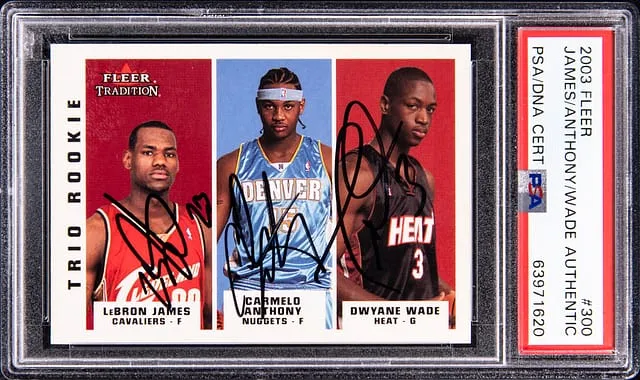
LeBron/Melo/Wade Triple-Signed 2003 Fleer Sale
Goldin sold a Pop 1 2003-04 Fleer Tradition #300 LeBron/Anthony/Wade multi-signed rookie, PSA/DNA Authentic, for $40,260. Here’s the market context.
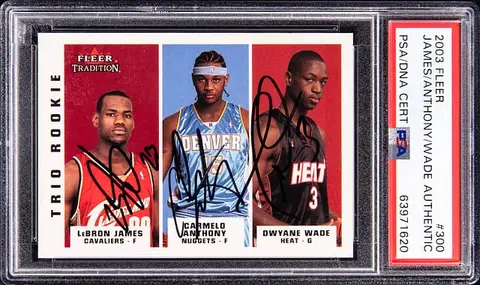
Sold Card
2003-04 Fleer Tradition #300 LeBron James/Carmelo Anthony/Dwyane Wade Multi-Signed Rookie Card - PSA Authentic, PSA/DNA Authentic - Pop 1; Only Signed Copy Validated by PSA/DNA
Sale Price
Platform
Goldin2003-04 Fleer Tradition #300 LeBron James / Carmelo Anthony / Dwyane Wade Multi-Signed Rookie Card – Market Breakdown
On March 8, 2026, Goldin sold a uniquely important early-2000s basketball grail: a 2003-04 Fleer Tradition #300 LeBron James / Carmelo Anthony / Dwyane Wade multi-signed rookie card, authenticated by PSA with PSA/DNA autograph authentication. The card realized $40,260 USD, and PSA currently lists it as a Pop 1 – the only copy of this card that PSA/DNA has validated as signed by all three players.
For collectors who focus on rookie-era autographs and historically important sets, this sale is a useful snapshot of how the market is currently valuing early LeBron-era cardboard, especially pieces that connect multiple franchise players on a single card.
Card overview: what exactly sold?
Let’s start by clearly identifying the card that crossed the block at Goldin:
- Year and set: 2003-04 Fleer Tradition
- Card number: #300
- Players: LeBron James, Carmelo Anthony, Dwyane Wade
- Type: Multi-player rookie card (featuring three key rookies from the 2003 draft class)
- Autographs: Multi-signed – all three players have signed the same card
- Grading and authentication:
- PSA slabbed as “PSA Authentic” (card itself is authenticated but not numerically graded)
- Autographs certified as “PSA/DNA Authentic”
- Population: PSA’s pop report lists this exact configuration as Pop 1, and Goldin notes it as the only copy validated as signed by PSA/DNA at the time of sale.
This is not a pack-issued Fleer autograph card. It’s a standard rookie-era Fleer Tradition triple rookie that has subsequently been signed by all three players and then authenticated by PSA/DNA. That combination – mainstream set, triple rookie, and three on-card signatures – is what makes the card stand out.
Why this card matters to collectors
1. The 2003 draft class connection
The 2003-04 season is one of the most collected modern eras in basketball because of the rookie class:
- LeBron James – widely viewed as one of the greatest players ever
- Carmelo Anthony – Hall-of-Fame-level scorer and global name
- Dwyane Wade – three-time NBA champion and Finals MVP
A single rookie-era card that links all three, and then adds on-card signatures from each, taps into several collector interests at once: LeBron collectors, Wade collectors, Melo collectors, and hobbyists who build 2003-04 focused PCs (personal collections).
2. Fleer Tradition as a set
2003-04 Fleer Tradition is a widely recognized early LeBron-era base set. It is not as high-end as Exquisite or some of the premium chromium issues, but it has several traits collectors appreciate:
- A more traditional, paper-based card stock and design
- Broad availability when it was released, which makes iconic cards from the set feel familiar and nostalgic
- Strong rookie content, including LeBron, Wade, and Carmelo
Because it’s a mainstream release, a multi-signed rookie example stands out even more – most copies of #300 exist as unsigned base cards. Turning a common rookie card into a one-of-one signed piece authenticated by PSA/DNA pushes it into a different lane entirely.
3. Pop 1 and autograph authenticity
In grading and authentication, “pop report” (population report) refers to how many copies of a specific card in a specific grade or status a company has recorded. Here, PSA reports this multi-signed #300 as a Pop 1, meaning:
- Only one example in PSA’s database is recorded as this exact signed card
- It is currently the only copy with PSA/DNA certification for all three signatures
That does not mean no other signed copies exist in the world, but it does highlight how rarely this card appears in a major authentication holder with all three autographs verified.
For high-end collectors, third-party autograph authentication, especially from PSA/DNA, is often a prerequisite for serious bidding. The Pop 1 note helps explain why there was strong interest around this particular example at Goldin.
Market context and recent sales
A note on comps and data
In the hobby, “comps” are comparable recent sales that collectors use as reference points for current value. For an item this specific – a Pop 1, multi-signed, rookie-era triple card – direct comps are naturally limited.
Instead of one-to-one equivalents, it’s more realistic to look at three buckets:
- Unsigned 2003-04 Fleer Tradition #300 copies
- Other LeBron / multi-star signed rookie-era cards
- Multi-signed pieces featuring this 2003 trio, regardless of set
Across public marketplaces and auction archives, unsigned copies of Fleer Tradition #300 tend to transact at much lower levels, even in high grade, because they are standard base rookies from a mass-produced set. Their prices usually depend heavily on numerical grade (e.g., PSA 9 vs PSA 10) rather than any special rarity.
By contrast, triple-signed pieces of LeBron, Wade, and Carmelo from their rookie window are far scarcer and often appear more often in memorabilia (like signed photos or balls) than on licensed trading cards. When similar hobby items do appear, they tend to be treated more like unique collectibles than like routinely traded cards.
Within that context, the $40,260 realized price positions this card firmly within the high-end, niche segment of modern basketball. It is materially above what unsigned Fleer Tradition rookies would justify on their own and more in line with:
- Early LeBron-era signed pieces with strong provenance
- Unique or near-unique items combining multiple Hall-of-Fame-level names
Available public data suggests that this sale is on the stronger side of the range one would expect for a Pop 1, non-pack-issued, multi-signed rookie-era card rather than an outlier low result. That aligns with the combination of:
- Three major players
- Rookie-year imagery
- PSA and PSA/DNA labeling
- The auction house exposure at Goldin
Historical and hobby significance
The ultra-modern window
Cards from 2003-04 sit at the border between what many collectors call modern and ultra-modern. Production volumes were higher than in the 1990s, and grading is far more common. As a result:
- Base cards without a key differentiator (grade, auto, patch, serial number) are plentiful.
- Authentic, properly documented signatures from multiple top-tier rookies on the same copy remain quite scarce.
This is part of why the market tends to separate “standard” 2003-04 rookies from special items in the same year such as:
- High-end pack-issued autograph sets
- Low-serial-number parallels
- Unique multi-signed pieces like this one
Player and hobby trends
As of early 2026, all three players have fully established legacies:
- LeBron James continues to reach and pass major all-time statistical milestones.
- Dwyane Wade’s playing career is complete, and his Hall of Fame status and growing off-court profile (ownership, media) keep interest steady.
- Carmelo Anthony has moved into retirement with a strong scoring resume and international recognition.
For many collectors, this means that the speculation phase is largely over; instead, these cards are viewed as long-term pieces tied to completed or near-completed careers. That tends to put more focus on scarcity, authenticity, and narrative rather than short-term performance.
This card’s narrative is straightforward but powerful: three cornerstone names of a defining modern draft class, pictured in their rookie season, all signing the same well-known base card, then locked in and certified by PSA/DNA.
How this sale fits into the broader market
1. Unique items vs. price guides
Because this card is effectively one-of-one within PSA’s ecosystem, traditional price guides or strict comp-based valuation can only go so far. Instead, sales like this reflect:
- How much collectors prioritize multi-player signatures
- The premium they assign to rookie-era items
- The trust they place in PSA/DNA authentication
A Pop 1 designation does not automatically mean a card will reach sky-high numbers, but it often ensures competitive bidding among collectors who prioritize uniqueness.
2. Demand for multi-signed LeBron-era cards
Multi-signed cards can be polarizing. Some collectors prefer solo-focus LeBron cards or chase pack-issued autos and low-serial parallels. Others enjoy the story that comes from putting several stars on one surface, especially when it ties directly to a specific draft or era.
Sales like this one at Goldin suggest that there remains a healthy, if niche, demand for:
- Pieces that connect LeBron to his contemporaries in a meaningful way
- Items that clearly belong to the 2003-04 window
- PSA/DNA-certified multi-signature items over un-certified or raw examples
3. What collectors can take away
For active hobbyists, this sale doesn’t set a broad “market price” for every 2003-04 Fleer Tradition rookie. Instead, it highlights a few practical points:
- Context matters. The same base card, unsigned, is a fundamentally different asset than a triple-signed, PSA/DNA-authenticated example.
- Authentication and documentation carry weight. Pop report notes, PSA/DNA certs, and auction house descriptions all contributed to buyer confidence.
- Unique or near-unique multi-signed pieces tend to trade in their own lane. Comps are more directional than precise.
Final thoughts
The March 8, 2026 sale at Goldin of the 2003-04 Fleer Tradition #300 LeBron James / Carmelo Anthony / Dwyane Wade multi-signed rookie card for $40,260 underscores how the market treats special, authenticated pieces from the 2003 draft class.
It’s not just a Fleer Tradition base rookie anymore; it’s a Pop 1, PSA/DNA-authenticated triple autograph that ties together three players whose careers defined an era. For collectors tracking the intersection of rookie-year nostalgia, autograph scarcity, and third-party authentication, this result is a useful reference point—and a reminder that some of the most interesting cards in the hobby started life as ordinary base issues before becoming something far more distinctive in the years that followed.