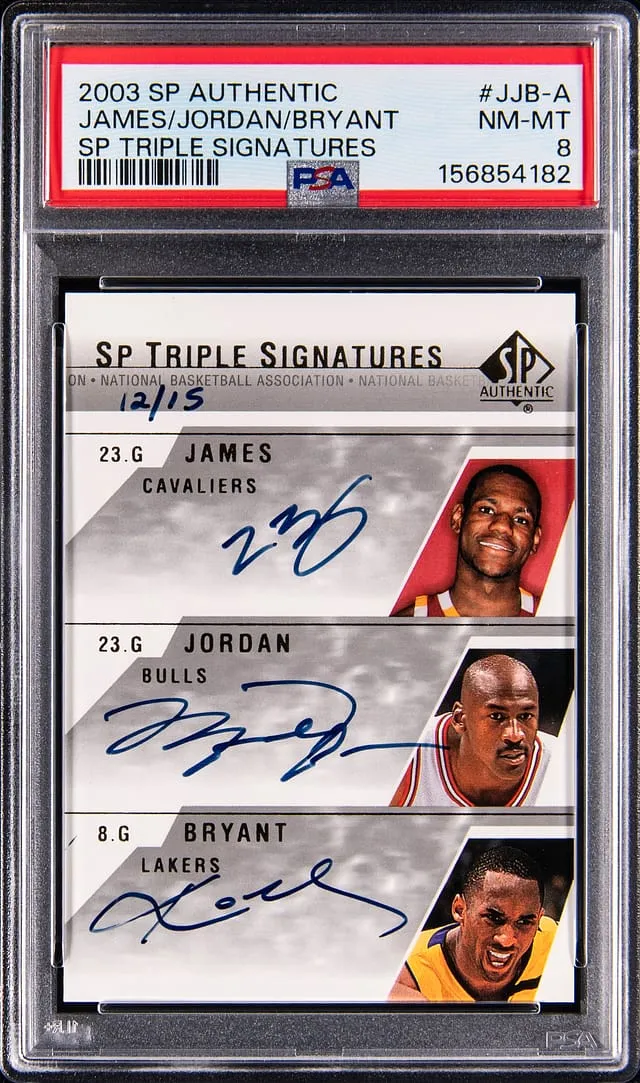
LeBron/Jordan/Kobe Triple Auto Rookie Card Sells Big
Goldin sold a 2003-04 SP Authentic LeBron/Jordan/Kobe triple-signed rookie-era card /15 (PSA 8, pop 2) for $762,500. Here’s what it means for collectors.
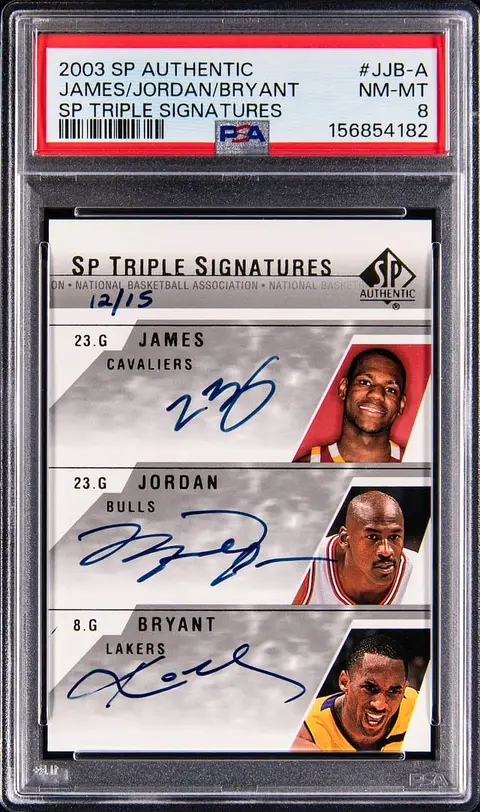
Sold Card
2003-04 Upper Deck SP Authentic SP Triple Signatures #JJB-A LeBron James/Michael Jordan/Kobe Bryant Multi-Signed Rookie Card (#12/15) - PSA NM-MT 8 - Pop 2
Sale Price
Platform
GoldinA triple-signed rookie-era card featuring LeBron James, Michael Jordan, and Kobe Bryant just changed hands at Goldin, and it quietly says a lot about where the high-end basketball market sits in 2026.
On May 10, 2026 (UTC), Goldin sold a 2003-04 Upper Deck SP Authentic SP Triple Signatures #JJB-A LeBron James/Michael Jordan/Kobe Bryant Multi-Signed Rookie Card, serial-numbered 12/15, graded PSA NM-MT 8, for $762,500. According to PSA’s population report, this specific serial-numbered copy sits in a population of just 2 at the PSA 8 grade.
Below is a breakdown of what this card is, why it matters, and how this sale fits into the broader market context.
Card overview
Card: 2003-04 Upper Deck SP Authentic SP Triple Signatures #JJB-A
Players: LeBron James (Cleveland Cavaliers), Michael Jordan (Washington Wizards on checklist era, global Bulls icon), Kobe Bryant (Los Angeles Lakers)
Season: 2003-04
Set: SP Authentic – SP Triple Signatures subset
Serial numbering: /15 (this copy is 12/15)
Autographs: Triple on-card signatures (each player signed directly on the card)
Rookie context: LeBron’s true rookie year; this is a multi-signed card from his rookie season
Grading: PSA NM-MT 8 (Near Mint–Mint)
Population: Pop 2 in PSA 8 (per auction description/pop report at time of sale)
SP Authentic in the early 2000s was Upper Deck’s premium, autograph-focused product line. The “SP” name was synonymous with short prints—cards intentionally produced in low quantities—and the Triple Signatures subset highlighted some of the toughest multi-autograph pulls in the product.
With just 15 copies produced, this card qualifies as a true low-serial, high-end insert. The combination of on-card ink, LeBron’s rookie season, and two established all-time greats (Jordan and Kobe) makes it less of a typical rookie card and more of a hobby centerpiece.
Why collectors care about this card
1. Three all-time pillars on one on-card auto
There are plenty of multi-signed cards, but very few combine:
- LeBron James in his 2003-04 rookie season
- Michael Jordan, the defining star of the 1990s
- Kobe Bryant, the bridge between the Jordan and LeBron eras
Getting all three signatures on one card—and on-card, not sticker—gives this issue a unique place in hobby history. For many collectors, these three players effectively define three generations of modern NBA fandom.
2. 2003-04: a cornerstone modern basketball year
The 2003-04 season is one of the most heavily collected modern seasons because of the legendary rookie class: LeBron James, Dwyane Wade, Carmelo Anthony, Chris Bosh, and more.
Most discussion focuses on LeBron’s flagship rookies (for example, Topps Chrome or SP Authentic Rookie Patch Autos), but this Triple Signatures card represents a different kind of chase piece from the same era—less about being a “base” rookie and more about ultra-limited, high-end content.
3. Ultra-low print run and hard-to-obtain autos
Serial numbering to 15 means that, at a maximum, 15 copies were available worldwide. In reality, fewer may be actively circulating because some are locked away in long-term collections.
Triple on-card autos are logistically difficult for manufacturers. Coordinating three players, especially stars of this magnitude, reduces how often cards like this can be produced. That scarcity is both built-in (print run) and practical (scheduling and signing).
4. Kobe’s passing and long-term sentiment
Kobe Bryant’s tragic passing in 2020 permanently reshaped demand for his key cards and autographs. Collectors tend to treat on-card Kobe autos from the 2000s as finite pieces of basketball history.
When you add Jordan—whose autograph is tightly controlled and typically appears only in specific Upper Deck products—and LeBron, whose high-end rookies anchor the modern market, you get a card that many collectors view more as a historical artifact than a trading card.
Market context and recent sales
Because of the very low print run, there are not many public sales of this exact card in any grade. Modern, ultra-rare multi-signature cards like this tend to surface at major auction houses (Goldin, PWCC, Heritage, etc.) rather than on day-to-day marketplaces.
Some context based on available information and adjacent cards:
- Extremely sparse comps: Public data for this exact #JJB-A /15 triple auto is limited. When a card has 15 copies and many sit in long-term collections, it can go years between public sales.
- Comparable multi-signature LeBron/Jordan/Kobe cards: Related multi-autograph cards featuring all three players in high grades have previously achieved strong six-figure results, especially when tied to LeBron’s rookie year or key Upper Deck high-end brands. Exact numbers vary by set, design, and condition, but this tier of card is well established in the upper end of the market.
- This sale at $762,500: At $762,500, this result places the PSA 8 example firmly in high-end territory, consistent with the top of the modern basketball market where rare LeBron rookie-era and LeBron/Jordan/Kobe combinations reside.
Because verified comps are sparse, it is difficult to call this sale definitively low, high, or “market.” Instead, it’s more accurate to say that this transaction helps define the current market level for this particular card and grade. For pop-2, /15 cards, each auction becomes its own reference point.
Understanding the PSA grade and population
This copy earned a PSA NM-MT 8 grade. For collectors newer to grading:
- PSA is one of the leading third-party grading companies; they assign numeric grades from 1 to 10 based on condition.
- NM-MT 8 indicates a Near Mint–Mint card: strong overall condition but with minor flaws such as small edge or corner touches or slight surface issues.
The pop report (population report) is simply PSA’s count of how many copies of a specific card have received each grade. In this case:
- PSA 8 is pop 2 for this serial number and issue, meaning only two copies have been graded an 8.
With just 15 total numbered copies possible, even a handful of graded examples make up a significant share of the known population. When one of those surfaces in a public auction, it becomes a key data point for tracking demand and pricing over time.
How this sale fits into today’s basketball card market
1. Consolidation at the top end
Over the last few years, the broader card market has seen ups and downs. However, the very top tier—true grails with:
- ultra-low serial numbering,
- on-card autographs,
- all-time great players—
has generally held more stable than speculative modern rookies or high-population parallels.
This sale continues that pattern: it centers on a card with inherent scarcity and legendary names, not on hype cycles around unproven prospects.
2. The LeBron–Jordan–Kobe “trinity” effect
Collectors who moved beyond single-player PCs (personal collections) sometimes focus on era-defining combinations. Jordan–Kobe–LeBron is arguably the most important trio in modern basketball collecting.
Cards that bring them together, especially from LeBron’s rookie season and in premium brands like SP Authentic, form a small but critical category in the modern grail landscape.
3. Rookie-year gravity
Even when a card is not a classic base rookie, attaching anything to LeBron’s 2003-04 season tends to increase interest. Rookie-year patches, autos, and multi-signed cards generally sit a tier above similar content from later in his career.
This card benefits from that gravity: it’s not LeBron’s primary rookie auto, but it is a rookie-year on-card autograph paired with the two prior era-defining stars.
What this means for collectors and small sellers
A result like $762,500 for this PSA 8 does not mean that all LeBron/Jordan/Kobe cards will suddenly be worth more. Instead, it offers a few practical takeaways:
- True scarcity still matters. Ultra-low serial numbering (like /15) combined with on-card signatures remains one of the clearest markers of long-term demand, especially for all-time greats.
- Player tiers are critical. The closer a card is—by rarity and quality—to the hobby’s most significant brands and years for Jordan, Kobe, and LeBron, the more insulated it tends to be from short-term swings.
- Rare grails set the top of the range. For anyone holding lower-tier but related cards (for example, single-player autos from similar years), grail-level results help frame the upper boundary of what the best pieces in that lane can do, without guaranteeing anything for more common cards.
If you are a newer collector:
- Use these marquee sales as education rather than a direct price guide.
- Focus on understanding why this card commands such a result: rookie-year connection, ultra-low print run, on-card auto, and the specific trio of signatures.
If you are a hobbyist or small seller:
- When evaluating your own inventory, look at print run, autograph type (on-card vs sticker), player tier, and grading populations.
- Big auction outcomes can be useful reference points, but condition, exact card, and timing all matter.
Final thoughts
The 2003-04 Upper Deck SP Authentic SP Triple Signatures #JJB-A LeBron James/Michael Jordan/Kobe Bryant /15 is not just another high-end card—it’s a snapshot of three eras of basketball on one piece of cardboard.
Goldin’s May 10, 2026 sale of this PSA NM-MT 8, pop 2 copy for $762,500 underscores how the hobby continues to reserve its highest respect (and dollars) for cards that combine true scarcity with generational talent.
As more collectors refine their focus toward historically significant pieces, sales like this help map out what the long-term core of the modern basketball market really looks like—and this triple-signed rookie-era card sits squarely in that conversation.