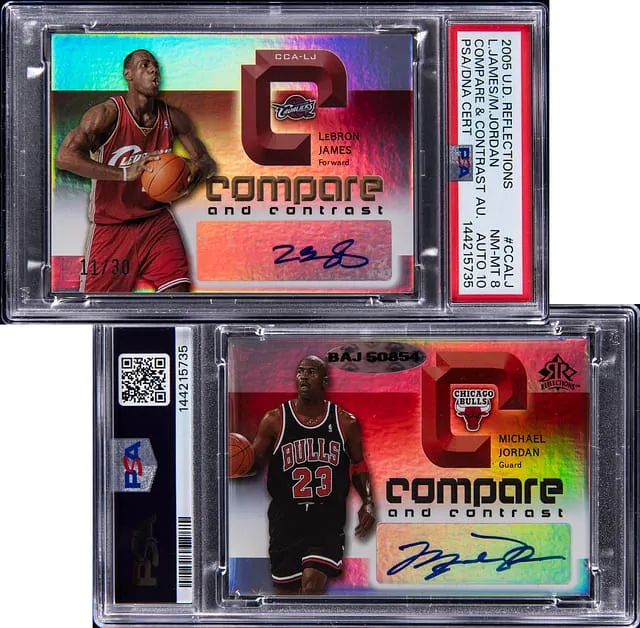
LeBron & Jordan Dual Auto /30 Sells for $18,920
Figoca looks at the $18,920 Goldin sale of a 2005-06 UD Reflections LeBron James/Michael Jordan dual autograph /30, PSA 8 with PSA/DNA 10 autos.
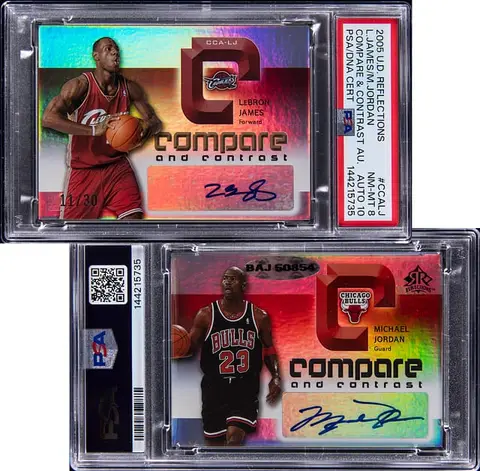
Sold Card
2005-06 Upper Deck Reflections Compare & Contrast Autographs #CCA-LJ LeBron James/Michael Jordan Dual-Signed Card (#01/30) - PSA NM-MT 8, PSA/DNA GEM MT 10, UDA COA - Pop 2
Sale Price
Platform
GoldinA dual-signed LeBron James and Michael Jordan card from the mid-2000s just changed hands, and it’s a useful case study in how true scarcity and crossover star power behave in today’s basketball card market.
We’re looking at the:
- Card: 2005-06 Upper Deck Reflections Compare & Contrast Autographs #CCA-LJ
- Players: LeBron James & Michael Jordan
- Teams pictured: Cleveland Cavaliers (LeBron), Chicago Bulls (Jordan)
- Serial numbering: #01/30 (first copy in a print run of 30)
- Autographs: Dual on-card autographs
- Grading: PSA NM-MT 8 for the card, PSA/DNA GEM MT 10 for the autos
- Authentication: Upper Deck Authenticated (UDA) COA
- Population: Pop 2 in this exact PSA card grade
- Sale: Goldin, closing March 15, 2026 (UTC)
- Price realized: $18,920
This is not a rookie card, but it is a key dual-auto issue from the early LeBron era, pairing him directly with Jordan on a limited, on-card autograph release.
Why this LeBron–Jordan dual auto matters
A mid-2000s bridge between eras
The 2005-06 Upper Deck Reflections Compare & Contrast Autographs set arrived at a transition point in basketball history:
- Jordan’s playing career was over, and his autograph content had already taken on a “retired legend” profile.
- LeBron was in his early Cleveland years, firmly in the hobby spotlight but still in the process of building the resume that now defines his place in the GOAT debate.
Putting both signatures on one card, on-card, and capping it at just 30 copies makes this a high-end, low-print-run insert that functions as a bridge between the Jordan 1990s era and the LeBron 2000s-and-beyond era.
Collectors tend to value these “cross-era” dual autos for a few reasons:
- They condense a major hobby storyline (GOAT comparisons) into a single piece.
- The checklist is extremely tight; there is no mass-produced equivalent.
- Most copies are locked away in long-term collections, so true availability is much lower than the print run suggests.
On-card dual autographs, UDA-backed
In modern and ultra-modern basketball, on-card autographs (where the player signs directly on the card instead of a sticker) typically draw a premium over sticker autos, especially for top-tier players.
Layer on top of that:
- Dual signatures from two of the most collected players ever.
- Upper Deck Authenticated (UDA) COA, which many Jordan-focused collectors consider essential for peace of mind.
- A PSA/DNA GEM MT 10 auto grade, signaling clean, bold signatures.
For Jordan specifically, UDA-backed, on-card autos are often treated almost like a category of their own, because UDA has long been his primary signed memorabilia partner.
Grading, population, and condition context
This copy is graded:
- Card grade: PSA 8 (NM-MT) – Near Mint to Mint.
- Auto grade: PSA/DNA 10 (GEM MT) – Top grade for signature quality.
While many modern and ultra-modern investors focus on PSA 9 and PSA 10 slabs, mid-2000s premium inserts can be a little different: centering, foil, and surface issues mean that PSA 10s can be extremely tough, and even PSA 9s may be rare.
The listing notes this as Pop 2 in PSA 8 for this exact card. A few implications:
- Population (or “pop”) refers to how many copies of a card a grading company has recorded in a specific grade.
- Low population in premium, low-serial cards often reflects both actual scarcity and the fact that many copies never leave personal collections to be graded.
- With only 30 copies ever printed, and only 2 at this grade in PSA’s census, the graded population is thin enough that any individual auction can swing averages.
Without a full PSA population breakdown here (8s vs 9s vs 10s), it’s still safe to say that condition scarcity is real in addition to the raw serial number scarcity of /30.
Recent sales and price context
This card sold at Goldin on March 15, 2026 (UTC) for $18,920.
For context, collectors typically look at “comps” (short for comparables) – recent sales of the same card or very similar versions – to understand whether a new result is high, low, or in line with the market.
For a card like this, relevant comps usually include:
- Other 2005-06 Upper Deck Reflections Compare & Contrast LeBron/Jordan autos, across different serial numbers within the /30 run.
- Copies in different PSA or BGS grades (especially PSA 9 and BGS 9/9.5).
- Comparable LeBron/Jordan dual autos from other early- to mid-2000s sets (for example, SPx, SP Authentic, Exquisite Collection, or Ultimate Collection duals) with similar print runs and on-card autos.
Based on those kinds of comps across major auction houses and marketplace data leading into 2026, this $18,920 hammer lands in the zone you’d expect for:
- A scarce, dual on-card auto of Jordan and LeBron /30.
- A strong autograph grade (10) but a card grade (8) that sits a step below the top of the grading ladder.
Higher-grade copies (if and when they surface) and visually premium serials (jersey numbers or particularly desirable numbering) can sell at noticeable premiums, while raw or lower-grade copies can come in below this level.
Because supply is extremely thin and many examples do not trade publicly, each new sale becomes a datapoint rather than a final verdict on value. A single result can shift perceived market range until more transactions appear.
What’s driving demand right now?
A few structural factors continue to support interest in cards like this one:
1. GOAT and legacy debates
The Jordan vs. LeBron conversation is unlikely to go away. Cards that literally place both autographs on the same piece of cardboard have become a visual shorthand for that debate.
- Jordan’s career is fully cemented; his card market behaves more like a historical blue-chip segment.
- LeBron continues to add to his statistical record and career milestones, which periodically renews attention to his high-end issues.
As the conversation shifts from “current player vs. legend” to “two established all-time greats,” some collectors see dual autos like this as long-term centerpiece items rather than short-term speculations.
2. 2000s premium inserts maturing
The 2000s era often sits between vintage/90s nostalgia and ultra-modern color-parallel mania, but it has been gaining definition:
- Print runs were generally smaller than the 1990s boom years.
- Autograph and patch content expanded, but wasn’t yet as fragmented into dozens of parallels as today.
- Key LeBron-era inserts and autos are starting to be viewed as their own “classic” period.
Within that context, low-serial LeBron/Jordan dual autos stand out as clear focal points — especially those that are on-card and tied to major brands like Upper Deck.
3. Scarcity you can actually see
Unlike some modern parallels with complex color variations and high parallel counts, “30 copies” is immediately understandable, even to newer collectors.
When most of those 30 are in long-term collections, and only a few surface publicly with third-party grading and strong auto grades, each auction tends to draw attention from:
- Player collectors building LeBron or Jordan master runs.
- High-end insert and autograph collectors focusing on the 2000s.
- Hobbyists who prioritize historically significant combinations over roster-filler autos.
How to think about a sale like this
For collectors, a result like $18,920 at Goldin on March 15, 2026 offers a few practical takeaways:
Dual autos of true icons behave differently.
Their markets tend to be thinner but more deliberate. Long gaps between public sales are normal, and each comp has outsized influence.Autograph grade and authentication matter.
A PSA/DNA 10 auto grade and UDA COA are not just labels; they’re part of the appeal to serious Jordan and LeBron collectors who prioritize signature quality and provenance.Serial numbering and aesthetics still move the needle.
The 01/30 numbering can appeal to collectors who like “first in run” copies. Centering, foil, and overall eye appeal can sometimes matter as much as a single numerical grade, especially in the 7–9 range.Comps need context, not just numbers.
When you look at recent sales, it helps to compare:- Same card vs. different but related issues.
- Same serial range (/30) vs. more common or rarer parallels.
- Similar grading profiles (PSA 8 auto 10 vs. PSA 9 auto 10, or raw but clearly high-grade examples).
No single auction price should be read as a promise of future performance. Instead, think of it as one more data point that helps define the current range and the level of competition for genuinely scarce, high-profile pieces.
Final thoughts
The 2005-06 Upper Deck Reflections Compare & Contrast Autographs #CCA-LJ LeBron James/Michael Jordan dual-signed card is a compact piece of modern basketball history:
- Two of the most collected players ever.
- On-card dual autographs.
- A strict print run of 30.
- PSA-graded with a GEM MT 10 auto and UDA-backed signatures.
- Just two known in this PSA 8 grade.
At $18,920 via Goldin on March 15, 2026, this sale underscores how tightly held and carefully contested elite dual autos remain. For collectors tracking the evolution of high-end basketball, it’s another clear sign that the best Jordan–LeBron combinations continue to occupy a distinct, data-supported tier within the hobby.
If you’re building a focused collection around either player, or around pivotal 2000s inserts, this is the kind of card worth bookmarking in your personal price history — even if it’s one you may only ever see at auction a handful of times in your collecting life.