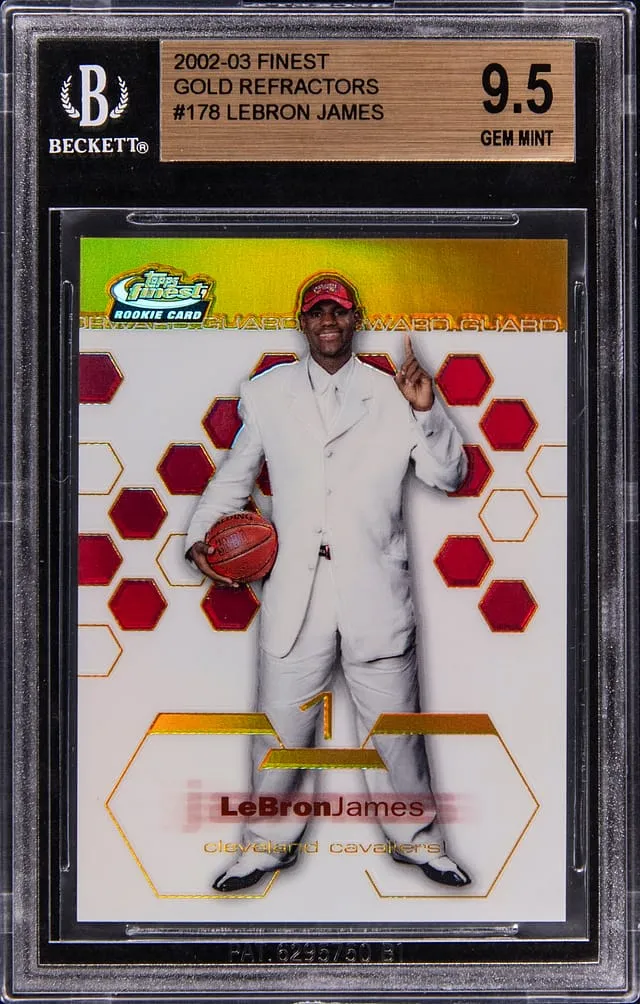
LeBron 2002-03 Finest Gold Refractor BGS 9.5 Sale
Goldin sold a 2002-03 Topps Finest Gold Refractor LeBron James BGS 9.5 /25 for $161,040. See how this scarce rookie fits into the LeBron market.
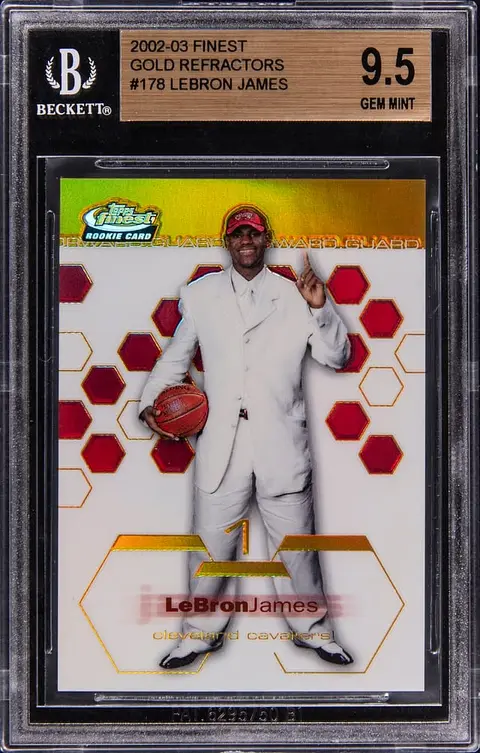
Sold Card
2002-03 Topps Finest Gold Refractor #178 LeBron James Rookie Card (#17/25) - BGS GEM MINT 9.5 - Pop 5
Sale Price
Platform
Goldin2002-03 Topps Finest Gold Refractors have quietly become an important chapter in the LeBron James rookie story, and a recent sale has put a spotlight back on this parallel.
On March 8, 2026, Goldin sold a 2002-03 Topps Finest Gold Refractor #178 LeBron James Rookie Card, serial numbered 17/25, graded BGS GEM MINT 9.5, for $161,040. The card is a true low-serial rookie parallel from LeBron’s debut NBA season and carries a Beckett (BGS) population of just 5 in 9.5 according to the auction description.
Below, we’ll unpack why this card matters, how this sale fits into the broader LeBron rookie market, and what collectors can take away from the data.
Card overview
Let’s start by clearly identifying the card:
- Player: LeBron James
- Team: Cleveland Cavaliers
- Year: 2002-03
- Product: Topps Finest Basketball
- Card number: #178
- Parallel: Gold Refractor
- Serial numbering: /25 (this copy is 17/25)
- Rookie status: Recognized LeBron rookie card
- Grading company: Beckett Grading Services (BGS)
- Grade: GEM MINT 9.5
- Population: Pop 5 in BGS 9.5, per Goldin’s listing
Topps Finest is a chromium-style (“chrome”) product known for its reflective refractors and color parallels. In the early 2000s, print runs were materially lower than in today’s ultra-modern era, and a gold refractor numbered out of 25 is a legitimately scarce chase.
Why this card matters to collectors
A premium, low-serial LeBron rookie
LeBron’s rookie portfolio is deep: 2003-04 Topps Chrome, Exquisite, Ultimate, SP Authentic, and more. While 2003-04 Topps Chrome is often called his “flagship” chrome rookie, the 2002-03 Finest Gold Refractor occupies a different lane:
- It predates his 2003-04 NBA-licensed rookies as a key early Finest issue.
- It’s a Gold Refractor /25, which is a very short print run by early-2000s standards.
- It is graded BGS 9.5 GEM MINT, with just 5 copies in that grade according to the auction pop note.
For collectors, this combination of:
- Early-era LeBron rookie card
- Recognizable brand (Topps Finest)
- Gold refractor parallel
- True low serial numbering /25
- High grade with a small population
makes the card feel closer to a “mini-grail” within the non-autograph, non-patch LeBron rookie lane.
Era and set context
The early 2000s fall between the 90s insert boom and today’s ultra-modern explosion. There were fewer parallel tiers and fewer one-of-one cards, but also much smaller production runs compared with today’s mass-printed products.
Topps Finest occupies an interesting position:
- More niche than Topps Chrome, but widely respected among chrome and refractor collectors.
- Known for colorful parallels (Gold, X-Fractor, etc.).
- Often overshadowed in headline prices by Exquisite and Chrome, but it has a loyal following.
In that context, a Gold Refractor /25 LeBron rookie is not just another color parallel; it’s part of a relatively tight ecosystem of premium early LeBron chromium cards.
Market context and price discussion
The realized price on Goldin was $161,040. To understand what that means, it helps to look at:
- Direct past sales of this card
- Closely related versions (other grades, other parallels)
- The broader LeBron rookie market at high-end auction houses
Direct comps and nearby cards
Exact, up-to-the-week public sales for this specific card—2002-03 Topps Finest Gold Refractor #178 /25 BGS 9.5—are limited. This is expected for a low-pop, /25 gold refractor: copies do not change hands very often, and when they do, they frequently go through major auction houses like Goldin rather than daily marketplaces.
More commonly seen are:
- Other LeBron Topps Finest refractors (non-gold, higher print runs)
- Different color parallels from 2003-04 chrome-style products
- Other BGS grades (9, 9.5 with varying subgrades) that surface sporadically
Those cards tend to land in clearly lower ranges than this $161,040 sale, which underscores how much collectors are differentiating between:
- Base refractors and higher-numbered parallels, and
- True short-print color parallels like gold /25 in high grade.
Without forcing a comparison to an exact dated comp, what we can say reliably is:
- This sale sits in the high-end tier for non-auto LeBron rookies that aren’t Exquisite-level cards.
- It reflects the market’s continuing willingness to pay a premium for early, low-serial, gold refractor LeBron rookies in top grades.
Relationship to the broader LeBron rookie market
High-end LeBron rookies—especially Exquisite RPAs, key Topps Chrome refractors, and iconic inserts—have set some of the headline numbers in modern basketball. Over the last few years, however, the broader modern market has seen some cooling after the 2020–2021 spike.
Within that environment, a $161,040 result for a scarce, non-auto, non-patch parallel suggests:
- There is still deep demand at the top of the LeBron market, particularly for scarce color.
- Buyers differentiate sharply between true scarcity (like /25 golds) and more abundant parallels.
- Proven auction houses like Goldin remain a preferred venue for moving these types of cards.
Rather than reading this sale as a “new normal” for all LeBron rookies, it’s more accurate to see it as a data point for:
- High-pop vs. low-pop dynamics
- The premium attached to truly rare, early-2000s color parallels
Grade, population, and why BGS 9.5 matters
In hobby shorthand, the pop report (population report) is a grading company’s public count of how many copies of a card have been graded at each grade level.
For this card:
- BGS 9.5 GEM MINT is considered a premium grade.
- Goldin’s listing notes a BGS 9.5 population of 5, which is extremely tight.
When a card is both:
- Serial numbered /25, and
- Low-pop in GEM MINT,
you end up with a situation where only a handful of collectors can own this specific configuration worldwide.
The market has historically rewarded that kind of constrained supply, especially for:
- All-time greats (LeBron clearly qualifies)
- Recognizable, early-era brands (Topps Finest, Chrome, Exquisite)
Potential drivers of interest around March 2026
The exact timing of this sale—March 8, 2026—sits within a period where LeBron continues to extend his career totals and records. While we won’t tie this sale to any single game or milestone, the broader context includes:
- Ongoing accumulation of career records and milestones
- Continued media and hobby attention on his longevity
- Speculation about post-retirement legacy and long-term status in basketball history
For serious collectors, these macro factors often reinforce the appeal of owning truly rare rookie-era pieces, rather than driving short-term speculation.
Takeaways for collectors and small sellers
1. True scarcity still matters
This sale is a reminder that not all parallels are created equal. Collectors are paying attention to:
- Serial numbering (like /25 vs. /199 or /999)
- Brand strength (Topps Finest, Chrome, Exquisite)
- Grade and population data
Low-pop, low-serial rookies of historically important players tend to behave differently from high-pop base rookies, especially in softer markets.
2. Market data is thinner at the top
For a card like this, comps (comparable recent sales used as price references) are naturally sparse. That means each sale can swing the perceived range more than it would for a heavily traded card.
When you’re buying or selling at this level, it’s helpful to:
- Look across multiple, similar cards (other golds, other key LeBron chromes)
- Factor in grade differences and population gaps
- Use auction results, not just fixed-price listing sites
3. Auction houses shape visibility
Goldin’s handling of this sale on March 8, 2026, underscores the role of major auction houses in setting public benchmarks for high-end pieces. For more common cards, marketplaces and peer-to-peer platforms tend to dominate; for rare, five-pop gold refractors, auction houses often provide:
- Wider visibility to serious bidders
- Publicly recorded sale data the hobby can reference
How to think about cards like this going forward
If you’re a newer or returning collector, you don’t need a six-figure budget to apply the same framework:
- Focus on clearly defined rookies of players you believe in.
- Pay attention to true serial numbering and how scarce a parallel really is.
- Use population reports to understand how many high-grade copies exist.
- When looking at prices, separate:
- High-pop base rookies
- Mid-tier numbered parallels
- Truly low-serial, premium parallels like gold /25
The 2002-03 Topps Finest Gold Refractor #178 LeBron James BGS 9.5 sale at $161,040 is a strong reminder that the market is still willing to reward that combination of rarity, grade, and historical significance.
As always, these observations are about understanding hobby behavior and price context. They’re not financial advice or predictions—just data points to help you see where this card fits in the larger LeBron and early-2000s basketball landscape.