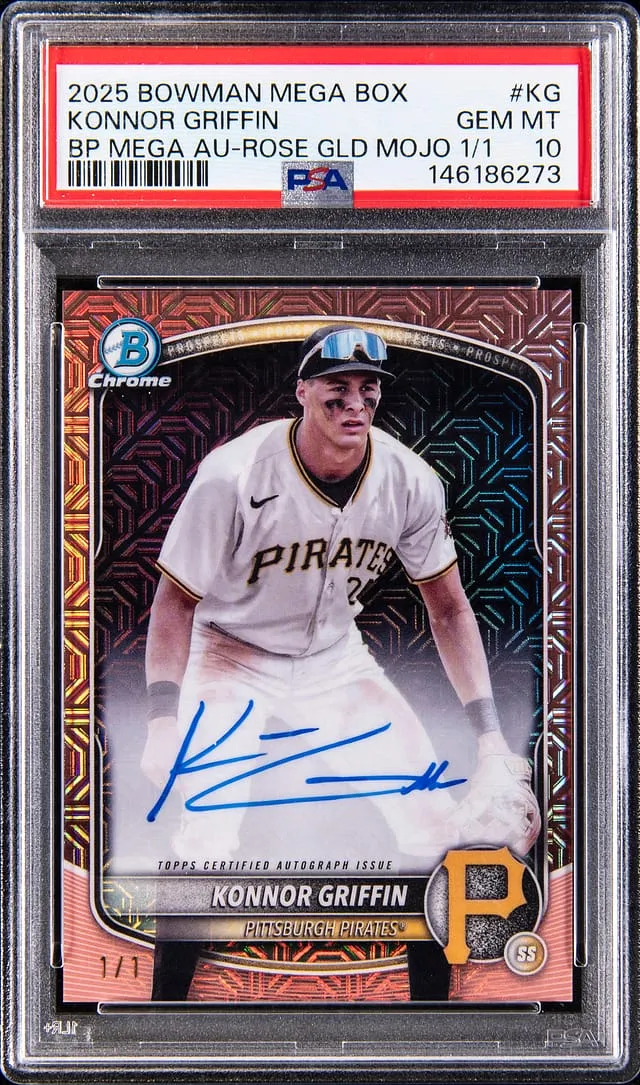
Konnor Griffin 2025 Bowman Mega 1/1 PSA 10 Sale
Breaking down the $19,825 Goldin sale of the 2025 Bowman Mega Box Rose Gold Mojo 1/1 Konnor Griffin autograph in PSA 10 and what it means for collectors.
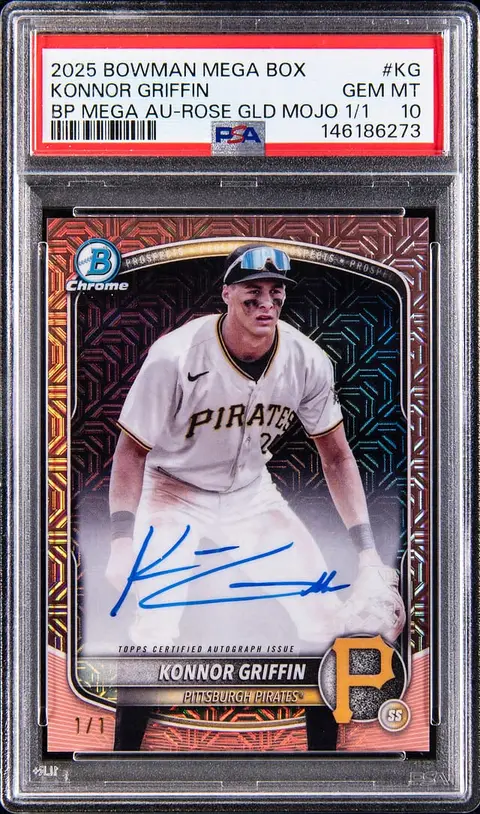
Sold Card
2025 Bowman Mega Box Bowman Prospect Mega Autographs Rose Gold Mojo #BMA-KG Konnor Griffin Signed Rookie Card (#1/1) - PSA GEM MT 10
Sale Price
Platform
Goldin2025 Bowman Mega Box Rose Gold Mojo Konnor Griffin Auto 1/1 Hits $19,825 at Goldin
When an ultra-modern Bowman prospect card pushes close to $20,000, collectors tend to stop and take notice. That’s exactly what happened on April 12, 2026, when Goldin sold a 2025 Bowman Mega Box Bowman Prospect Mega Autographs Rose Gold Mojo #BMA‑KG Konnor Griffin Signed Rookie Card (#1/1), graded PSA GEM MT 10, for $19,825.
For figoca users tracking early prospect issues and 1-of-1s, this sale offers a useful snapshot of how the hobby is currently valuing high‑end Bowman Mega Box autos of a major prep star.
The card at a glance
Let’s break down exactly what this card is:
- Player: Konnor Griffin
- Year: 2025
- Product: 2025 Bowman Mega Box
- Subset: Bowman Prospect Mega Autographs
- Parallel: Rose Gold Mojo
- Serial numbering: Hand-numbered 1/1 (one of one)
- Card number: #BMA‑KG
- Autograph: Signed (pack‑issued Bowman prospect auto)
- Rookie/prospect status: Key early Bowman prospect autograph (a “first big Bowman auto” type card)
- Grading company: PSA
- Grade: GEM MT 10 (PSA’s highest standard grade)
The Rose Gold Mojo treatment combines the popular Mega Box “mojo” refractor pattern with a premium, ultra‑low‑print parallel. In this case, the Rose Gold is a true 1/1, which means this is the only copy of this specific version in existence.
In PSA 10, a one‑of‑one like this effectively sits at the very top of the Bowman ladder for this particular Konnor Griffin issue.
Why Bowman Mega Box prospect autos matter
For newer collectors: Bowman is widely seen as the key “first card” destination for baseball prospects. While a player’s official “rookie card” might show up later in flagship Topps, Bowman prospect autos often become the hobby’s long‑term reference point for that player’s early market.
Bowman Mega Box releases have developed their own lane in that ecosystem:
- They feature the distinct “mojo” refractor pattern, which many collectors specifically chase.
- Mega Box autos and parallels are generally printed in far smaller quantities than base prospect cards.
- Top parallels like 1/1s, Reds, Oranges, and Golds are where serious prospectors often concentrate their attention.
This Rose Gold Mojo 1/1 sits at the very top of that structure: it’s a signed, pack‑issued Bowman Mega prospect card, with the most limited serial numbering possible.
Market context: how does $19,825 fit in?
Using public auction archives and marketplace data, we can place this sale in context, even though this exact 1/1 naturally has no direct duplicate comps (comparable previous sales of the exact same card):
- Exact card:
- 2025 Bowman Mega Box Bowman Prospect Mega Autographs Rose Gold Mojo #BMA‑KG Konnor Griffin 1/1, PSA 10
- Sold at Goldin on April 12, 2026 for $19,825.
Because a 1/1 only sells when the lone copy surfaces, the best we can do is look at “comp families”—similar cards that give a sense of price brackets rather than exact valuation.
1. Other high-end Konnor Griffin Bowman issues
Recent public sales (across major auction houses and fixed‑price marketplaces) for Konnor Griffin’s premium Bowman prospect cards show a familiar pattern for a top‑tier prep prospect:
- Lower‑tier parallels and non‑1/1 autos typically land well below this Goldin result, often in the low‑ to mid‑four‑figure range depending on color, condition, and whether the autograph is graded.
- Stronger colors (Gold, Orange, Red) tend to occupy the mid‑ to upper‑four‑figure range when graded well, occasionally creeping higher if multiple bidders line up.
While exact dollar amounts vary by color, timing, and platform, the $19,825 result for this Rose Gold Mojo 1/1 clearly sits above the usual range for Griffin’s non‑1/1 parallels. That is consistent with how the hobby typically values:
- A true 1/1 parallel from a popular Bowman line, and
- A PSA GEM MT 10 grade, which removes condition questions for many buyers.
2. Bowman Mega Box 1/1 prospect autos in general
Looking beyond Griffin specifically, 1/1 Bowman Mega Box autos of well‑regarded prospects share a few characteristics:
- They don’t come up often, so pricing is driven by who shows up to bid on a given day.
- Public sale prices for similar 1/1 Mega autos of notable names typically stretch into the higher four figures, and in stronger cases, into the five‑figure bracket.
- PSA 10s generally outpace raw or lower‑grade versions, especially where condition-sensitive surfaces and corners are involved.
Within that broader pattern, $19,825 for a PSA 10, on‑card Bowman 1/1 of a high‑profile prep remains aggressive but understandable. It lands in the upper tier of what recent Mega Box prospect 1/1s have achieved, which reflects both the card’s scarcity and Griffin’s current standing in the prospect conversation.
Because there are no previous public sales of this exact 1/1, it functions as a reference point more than a repeatable benchmark. Future sales of other high‑end Griffin pieces may get compared back to this Goldin result.
Grading, population, and why a PSA 10 matters
PSA’s GEM MT 10 is their top mainstream grade, indicating a card that is, by their standards, essentially pack‑fresh and free of notable flaws.
For ultra‑modern chromium and refractor‑style cards, condition is not automatic:
- Surfaces can scratch or show faint print lines.
- Centering can be slightly off.
- Corners and edges may show micro‑wear straight from the pack.
A 1/1 will always be scarce, but a 1/1 that also achieves a top grade removes questions about eye appeal and condition. That can:
- Attract both player collectors (who focus on everything of a given player) and
- Set or parallel collectors (who chase specific colors and patterns across many players).
While PSA’s population report (often called a “pop report”, which counts how many copies of a card exist in each grade) isn’t as informative for a true 1/1 as it is for mass‑printed cards, the grade still matters psychologically and practically. Many high‑end buyers prefer the certainty and liquidity that come with a PSA 10 label.
Why collectors care about this card
Several hobby angles converge in this single piece:
Early Bowman prospect auto
Bowman prospect autos often become the cornerstone cards for a player’s story in the hobby. Early, premium‑color versions tend to be the ones collectors remember.Top-tier scarcity: 1/1 Rose Gold Mojo
Even among low‑serial parallels, a true 1/1 occupies its own category. The Rose Gold Mojo combines visual appeal with confirmed uniqueness.Desirable configuration: signed and graded
- On‑card or pack‑issued autographs are a major draw for modern baseball cards.
- PSA 10 condition simplifies things for bidders; they’re less concerned about hidden flaws.
Ultra‑modern era dynamics
This card is part of the ultra‑modern era (roughly mid‑2010s onward), defined by:- More parallel colors, patterns, and short prints.
- Heavy focus on prospects and pre‑MLB performance.
- Rapid reaction to player news, injuries, and scouting reports.
In that environment, unique Bowman prospect pieces like this one become a way for collectors to plant a flag early in a player’s story.
Player and hobby backdrop
The interest around this card sits within a broader trend: sustained enthusiasm for high‑upside prep and international prospects via Bowman products.
While individual scouting reports, rankings, and performance data can change quickly, the hobby has consistently:
- Paid premiums for the earliest, most limited Bowman autos of highly touted teenagers.
- Used key sales like this as informal signals of how confident certain buyers are in a player’s long‑term potential.
As always, performance on the field will ultimately shape how collectors look back on this card in a few years. But in April 2026, the market was willing to assign nearly $20,000 to this specific intersection of player, set, scarcity, and grade.
What this sale means for collectors and small sellers
For collectors and small sellers using figoca to track the market, a few takeaways stand out:
High-end Bowman Mega parallels are firmly on the radar.
The Goldin result confirms that Mega Box 1/1 autos of major prospects can command serious attention and pricing, on par with or above some traditional Bowman Chrome color autos.Scarcity plus grade can outweigh product hierarchy.
While Bowman Chrome is often the first product that comes to mind, truly scarce Mega Box parallels—especially in PSA 10—can land in similar price zones when the player demand is there.1/1 sales are reference points, not price guarantees.
A single auction does not define a stable “market price,” especially for a one‑of‑one. It does, however, give a data point that future buyers, sellers, and auction houses will reference.Comps need context.
When you look for “comps” (recent comparable sales used for price reference), it’s important to:- Compare by player, set, parallel level, and grade, not just by name.
- Recognize that a 1/1 behaves differently from a /25 or /50 card.
- Factor in the auction house: events at places like Goldin or other major houses can pull strong bidding fields.
Final thoughts
The sale of the 2025 Bowman Mega Box Bowman Prospect Mega Autographs Rose Gold Mojo #BMA‑KG Konnor Griffin Signed Rookie Card (#1/1) PSA GEM MT 10 for $19,825 at Goldin on April 12, 2026 is a clear marker of how the market currently views premium Bowman prospect 1/1s.
For some collectors, this card will be a long‑term centerpiece. For others, it serves as a benchmark when evaluating their own Griffin cards or similar high‑end Bowman prospects.
Either way, it’s a useful case study: when you combine a high‑profile prospect, a unique parallel, an on‑card autograph, and a PSA 10 grade in a respected Bowman configuration, the market is willing to pay attention—and, in this instance, nearly $20,000 to secure the only copy that exists.
As always, collectors should treat this result as one data point among many, and enjoy the process of learning how scarcity, set choice, and player storylines intersect in today’s ultra‑modern baseball card market.