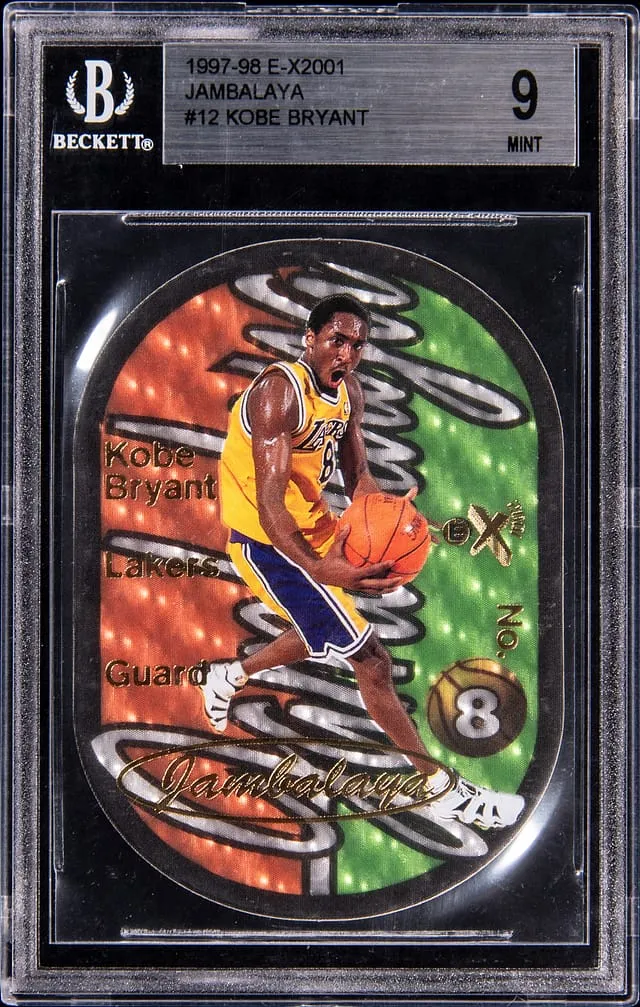
Kobe Jambalaya BGS 9 Sells for $24,401 at Goldin
Deep dive on the 1997-98 SkyBox E-X2001 Jambalaya #12 Kobe Bryant BGS 9 that sold for $24,401 at Goldin on March 15, 2026.
Sold Card
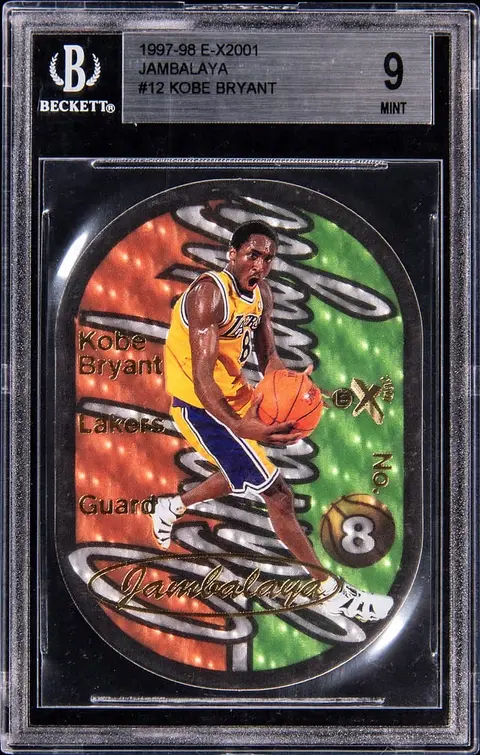
1997-98 SkyBox E-X2001 Jambalaya #12 Kobe Bryant - BGS MINT 9
Sale Price
Platform
Goldin1997-98 SkyBox E-X2001 Jambalaya Kobe Bryant BGS 9 Sells for $24,401 at Goldin
On March 15, 2026, a 1997-98 SkyBox E-X2001 Jambalaya #12 Kobe Bryant graded BGS MINT 9 sold for $24,401 at Goldin. For many basketball collectors, this is one of the defining 1990s inserts, and this sale adds another clear data point to an already closely watched market.
In this breakdown, we’ll look at what the card is, why it matters, and how this result fits into recent sales data.
The card at a glance
- Player: Kobe Bryant
- Team: Los Angeles Lakers
- Season: 1997-98
- Set: SkyBox E-X2001 Jambalaya
- Card number: #12
- Card type: Premium die-cut insert (not a rookie card)
- Era: Late 1990s insert era
- Grading company: Beckett Grading Services (BGS)
- Grade: BGS MINT 9
Jambalaya is a tough, acetate-style, die-cut insert run from 1997-98 SkyBox E-X2001. While not serial numbered on the card, the checklist is widely considered low production compared with most inserts from the same timeframe. The combination of design, scarcity, and player selection has made Jambalaya a pillar of 1990s basketball inserts.
Kobe’s #12 Jambalaya is not a rookie card (his rookies are from 1996-97), but it is often treated as a key issue for his 1990s portfolio—similar in status to some of the most sought-after inserts and parallels of the era.
Why collectors care about Jambalaya
For newer or returning collectors, it helps to understand why “Jambalaya” gets mentioned so often when people talk about grail-level 1990s inserts:
- Design and innovation: The card features a bold, colorful, oval die-cut design with a textured, almost layered feel that stood out even in the late 90s. It looks different from almost anything in the base set or other inserts of the time.
- Short print nature: While not numbered, hobby consensus and historical production patterns point to Jambalaya being a legitimately tough pull. These were not falling out of every box.
- Star-heavy checklist: The insert run is loaded with 1990s stars, so competition for copies is high. Kobe, Jordan, and other headliners tend to anchor demand.
- Insert-era significance: The late 1990s “insert boom” is now recognized as a distinct historical chapter, and Jambalaya is one of the sets collectors mention alongside other iconic inserts when describing that era.
For Kobe specifically, this card captures him early in his career, pre-three-peat and pre-MVP, when his potential was already obvious but not yet fully realized. Many collectors like that combination of youth and established stardom.
The grade: BGS MINT 9
This copy received a BGS MINT 9 from Beckett. Beckett’s 9 is considered a strong grade for a 1990s die-cut insert for a few reasons:
- Die-cut edges: The oval shape and cutouts introduce extra edges and corners that are susceptible to chipping and wear.
- Surface and finish: The layered design and finish can pick up scratches or print issues that limit how many copies can reach high grades.
Because of those challenges, high-grade Jambalayas—especially of major players like Kobe—tend to be relatively scarce compared to many modern, mass-submitted cards. Population reports (often called "pop reports," the grading-company counts of how many cards exist at each grade) reinforce that high-grade Jambalayas are not common.
Market context and recent sales
When collectors talk about “comps,” they’re referring to comparable recent sales of the same card or close variants. For a card like this, useful comps include:
- Recent sales of the same card in BGS 9
- The same card in higher grades (e.g., BGS 9.5, PSA 10)
- The same card in PSA 9 as a neighboring benchmark
Across major marketplaces and auction houses over the past couple of years, Kobe Jambalaya prices have generally reflected a few broad patterns:
- Sharp premium for top grades: PSA 10 and BGS 9.5 examples tend to command substantial premiums over PSA 9 or BGS 9, often due to lower populations and the difficulty of achieving those grades on a die-cut 1990s insert.
- Stable interest in 1990s inserts: While overall market conditions can shift, high-end 90s inserts of Hall of Famers like Kobe and Jordan have tended to maintain consistent collector interest.
Against that backdrop, the $24,401 BGS 9 sale at Goldin on March 15, 2026 sits in the upper tier of what collectors typically expect for a strong, mint copy, while still coming in below the levels that truly top-pop copies might reach. It fits within the general pattern where:
- Mid-to-high grade copies are well-established as premium items.
- Elite grades command a higher tier that reflects their scarcity.
The exact number will move with broader market conditions—interest rates, overall hobby sentiment, and changing demand for Kobe cards—but this result is consistent with the way Jambalaya has been treated as a cornerstone insert.
How this sale fits into Kobe’s broader market
Kobe’s card market has had several distinct phases: pre-retirement collecting, post-retirement reflection, and the more reflective stage after his passing. Through all of those, a few themes have held up:
- Focus on true keys: Flagship rookies, important 1990s inserts, and strong on-card autographs tend to attract the most stable attention.
- Preference for condition and originality: High grades, eye appeal, and unaltered surfaces matter considerably, especially on condition-sensitive issues like Jambalaya.
This Jambalaya sale at $24,401 supports the idea that collectors continue to separate Kobe’s true “key issues” from the broader field of 2000s and 2010s parallels. For many, this card is one of the handful that defines his 1990s cardboard presence.
What this means for collectors and small sellers
If you’re a newer or returning collector trying to understand a result like this, a few practical takeaways:
Context matters more than any single sale
One auction price is a data point, not a final verdict. Use multiple comps across time and platforms to understand a realistic range.Condition-sensitive designs command premiums
Die-cuts, foil, and layered finishes from the 1990s often grade harshly. High-grade examples tend to separate themselves in price, especially for Hall of Famers.Iconic inserts can function like “core holdings” for a player
For Kobe, Jambalaya sits alongside his very top inserts and parallels from the era. Not every rare insert achieves that status; sets like this do because of design, scarcity, and long-term recognition.Grading choice shapes liquidity and price bands
PSA and BGS each have their own following. A BGS 9 Jambalaya will often be compared directly to a PSA 9 in buyer decision-making, but premium collectors may chase the highest-graded examples in either holder.
Final thoughts
The March 15, 2026 Goldin sale of a 1997-98 SkyBox E-X2001 Jambalaya #12 Kobe Bryant BGS MINT 9 at $24,401 reinforces this card’s standing as one of Kobe’s essential 1990s inserts. For collectors, it’s another reminder that a small group of well-known, historically important inserts from this era continue to attract consistent attention.
As always, rather than treating any single sale as a signal to buy or sell, it’s more useful to log it mentally (or in a spreadsheet), compare it against other recent results, and use that broader picture to understand where this card currently sits in the Kobe and 1990s insert landscape.