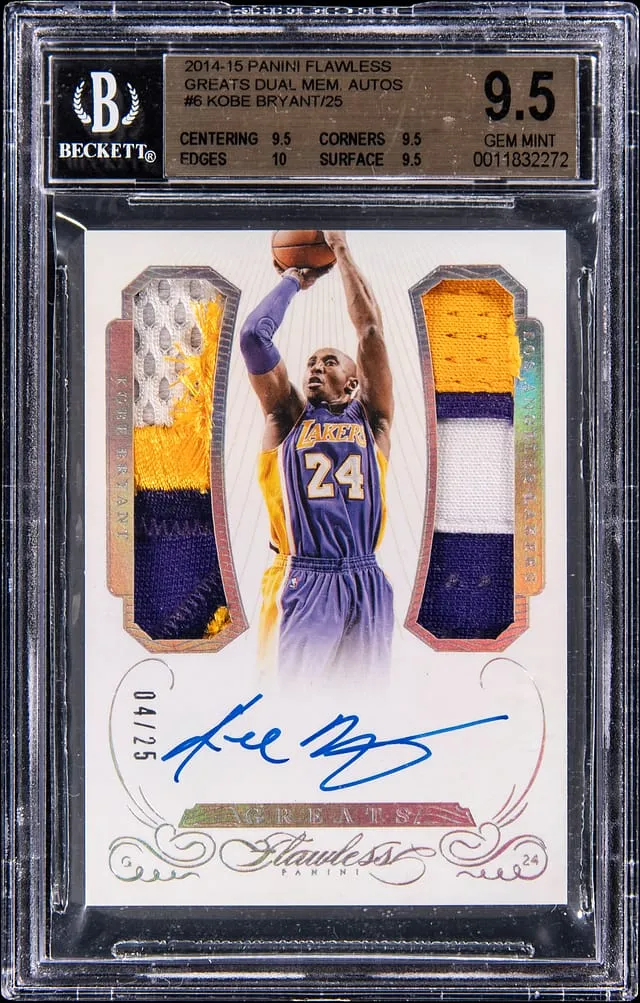
Kobe Bryant 2014-15 Flawless Dual Auto Patch Sells Big
Goldin sold a 2014-15 Panini Flawless Kobe Bryant dual memorabilia auto /25 in BGS 9.5 True Gem+ with 10 auto for $209,230 on June 7, 2026.
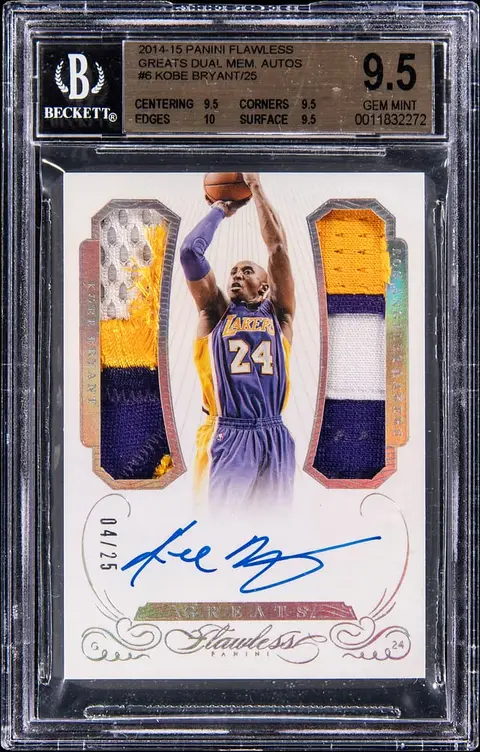
Sold Card
2014-15 Panini Flawless Greats Dual Memorabilia Autograph #GDM-KB Kobe Bryant Signed Patch Card (#04/25) - BGS GEM MINT 9.5, Beckett 10 - True Gem+
Sale Price
Platform
Goldin2014-15 Panini Flawless Greats Dual Memorabilia Autograph #GDM-KB Kobe Bryant Signed Patch Card (#04/25) - BGS GEM MINT 9.5, Beckett 10 - True Gem+
On June 7, 2026, Goldin closed a major modern Kobe Bryant sale that caught the eye of many high-end basketball collectors: a 2014-15 Panini Flawless Greats Dual Memorabilia Autograph #GDM-KB, serial numbered 04/25, graded BGS Gem Mint 9.5 with a Beckett 10 autograph and “True Gem+” subgrades. The final price landed at $209,230.00.
For a hobby that has spent the last few years recalibrating around supply, scarcity, and true blue-chip pieces, this sale is a useful data point for how the market continues to value premium, game-used, on-card Kobe autos in top grades.
Card overview: what exactly sold?
Let’s break down the key details collectors care about:
- Player: Kobe Bryant (Los Angeles Lakers)
- Year: 2014-15
- Product: Panini Flawless Basketball
- Subset: Greats Dual Memorabilia Autographs
- Card number: #GDM-KB
- Serial numbering: #04/25 (only 25 copies produced)
- Autograph: On-card (signed directly on the card, not a sticker)
- Memorabilia: Dual patch pieces, from Lakers uniforms
- Rookie status: This is not a rookie card. It’s a high-end, later-career, premium autograph and patch issue.
- Era: Modern / early Panini premium era
- Grading company: Beckett Grading Services (BGS)
- Grade: BGS 9.5 Gem Mint with a 10 Autograph
- Subgrades: True Gem+, meaning all four subgrades are 9.5 or higher, with at least one 10 (for example, centering 10, corners 9.5, edges 9.5, surface 9.5). Collectors typically treat True Gem+ as a slight premium over a basic 9.5.
This is a classic example of what many consider a “tier-one” modern Kobe card: low print run, thick premium stock, dual memorabilia windows, and an on-card autograph from one of the hobby’s foundational players.
Why the 2014-15 Flawless Greats Dual Memorabilia Auto matters
1. Flawless as a product line
Panini Flawless sits near the top of Panini’s basketball pyramid. During the 2010s, high-end products like National Treasures and Flawless became the go-to sets for serious collectors chasing:
- Game-used (or at least event-worn) patches
- On-card autographs
- Very low serial numbering
The Greats Dual Memorabilia Autograph checklist in 2014-15 Flawless brings legends and franchise icons into this premium format. Kobe’s inclusion places him alongside other all-time names, and his cards from this era tend to age better than most because they capture him in the final phase of his career, not in a speculative rookie window.
2. Dual memorabilia and on-card ink
Dual memorabilia means the card features two separate swatches of jersey material. For many collectors, that adds both visual appeal and a sense of “substance” to the card.
The autograph is on-card, which is important. On-card autos are signed directly on the card surface, versus sticker autos where the player signs a separate label that is later applied to the card. On-card signatures are generally:
- More desirable aesthetically
- Perceived as more personal
- Often more condition-sensitive (ink placement, smudging, etc.)
Kobe’s on-card autos from premium 2010s products have become a central lane for collectors who want a high-end piece without chasing his top-tier rookies.
3. Low serial numbering: only 25 copies
At /25, this card sits in the kind of scarcity range that matters to high-end buyers:
- It’s limited enough that full availability at any given time is low.
- It’s not a one-of-one, so there is at least a small sale and comp history.
When there are only 25 copies, the number of high-grade examples that emerge from a thick, patch-based product like Flawless is even smaller. These cards are often prone to soft corners, edge chipping, and surface scratches straight from the factory.
Grading: why BGS 9.5 True Gem+ and 10 Auto are key
A few terms that matter here:
- BGS 9.5 Gem Mint: Beckett’s second-highest standard grade, signifying a near-flawless card.
- Subgrades: Beckett assigns four category grades (centering, corners, edges, surface). “True Gem” usually means all four are 9.5 or higher; “True Gem+” means at least one 10 subgrade in that mix.
- Beckett 10 Auto: The autograph itself is evaluated separately. A 10 means the signature is bold, clean, and fully present.
For thick, patch-based cards, a True Gem+ BGS 9.5 is not something you can assume. Many patch autos from this era sit in the 8.5–9 range because of how they come out of the pack. So when a copy surfaces with:
- Strong centering
- Sharp corners and edges
- A clean surface
- A 10-grade autograph
…it tends to command a premium over lower or even average 9.5s.
Market context: how does $209,230 fit in?
The Goldin sale closed at $209,230. To understand that, you want to look at comps—short for “comparables,” meaning recent sales of the same card or closely related versions.
Because this specific card is:
- Serial numbered /25
- High-grade (BGS 9.5 True Gem+ with 10 auto)
- From a premium line
…it trades infrequently. That limits the number of direct, identical comps available at any given moment. Instead, collectors often triangulate using nearby data points:
- Other 2014-15 Flawless Kobe patch autos (even from different subsets)
- Lower-grade copies of the same #GDM-KB card (BGS 9, PSA 9, BGS 9.5 non-True-Gem)
- Comparable Kobe Flawless autos numbered /25 or less from adjacent years
What we consistently see in the high-end Kobe space is a clear hierarchy:
- Rookie-era grails (e.g., 1996-97 premium issues) at the very top.
- Iconic Panini patch autos (National Treasures, Flawless) with on-card signatures and tight print runs.
- Then other modern autos, inserts, and parallels.
This Flawless Greats Dual Memorabilia Autograph sits firmly in that second tier. Within that tier, True Gem+ examples typically represent the best of the available population and are treated as “keeper” pieces by long-term collectors. That means they can be underrepresented in public auction data, simply because owners don’t sell often.
So how does $209,230 read in that context?
- It aligns with the ongoing trend where top-end Kobe patch autos—especially in Gem Mint with pristine autos—have separated themselves from mid-tier and base autos.
- It reinforces that the market still distinguishes sharply between: on-card vs. sticker, low-serial vs. mass-produced, and high vs. average grades.
Instead of thinking of this sale as a one-off spike, it’s more useful to see it as another data point in a longer-term curve where truly premium Kobe pieces continue to draw deep-pocketed, patient buyers.
Collector significance: why this card matters beyond the price
1. Kobe’s place in the modern hobby
Kobe occupies a unique lane:
- He is a direct link between the Jordan era and the current generation.
- He has a global following that translates directly into card demand.
- His passing in 2020 transformed the way many collectors view his cards—from speculation to legacy pieces.
In that landscape, well-documented, premium, on-card autograph cards like this Flawless Greats Dual Memorabilia Autograph function almost like “modern era heirlooms” for basketball collectors.
2. Game-used memorabilia and storytelling
Patch cards are partly about storytelling. Dual memorabilia windows invite questions:
- What games or stretches of his career were these jerseys from?
- How do these swatches fit into the visual narrative of the card (team colors, stitching, breaks)?
Even when exact game provenance is not specified on the back, collectors place a real premium on visually strong patches—multi-color, visible stitching, or number/letter cuts—over plain one-color swatches. While each individual card in a /25 run will differ, the market generally rewards cards whose patch aesthetics match the significance of the player and product.
3. Era and supply
2014-15 is modern Panini, but it’s early enough that:
- Flawless print runs and checklist sizes are more controlled than some ultra-modern releases.
- There was less fragmentation across dozens of parallel sets and inserts.
That means cards like this one can occupy a clearer, less crowded lane in a player’s overall card catalog compared to ultra-modern years with far more parallel and insert variations.
What this sale can mean for different types of collectors
This is not a signal that every Kobe auto or patch card will suddenly be worth six figures. It does, however, highlight several patterns worth paying attention to:
Quality over quantity: The market continues to reward:
- On-card autographs
- Low serial numbered cards
- Premium, established brands (like Flawless)
- Strong grades and subgrades
Grade nuance matters: The distinction between a BGS 9.5 with weak subgrades and a True Gem+ with a 10 auto is not just semantic—it often translates into real dollar differences.
Patience in thin markets: For cards with only 25 copies and limited high-grade examples, you may not see a steady stream of comps. When a strong copy finally does surface at a major house like Goldin, the result often resets or reaffirms the perceived level of the card.
Real demand for long-term pieces: In a period where many modern cards have softened, elite, culturally important pieces—like premium Kobe patch autos—continue to show that there is a stable base of collectors focused on long-term ownership, not quick flips.
Takeaways for newer and returning collectors
If you’re getting back into the hobby or just starting to understand the high-end Kobe lane, here are a few practical lessons this sale underlines:
Learn the product tiers. Sets like Hoops or Donruss have a different role than Flawless or National Treasures. Understanding that hierarchy helps you interpret prices more clearly.
Read the label carefully. On a BGS slab, “True Gem+” and a 10 autograph grade are meaningful details. The same holds for PSA (10 vs. 9) and other graders.
Check population and frequency, not just serial number. A card can be numbered /25 but rarely show up at auction if most copies are locked away in collections.
Use comps as guides, not promises. Past sales—including this $209,230 result—describe what has happened, not what must happen next.
Closing thoughts
The 2014-15 Panini Flawless Greats Dual Memorabilia Autograph #GDM-KB Kobe Bryant, #04/25, BGS 9.5 True Gem+ with a Beckett 10 autograph, selling for $209,230 at Goldin on June 7, 2026, is another reminder of how the market differentiates within modern cards.
It isn’t just “a Kobe auto.” It’s a tightly produced, on-card, dual memorabilia piece from a premium product, in one of the best grades likely to exist for the run. For collectors who focus on the intersection of player legacy, brand strength, and condition quality, this is precisely the kind of card that defines the top end of the modern basketball market.
As always, this information is best used as context and education, not as prediction. The hobby continues to evolve, but fundamentals like scarcity, condition, and authentic player significance remain at the center of long-term collector interest.