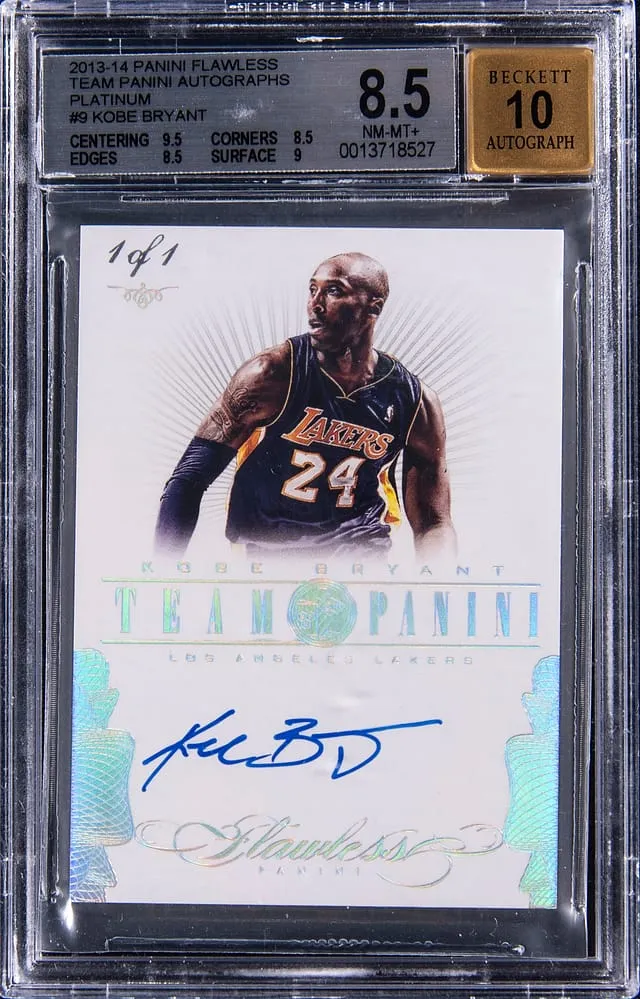
Kobe Bryant 2013-14 Flawless 1/1 Auto Sells for $73K
Goldin sold a 2013-14 Panini Flawless Team Panini Platinum 1/1 Kobe Bryant auto (BGS 8.5, 10 auto) for $73,200. Here’s what it means for the market.
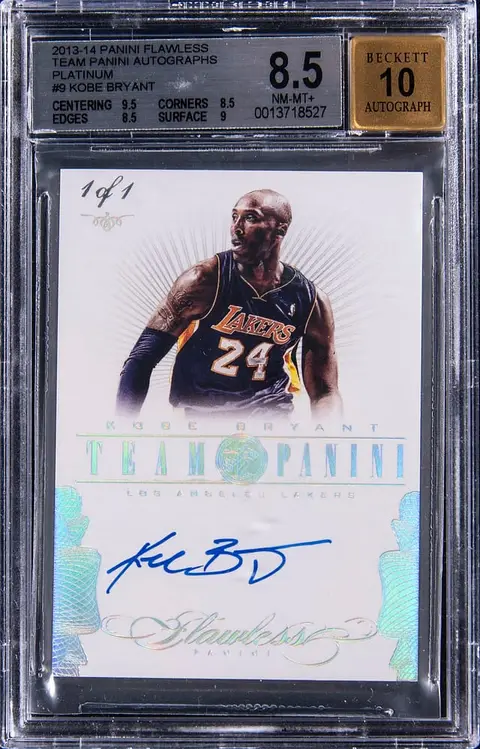
Sold Card
2013-14 Panini Flawless Team Panini Autographs Platinum #TM-KB4 Kobe Bryant Signed Card (#1/1) - BGS NM-MT+ 8.5, Beckett 10
Sale Price
Platform
Goldin2013-14 Panini Flawless Team Panini Autographs Platinum #TM-KB4 Kobe Bryant Signed Card (#1/1) – BGS 8.5 / 10 Auto
On March 8, 2026, Goldin closed a notable high-end Kobe Bryant sale: a 2013-14 Panini Flawless Team Panini Autographs Platinum #TM-KB4, serial-numbered 1/1, graded BGS NM-MT+ 8.5 with a Beckett 10 autograph. The final price was $73,200.
For Kobe collectors and modern basketball enthusiasts, this card touches several important lanes at once: premium brand, on-card signature, true one-of-one, and a strong grade with a perfect auto.
Card overview
Let’s lay out the basics of the card itself:
- Player: Kobe Bryant (Los Angeles Lakers)
- Year: 2013-14
- Set: Panini Flawless – Team Panini Autographs
- Parallel: Platinum (serial-numbered 1/1)
- Card number: #TM-KB4
- Autograph: On-card, Beckett 10 (gem mint auto)
- Grading company: BGS (Beckett Grading Services)
- Grade: NM-MT+ 8.5
- Serial numbering: 1/1 (the only copy of this exact card)
- Era: Modern / early ultra-modern Panini premium
This is not a rookie card (Kobe’s rookies are 1996-97), but it is a key premium autograph issue from one of Panini’s flagship high-end brands. Flawless is known for very low print runs, on-card autos, and a clean, minimal design.
Why this card matters to collectors
1. Panini Flawless as a brand
Panini Flawless debuted in the early 2010s as one of the hobby’s true “super-premium” products. Boxes are extremely expensive, and every card is designed to be a hit: low serial numbering, patches, gems, and on-card autographs.
In that context, a Team Panini Autographs Platinum 1/1 represents the very top of what the product can offer for a given player. It sits alongside Logoman and premium patch autos as one of the set’s chase-level cards.
2. Kobe Bryant’s high-end autograph market
Kobe’s passing in 2020 reshaped his market. Supply of new, on-card autographs effectively stopped, and collectors shifted their focus toward:
- Low-numbered on-card autos from premium brands (Flawless, National Treasures, Immaculate, Exquisite-era Upper Deck)
- Iconic or aesthetically strong designs
- Serial-numbered cards with clear scarcity (like 1/1s)
This card checks all of those boxes. While it is a modern-era issue rather than a playing-days rookie, 2013-14 is still within Kobe’s active career window and from the early Panini premium years.
3. The 1/1 factor
A 1/1 (one-of-one) means there is only a single copy of this exact card in existence. That changes how collectors evaluate it:
- There is no direct duplicate to compare against; each sale can set its own price context.
- The focus shifts from strict population counts (“pop report”) to overall demand for top-tier Kobe 1/1 autos from respected brands and years.
Because there’s only one, traditional price discovery is slower and often driven by a small pool of high-end buyers.
Grading details: BGS 8.5 with 10 auto
The card received a BGS NM-MT+ 8.5 grade, with a Beckett 10 autograph. In the high-end market, collectors usually separate two concepts:
- Card grade – centering, corners, edges, surface
- Autograph grade – how clean and bold the signature is
For a thick, premium card from Flawless, an 8.5 is fairly common. These cards can have:
- Edge and corner chipping due to thick stock
- Surface issues from handling, packing, or the on-card signing process
The 10 auto is important because:
- It confirms a bold, complete signature with no major streaks or fading.
- Many high-end buyers will accept an 8.5 or 9 card grade as long as the autograph is a 10.
Market context and price positioning
This specific card is a 1/1, so there are no direct, perfectly matching comps (comparison sales). Instead, collectors look at:
- Other Kobe Bryant Flawless 1/1 autographs
- Similar ultra-premium 1/1s from National Treasures, Immaculate, and high-end Upper Deck
- Serial-numbered Kobe autos from Flawless (e.g., /10, /15, /25) to get a general range
Comparable categories (directional only)
Because 1/1s don’t trade often, public sales are spotty, but the general patterns have been:
- Flawless Kobe autos /10 or /15 in strong grades can range from the low thousands to well into five figures depending on patch, design, and year.
- Kobe 1/1 autos from premium brands often command a meaningful premium over /10 or /15 parallels, especially when they’re on-card.
At $73,200, this Goldin sale:
- Sits in the upper tier of modern Kobe auto results that are not rookie-year Exquisite or Logoman cards.
- Aligns with the idea that premium, early Panini-era Kobe 1/1 autos occupy a strong niche just below the true record-setting grails (Exquisite RPAs, Logomans, and unique historically significant pieces).
Because of limited public data on this exact card, this result is best viewed as a fresh benchmark for:
- 2013-14 Flawless Kobe 1/1 autograph pricing
- Market appetite for non-rookie, high-end Kobe on-card autos in the current environment
How this fits into the broader Kobe market
1. Shift toward quality over volume
Kobe’s market contains a huge number of inserts and lower-end autos, but the sustained interest has centered on:
- Low-serial, on-card autographs
- Recognizable premium brands
- Clean designs with strong photographic presence
This sale reinforces that pattern. Rather than a wild spike, it looks like another data point showing that top-tier Kobe pieces continue to find willing buyers when the right card surfaces.
2. Era and set significance
2013-14 sits at an interesting point:
- Panini had firmly taken over the NBA license.
- Flawless was still relatively new, and early-year Flawless issues have a bit of an “establishing era” appeal.
Collectors often view early-run premium sets as historically important, not just for the player but for the brand itself. For Flawless, those first several years helped define what the line would stand for: short print runs, on-card autos, and clean, high-end design.
Takeaways for collectors and small sellers
A few practical observations if you’re navigating this part of the market:
1/1s are their own category. Traditional price ladders (PSA 8 vs 9 vs 10, etc.) don’t apply neatly to 1/1s. Each transaction can reshape expectations.
Brand and autograph type matter as much as grade. For thick, premium card stock, buyers often prioritize:
- On-card autograph over sticker
- Recognized high-end brand over mid-tier
- Autograph grade 10, even if the card itself is 8.5 or 9
Context beats hype. Rather than treating one big sale as a signal that “everything is up,” it’s more useful to see this as a confirmation that:
- Serious collectors still allocate capital to rare, brand-defining cards.
- Modern legends like Kobe have a layered market, with clear separation between true premiums and everything else.
Watch related categories, not just the exact card. If you collect or sell high-end Kobe:
- Track prices for Flawless, National Treasures, and Immaculate autos.
- Note the gaps between /1, /5, /10, and /25 cards.
- Compare on-card autos versus sticker autos in similar serial ranges.
Final thoughts
The $73,200 sale of the 2013-14 Panini Flawless Team Panini Autographs Platinum #TM-KB4 Kobe Bryant 1/1 at Goldin on March 8, 2026 is a clear reminder of where the hobby still places its long-term confidence:
- Hall of Fame-level talent
- Scarcity that’s easy to understand (1/1)
- On-card signatures from a respected premium brand
For collectors, it’s another data point in the ongoing story of Kobe’s high-end market. For sellers, it’s a prompt to think carefully about how you position rare, modern-era autograph cards—by context, not just by headline numbers.
As always, none of this is a prediction or advice—just a look at what this sale tells us about how the market is currently valuing one of Kobe Bryant’s more exclusive modern autographs.