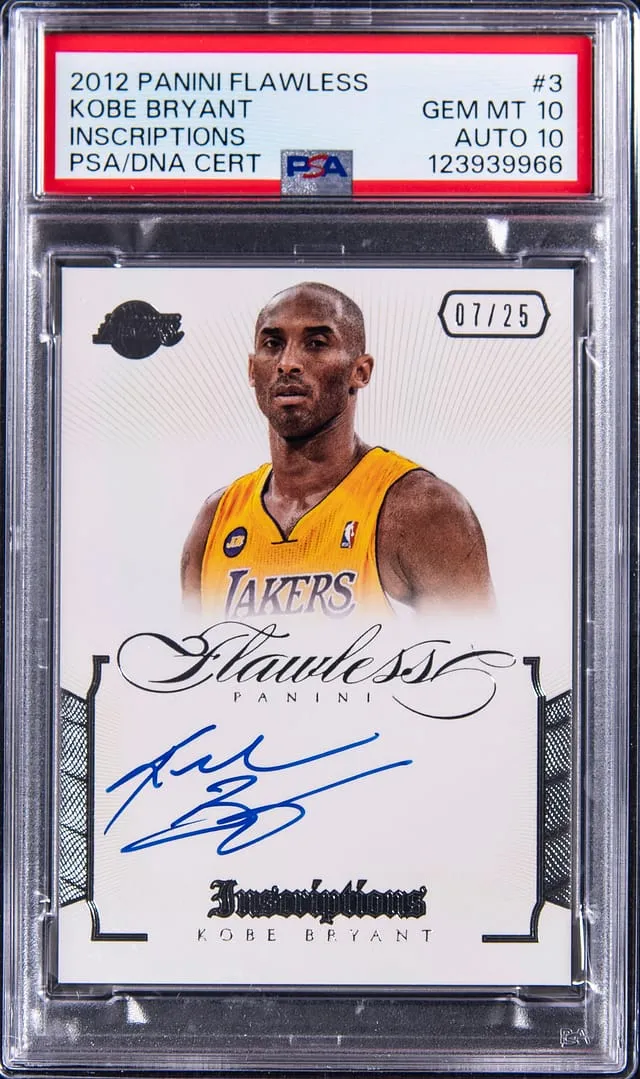
Kobe Bryant 2012-13 Flawless Inscriptions PSA 10 Sale
Goldin sold a 2012-13 Panini Flawless Inscriptions #3 Kobe Bryant PSA 10/10 Pop 1 for $29,280 on May 10, 2026. Here’s what it means for collectors.
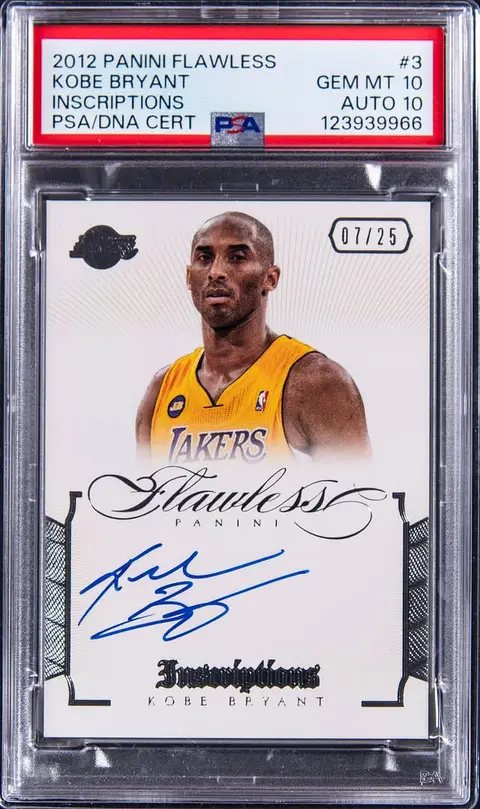
Sold Card
2012-13 Panini Flawless Inscriptions #3 Kobe Bryant Signed Card (#07/25) - PSA GEM MT 10, PSA/DNA GEM MT 10 - Pop 1
Sale Price
Platform
Goldin2012-13 Panini Flawless Inscriptions Kobe Bryant PSA 10 Sells for $29,280
On May 10, 2026, Goldin sold a premium Kobe Bryant autograph that quietly checks a lot of boxes for high-end basketball collectors: a low-serial, on‑card auto from one of Panini’s most respected ultra‑premium releases, graded Gem Mint across the board and sitting alone at the top of the pop report.
Below, we’ll walk through what this card is, why it matters, and how this $29,280 sale fits into the broader Kobe and Flawless markets.
Card overview: what exactly sold?
Card: 2012-13 Panini Flawless Inscriptions #3 Kobe Bryant
Player/Team: Kobe Bryant, Los Angeles Lakers
Set/Year: 2012-13 Panini Flawless (Basketball)
Insert: Inscriptions (on‑card autograph subset)
Serial Numbering: Hand-numbered 07/25
Autograph Type: On‑card (signed directly on the card, not on a sticker)
Grading:
- Card: PSA GEM MT 10
- Autograph: PSA/DNA GEM MT 10
Population: Pop 1 at this grade/auto combo (only one in PSA’s population report at 10/10 as of the sale).
This is not a rookie card; it’s from 2012-13, well into Kobe’s career. Its appeal comes from:
- Being part of Panini Flawless’ debut year (2012-13), a landmark ultra‑premium release.
- Low serial numbering to /25, which is genuinely scarce for an on‑card Kobe auto in a major high-end product.
- On‑card inscription design, giving Kobe more room for a clean signature and, on many copies in the set, short text/phrases alongside the auto.
- Top-of-the-scale grading: both the card surface/edges/corners and the autograph receive Gem Mint 10 labels from PSA.
Why 2012-13 Flawless matters to collectors
Panini Flawless debuted in 2012-13 as one of the hobby’s earliest true ultra‑premium basketball products. Boxes were sealed in briefcases with jewel cards, patches, and on‑card autos of stars and legends.
Collectors generally value 2012-13 Flawless because:
- It represents the first Flawless release, similar to how first-year Exquisite or first-year National Treasures have a special place in the high‑end market.
- The checklist is concentrated on stars, legends, and key rookies rather than volume.
- On‑card autographs are standard, which is increasingly important to collectors compared to sticker autos.
- Print runs are tightly controlled, and many hits are numbered to 25 or less.
Within that context, the Inscriptions subset is attractive because it combines clean photography with a spacious signing area. The card design emphasizes the signature as the focal point, which helps when evaluating eye appeal and auto quality.
Grading and population: why Gem Mint 10/10 matters
This copy received:
- PSA GEM MT 10 (card) – PSA’s highest standard grade, indicating virtually no visible flaws in corners, edges, surface, or centering under normal viewing.
- PSA/DNA GEM MT 10 (autograph) – confirms the autograph is authentic and also in Gem Mint condition (bold, clean, and well‑placed with no noticeable smearing or skipping).
PSA’s population report (often called “pop report”) is a count of how many copies of a card have been graded at each grade level. A Pop 1 in PSA 10 with a 10 auto means:
- Only one example has achieved this exact top combination at PSA.
- Even if more raw copies exist, their path to matching this grade is uncertain, especially given condition sensitivity on high-gloss, full-bleed, or foil‑heavy Flawless cards.
In modern and ultra‑modern basketball (late 1990s to present), pop counts can vary widely. But for a low‑serial Kobe auto from a high‑end set, the real supply in top grade tends to be thin, and that’s reflected here.
Sale details and price
- Auction House: Goldin
- Sale Date (UTC): May 10, 2026
- Final Price: 2,928,000 cents, which is $29,280 USD.
For clarity throughout this article, all prices are rounded to the nearest dollar and shown in USD.
Market context: how does $29,280 fit in?
Finding and reading comps
In the hobby, “comps” are comparable recent sales of the same or very similar cards, used to understand current price levels.
For a card like this, useful comps include:
- The same 2012-13 Flawless Inscriptions #3 Kobe Bryant in lower grades or raw.
- Other 2012-13 Flawless on‑card Kobe autos, especially short‑printed ones numbered to 25 or less.
- Non‑patch Kobe autos from other top‑tier brands (Exquisite, National Treasures, Immaculate, later‑year Flawless) with similar low serial numbering and high grades.
As of early 2026, public data suggests that:
- Lower‑grade or raw 2012-13 Flawless Kobe autos (non‑RPA, non‑emerald/diamond one‑of‑ones) generally transact in the mid‑four‑figure to low‑five‑figure range depending on numbering, inscription, and eye appeal.
- High‑grade, low‑serial Kobe on‑card autos from major brands (PSA 9/10 or BGS 9.5/10) can move into the five‑figure range, especially when pop counts are low or when the card is from a historically significant set.
- The very top of the Kobe market—rookie patch autos, logo shields, and one‑of‑one masterpieces—can trade far above that, but this Inscriptions card occupies a slightly different niche: premium, but not an RPA or 1/1.
Within that framework, $29,280 for a Pop 1 PSA 10/10 from first‑year Flawless sits on the strong side but not out of line for what advanced Kobe and high‑end basketball collectors have been willing to pay for truly scarce, best‑in‑class copies.
The price reflects several stacked factors:
- First‑year Flawless status.
- On‑card auto with a Gem Mint 10 autograph grade.
- Serial number /25, which is meaningfully scarce.
- PSA 10 Pop 1, creating a clear “best available example” narrative for collectors who care about registry ranking and top‑pop pieces.
Without an extensive public history of the exact card in other grades, it’s hard to state by how much this sale exceeds or lags specific prior results. But relative to:
- Mid‑tier Kobe autos from mass‑produced sets, this result is substantially higher (reflecting set and scarcity).
- Premium but more common Kobe autos, it’s at the upper end of the range.
- True grail‑level Kobe cards (rookie RPAs, logo shields), it’s still below those top tiers, which aligns with where an Inscriptions piece like this typically fits in a Kobe collection hierarchy.
Why collectors care about this card
A few factors make this specific card attractive to a wide range of Kobe and high‑end basketball collectors.
1. Kobe’s enduring legacy
By 2012-13, Kobe was already a multi‑time champion, MVP, and one of the most recognizable players in basketball history. Since his playing career ended, and especially following his tragic passing, demand for on‑card, licensed Kobe autographs from strong brands has remained consistently high.
Collectors looking for stable, long‑term centerpieces in a Kobe PC (personal collection) often prioritize:
- On‑card signatures.
- Recognized premium sets.
- Low serial numbering.
- Strong grades and eye appeal.
This Inscriptions card checks each of those boxes.
2. First‑year Flawless as a “key issue” era
While this is not a rookie, first‑year issues of major high‑end sets are often treated as “key issues”—important cards that mark the beginning of a brand’s history. For Panini’s NBA license era, 2012-13 Flawless is a cornerstone.
For players like Kobe with strong connections to the early 2010s hobby boom, cards from this era can feel both contemporary and historically significant.
3. Eye appeal and design
The Inscriptions design is intentionally clean:
- Minimal background clutter and a clear focus on Kobe and his signature.
- Ample signing area that helps avoid edge smearing or autograph crowding.
- Foil and high‑end stock consistent with Flawless’ positioning.
A strong PSA 10 grade suggests this copy avoided common issues such as surface dimples, chipping, or foil wear, which can be challenging with thicker, premium stock cards.
How this sale fits into the broader Kobe market
In the last several years, Kobe’s card market has gone through:
- Rapid growth in the late 2010s and early 2020s.
- A broad market correction across modern and ultra‑modern basketball.
- Gradual sorting between mass‑produced, lower‑tier issues and truly scarce, high‑end, on‑card autographs and rookies.
This Goldin sale lands squarely in that last category: a data point for a targeted segment of Kobe cards that continue to attract focused, long‑term collectors:
- Not mass‑produced.
- Not dependent on short‑term hype cycles.
- Supported by set reputation, autograph quality, and strong grading.
For collectors tracking the higher‑end Kobe market, this result suggests ongoing willingness to pay a premium for:
- First‑year Flawless cards.
- On‑card signatures with Gem Mint auto grades.
- Pop 1 or otherwise very low‑population examples.
Takeaways for collectors and small sellers
A few practical points if you’re active in this part of the hobby:
- Condition and grading matter more as you move up the ladder. On a $29,000‑plus card, the jump from a strong raw copy to a PSA 10/10 Pop 1 can be dramatic. Even small flaws on thick, premium cards can limit the ceiling.
- Set selection is critical. Kobe has many autographs, but not all are viewed equally. First‑year Flawless carries more weight than many mid‑tier releases from the same timeframe.
- Pop report is only part of the story. Pop 1 tells you about graded examples at PSA, not total supply. But for registry builders and collectors who prefer graded slabs, a top‑pop label can add meaningful demand.
- Comps should be read in context. When comparing this sale to other Kobe autos, factor in year, set, numbering, on‑card vs. sticker, and grade—not just that it’s a Kobe autograph.
Where this card sits in a Kobe collection
While not at the apex tier of Kobe rookie patch autos or 1/1 shields, the 2012-13 Panini Flawless Inscriptions #3 sits comfortably in the premium autograph lane:
- A strong candidate as a main Kobe auto for many high‑end collections.
- A complementary piece for collectors who already own a key Kobe rookie or patch card and want a top‑tier on‑card signature from a landmark modern set.
- A reference point for future sales of similar Kobe Flawless autos in PSA 9/10 or BGS 9.5/10.
The May 10, 2026 Goldin sale at $29,280 provides a clear, public benchmark for what a Pop 1, Gem Mint 10/10 copy of this card can command in the current market, and it underscores how carefully curated Kobe autographs from the right sets continue to draw serious attention.
For collectors building a focused Kobe portfolio, this result reinforces a familiar pattern: when set pedigree, autograph quality, scarcity, and grading all align, the market still responds.