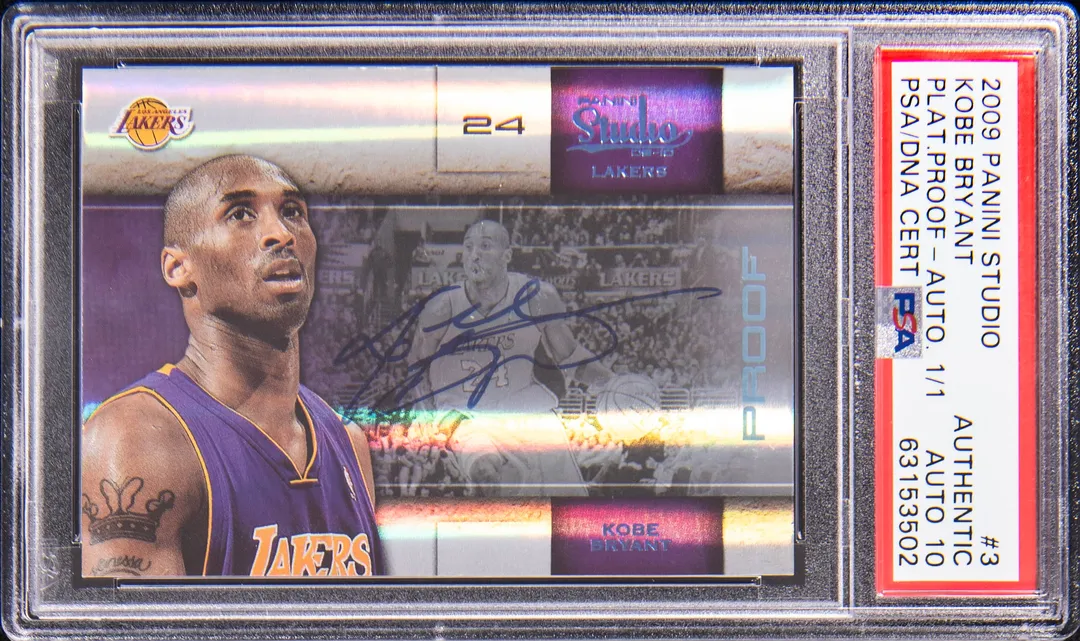
Kobe Bryant 2009-10 Panini Studio 1/1 Auto Sale
Breaking down the $13,731 Goldin sale of the 2009-10 Panini Studio Platinum Proof Autographs 1/1 Kobe Bryant, PSA Authentic with PSA/DNA 10 auto.
Sold Card
2009-10 Panini Studio Platinum Proof Autographs #3 Kobe Bryant Signed Card (#1/1) - PSA Authentic, PSA/DNA GEM MT 10
Sale Price
Platform
GoldinA 2009-10 Panini Studio Platinum Proof Autographs #3 Kobe Bryant just quietly reminded hobbyists how deep the Kobe market still runs.
On February 8, 2026, Goldin sold a copy of this card – serial-numbered 1/1 and graded PSA Authentic with a PSA/DNA GEM MT 10 autograph – for $13,731.
In this post, we’ll break down what this card is, where it fits in Kobe’s broader market, and how this sale sits within recent price context.
The card at a glance
- Player: Kobe Bryant
- Team: Los Angeles Lakers
- Year: 2009-10
- Set: Panini Studio
- Insert/parallel: Platinum Proof Autographs
- Card number: #3
- Serial numbering: 1/1 (one-of-one)
- Autograph: On-card, PSA/DNA GEM MT 10
- Card grade: PSA Authentic (card itself not numerically graded)
This is not a rookie card (Kobe’s rookies are from 1996-97), but it is a key on-card autograph parallel from Panini’s first full NBA license era, right as Kobe was in the middle of the Lakers’ back-to-back title window.
The “Platinum Proof” tag signals the highest-level parallel of this autograph insert within 2009-10 Panini Studio. For modern and ultra-modern collectors, a 1/1, on-card Kobe auto from an early Panini release combines a few things the market tends to respect:
- A clear, centered signature
- One-of-one scarcity
- A clean, studio-style portrait rather than heavy design clutter
- Early Panini-era Lakers uniform imagery
Grading details: PSA Authentic, PSA/DNA GEM MT 10
This copy carries two pieces of grading info:
- PSA Authentic (card): PSA has authenticated the card as genuine but has not assigned a numerical condition grade like PSA 8, 9, or 10. Collectors sometimes choose this route when a card is slightly condition-sensitive, or when the main value driver is the autograph itself.
- PSA/DNA GEM MT 10 (auto): PSA’s autograph arm, PSA/DNA, graded the signature itself a perfect 10. In simple terms, the autograph is as strong, bold, and clean as PSA expects from a top-tier signature.
For signed, low-serial modern cards, many collectors will accept an “Authentic” card grade as long as the auto gets a 10. The eye appeal of the signature often matters more than tiny surface or corner flaws.
Why 2009-10 Panini Studio matters
2009-10 is an important turning point season for basketball cards:
- It marks Panini’s early NBA-licensed era, as Panini took over the primary license from the Topps/Upper Deck period.
- Kobe was still active, still winning, and still the face of the Lakers – not a retired legend yet.
Panini Studio as a product focused on cleaner, photography-first designs. It never reached the long-term flagship status of sets like Prizm, National Treasures, or Flawless, but for Kobe collectors, Studio offers:
- A different visual lane than the busier, color-heavy Panini designs.
- Low-print, high-end inserts and parallels like Platinum Proof Autographs.
- The combination of on-card ink and low serial numbering, which is a persistent theme in higher-end Kobe demand.
Because it’s not a rookie product, it doesn’t command “face of the brand” status in the way 1996-97 Topps Chrome or Finest do. But within the post-rookie autograph lane, it’s a respected, relatively early Panini-era 1/1 that sits well with focused Kobe PC (personal collection) builders.
Market context: how does $13,731 fit in?
Looking across major marketplaces and auction results for comps (short for “comparables” – similar cards that have sold recently):
- Exact, repeated sales of a 1/1 like this are naturally limited. One-of-ones don’t trade often, and when they do, it’s usually through major houses like Goldin, PWCC, Heritage, or occasionally via private deals.
- Closely related cards – such as other Kobe 1/1 on-card autos from the late 2000s and early 2010s (Panini products, sometimes with slightly more “brand weight” like National Treasures or Limited Logos-type cards) – have been seen anywhere from the mid four figures into the mid five figures, depending on:
- Brand recognition of the set
- Patch or no patch
- Card grade vs. auto grade
- Imagery and overall eye appeal
Within that wider lane, a $13,731 sale for a non-rookie, non-patch, 1/1 on-card Kobe auto from an early Panini release is consistent with a market that:
- Still places a strong premium on true 1/1s.
- Rewards clean PSA/DNA GEM MT 10 signatures.
- Somewhat discounts lower-profile brands (like Studio) compared to National Treasures, Exquisite-era cards, or later “marquee” Panini products.
Given the information available, this price reads as healthy and within a reasonable range, not an outlier spike. It reflects measured demand for scarce, high-quality Kobe autos rather than speculative chasing.
Collector significance
A few reasons this card stands out to Kobe and Lakers collectors:
One-of-one scarcity
Even in a hobby full of serial numbering, a true 1/1 still carries real emotional weight. For a deep Kobe PC, this isn’t “one of” a print run. It is the run.On-card autograph with a perfect grade
Stickers are accepted in parts of the modern market, but on-card signatures, especially with strong pen pressure and full-name clarity, tend to be preferred. The PSA/DNA GEM MT 10 sticker reinforces what the eye already sees: it’s a standout autograph.Post-prime but still active-era Kobe
This card comes from a championship window, not a retirement or tribute release. For some collectors, that feels more connected to the player’s active legacy on the floor.Early Panini-era footprint
As the hobby continues to sort out how it values early Panini releases compared to the iconic late-90s/early-2000s brands, cards like this act as markers. They show that collectors are willing to pay strong but not runaway prices for high-quality, non-rookie, early Panini Kobe 1/1s.
What this sale suggests for the Kobe market
Without turning this into financial advice, this Goldin result does add a few data points for anyone tracking Kobe’s market:
- Scarce, premium autos remain well-supported. While mass-produced inserts and base cards can move up and down more quickly, true 1/1 on-card autos continue to attract bidders.
- Brand tiers still matter. A comparable 1/1 from a more iconic brand or with a patch window could reasonably sit higher than this. That difference reflects perceived scarcity and brand prestige, not just Kobe’s name.
- Condition balance is shifting more toward autographs. For autograph-driven cards, especially from the late 2000s and 2010s, more collectors are signaling they’ll accept a non-numerical card grade if the autograph is graded 10 and looks excellent.
For newcomers or returning collectors, this is a good example of how the hobby is currently weighting scarcity, autograph quality, and brand recognition in the non-rookie Kobe lane.
Takeaways for collectors and small sellers
If you’re a collector or small seller watching this space, a few practical points:
Understand your value driver.
For cards like this, the autograph and serial numbering are the primary engines of demand. Surface-level flaws that might drag a card from PSA 9 to PSA 8 are less impactful than a weak or streaky signature.Know the set and era.
Early Panini-era Kobe autos are now far enough in the rear-view mirror to be considered established moderns. They won’t have the same nostalgia pull as 90s inserts, but they do have defined tiers and patterns of demand.Use comps carefully for 1/1s.
Comparable sales for one-of-ones are always imperfect. When pricing or buying, it’s helpful to look at:- Other 1/1s of the same player in comparable brands
- Similar autograph grades
- How often that player’s true 1/1s actually come to market
Track auction houses and timing.
Big houses like Goldin, Heritage, and PWCC tend to attract the deepest buyer pools for niche, high-end items. The February 8, 2026 sale date places this result in a period where the broader market has cooled from its pandemic peak but still shows robust support for high-end legends.
Final thoughts
The 2009-10 Panini Studio Platinum Proof Autographs #3 Kobe Bryant 1/1 that sold at Goldin on February 8, 2026 for $13,731 isn’t the loudest Kobe grail, but it’s a clear, data-backed example of where serious collectors are willing to land for rare, on-card, early Panini-era autos.
For Kobe-focused PCs, it checks almost all the boxes: early Panini, Lakers uniform, one-of-one numbering, and a flawless PSA/DNA 10 signature.
For the broader market, it’s another steady marker that true scarcity plus strong autograph quality continues to command attention – even when the logo in the corner says “Studio” instead of a more headline-grabbing brand.