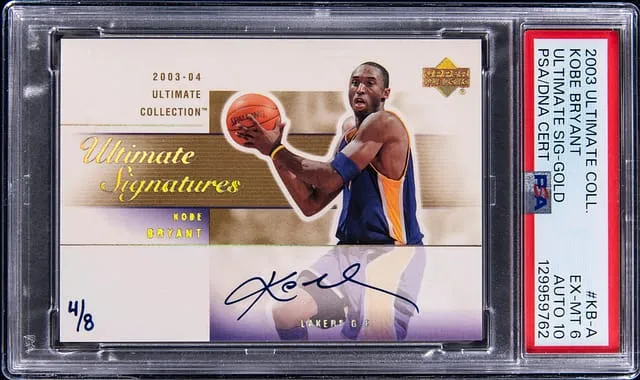
Kobe Bryant 2003-04 Ultimate Signatures Gold Sale
Goldin sold a 2003-04 Ultimate Collection Ultimate Signatures Gold Kobe Bryant /8 PSA 6, auto 10 for $78,383. Here’s what it means for collectors.
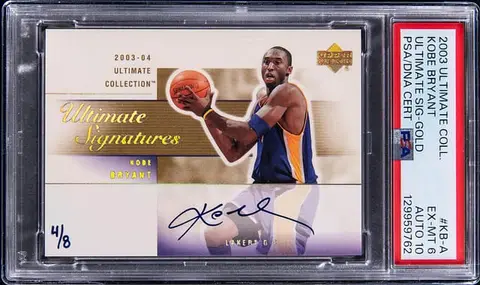
Sold Card
2003-04 Upper Deck Ultimate Collection Ultimate Signatures Gold #KB-A Kobe Bryant Signed Card (#4/8) - PSA EX-MT 6, PSA/DNA GEM MT 10
Sale Price
Platform
Goldin2003-04 Ultimate Signatures Gold Kobe Bryant Sells for $78,383
On April 12, 2026, a key early-2000s Kobe Bryant autograph changed hands at Goldin: a 2003-04 Upper Deck Ultimate Collection Ultimate Signatures Gold #KB-A Kobe Bryant, serial numbered 4/8, graded PSA EX-MT 6 with a PSA/DNA GEM MT 10 autograph. The card realized $78,383.
For collectors who follow on-card autographs and low-serial Kobe issues, this sale is a useful reference point for how the market is currently valuing premium, early-2000s Kobe ink.
Card overview
Let’s break down what this card is and why it matters:
- Player: Kobe Bryant, Los Angeles Lakers
- Year: 2003-04
- Set: Upper Deck Ultimate Collection – Ultimate Signatures insert
- Card: Ultimate Signatures Gold #KB-A
- Parallel: Gold, serial numbered to just 8 copies (#4/8)
- Autograph: On-card (signed directly on the card surface)
- Rookie card? No – this is a post-rookie, veteran-era autograph
- Era: Early 2000s “modern” period
- Grading:
- Card: PSA EX-MT 6 (moderate wear or flaws consistent with an Excellent-Mint card)
- Autograph: PSA/DNA GEM MT 10 (top grade for signature quality)
This is not a rookie card, but it is a scarce, high-end autograph from a premium brand at a time when pack-issued on-card autos were still relatively limited compared with today’s print runs.
Why this Kobe card matters to collectors
1. Ultimate Collection as a brand
Upper Deck’s Ultimate Collection line was positioned as a super-premium product in the early 2000s. Boxes were expensive for the time, print runs were tightly controlled, and the focus was on autographs, memorabilia, and low-serial-numbered content.
Within that context, Ultimate Signatures sat as a centerpiece autograph insert. The Gold parallel, limited to 8 copies, represents one of the tougher chase pieces for serious Kobe collectors who focus on the early high-end autograph era.
2. Low serial numbering and on-card ink
There are only 8 copies of this Gold parallel. For many collectors, that level of scarcity is close to “effectively impossible” to chase in a focused way—most copies sit locked into long-term player collections once they surface.
The autograph is on-card rather than on a sticker. For newer collectors: an on-card auto means the player signed directly on each card, which many hobbyists view as more desirable and organic. In the early 2000s, that was a relatively higher-end feature.
The PSA/DNA GEM MT 10 autograph grade matters here. It signals a clean, bold, well-preserved signature, which can be especially important on darker or glossy surfaces where streaking or fading is common.
3. Kobe’s place in the hobby
Kobe is one of the core long-term pillars of modern basketball collecting, alongside Jordan and LeBron. Within Kobe’s catalog:
- Rookie cards from 1996-97 define the base of his market.
- High-end 1990s inserts and parallels create a separate, very competitive lane.
- Early 2000s premium autographs, like this Ultimate Signatures Gold, act as a bridge between those 1990s grails and modern ultra-premium releases.
As a result, a card like this often appeals to:
- Player collectors building deep Kobe-only collections
- High-end set or insert run builders (Ultimate Signatures, Kobe autograph runs)
- Collectors who want a scarce, on-card Kobe auto without necessarily chasing a 1990s insert grail
Market context and price positioning
This copy sold at Goldin on April 12, 2026 for $78,383.
How to think about comps
In the hobby, “comps” generally means comparable recent sales of the same or closely related cards. For an /8 parallel from 2003-04, true one-to-one comps can be limited simply because the card doesn’t come to market often.
Based on available public information and the general pattern for this type of card:
- Copies of this exact Ultimate Signatures Gold #KB-A /8 surface rarely. When they do, they tend to appear in major auctions rather than fixed-price marketplaces.
- Lower-tier Kobe autos from the same era (higher serial numbering, less premium brands, or sticker autos) typically sell at a noticeable discount to this level, reflecting the difference in scarcity and brand prestige.
- At the top end, iconic 1990s Kobe inserts and super-short-print autos can command significantly more. This Ultimate Signatures Gold sits below the absolute peak Kobe grails, but clearly in the upper tier of his autograph market.
Because there are only 8 copies, condition variation also matters. A PSA 6 card grade might sound modest, but with ultra-low serial-numbered, early 2000s autographs, a strong auto grade and overall eye appeal can matter more than a technical card grade, especially when high-grade examples are scarce or possibly never surface.
How this $78,383 result fits in
Within the broader Kobe auto market, a sale at $78k+ suggests:
- Continued strong demand for scarce, early-2000s, on-card autographs from premium brands.
- Willingness from collectors to prioritize scarcity and autograph quality (GEM MT 10 auto) over having a perfectly high numeric card grade.
From a price-context perspective:
- This sale helps define a band for super-premium but non-rookie Kobe autos from respected early-2000s products.
- It gives collectors and small sellers a reference point when they see other Kobe autographs with similar attributes (low serial numbers, premium brands, on-card autos).
Because so few true copies have sold publicly, it’s difficult to map out a perfectly clean trend line. Instead, it’s more helpful to treat this result as a marker in the broader conversation about early-2000s Kobe autographs rather than as a precise price formula.
Grading details: PSA 6 with PSA/DNA 10 auto
The card received:
- PSA EX-MT 6 for the card
- PSA/DNA GEM MT 10 for the autograph
For newer collectors:
- A PSA 6 typically indicates visible wear—corner or edge wear, minor surface issues, or small print/scratch flaws. On a low-serial, early-2000s card, these can be the result of normal handling or pack-insertion wear.
- A GEM MT 10 autograph suggests a bold, well-centered, non-faded signature with no significant skipping.
In many high-end autograph markets, especially where copies are limited to 10 or less, the auto grade and overall visual appeal often carry as much or more weight than the card’s numeric grade. This sale reflects that pattern: the card still achieved a significant result despite the EX-MT 6 grade.
Where this fits in the Kobe landscape
From a collector’s point of view, this sale underlines a few ongoing themes:
Early-2000s premium remains relevant. While the hobby has seen a wave of ultra-modern, multi-patch, multi-auto, and ultra-high-end releases, there is still sustained interest in the simpler, clean-design, on-card autograph era of the early 2000s.
Scarcity can offset grade. With a print run of 8, collectors often accept less-than-perfect grades if the card is fundamentally tough to replace and the autograph presents well.
Kobe’s signature is a collecting category of its own. Many collectors focus on having at least one high-quality Kobe auto rather than chasing his entire catalog. For that group, cards like this Ultimate Signatures Gold present a compelling combination of brand, scarcity, and presentation.
Takeaways for collectors and small sellers
If you’re active in the Kobe market or considering stepping into this lane, here are a few practical observations drawn from this Goldin sale on April 12, 2026:
- Know your tiers. Not all Kobe autos are equal. Brand (Upper Deck Ultimate Collection, Exquisite, etc.), on-card vs. sticker, serial numbering, and design era can all have a big impact on demand.
- Look at more than the numeric grade. For low-serial autographs, pay attention to auto grade, centering, surface, and overall eye appeal. A PSA/DNA 10 auto can be a major plus.
- Use sales like this as context, not prediction. A $78,383 sale tells you how one serious buyer and the market met on a specific copy at a specific moment. It’s useful information, but not a guarantee of future prices.
For figoca users, this sale is a strong data point to log if you’re tracking Kobe’s autograph market over time. As more results emerge for similar early-2000s Kobe autos, you can start to compare patterns—how Ultimate Collection stacks up against other brands, how the market treats different serial-number ranges, and how much premium a GEM MT 10 autograph can command.
As always, think in terms of what you enjoy collecting first, and use sales like this one from Goldin on April 12, 2026 as reference points rather than targets.