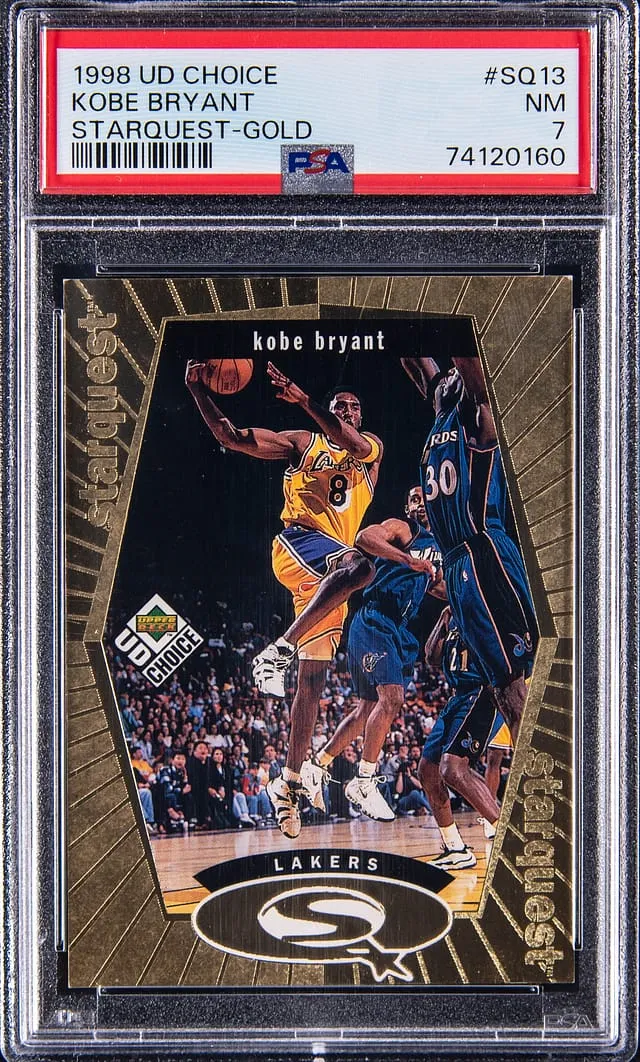
Kobe Bryant 1998-99 Starquest Gold PSA 7 sells for $37K
Figoca looks at the $37,320 Goldin sale of a 1998-99 Upper Deck Choice Starquest Gold Kobe Bryant PSA 7 and what it means for 90s insert collectors.
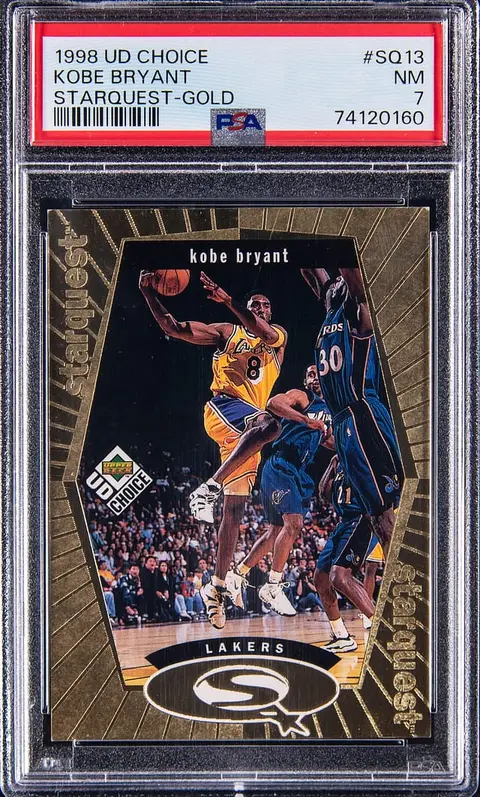
Sold Card
1998-99 Upper Deck Choice Starquest Gold #SQ13 Kobe Bryant (#081/100) - PSA NM 7
Sale Price
Platform
Goldin1998-99 Upper Deck Choice Starquest Gold cards sit in an interesting pocket of 90s basketball: mass-printed base product, but genuinely scarce, pack-pulled parallels. When one of the toughest Kobe Bryant versions surfaces, collectors tend to notice.
On March 15, 2026, Goldin sold a 1998-99 Upper Deck Choice Starquest Gold #SQ13 Kobe Bryant, serial numbered 081/100 and graded PSA NM 7, for $37,320. For a late‑90s insert that originally came from a kid-friendly product, that’s a serious result—and a useful data point for anyone tracking high‑end Kobe markets.
The card at a glance
- Player: Kobe Bryant (Los Angeles Lakers)
- Year: 1998-99
- Product: Upper Deck Choice
- Insert: Starquest Gold
- Card number: SQ13
- Serial number: 081/100
- Grading company: PSA (Professional Sports Authenticator)
- Grade: NM 7 (Near Mint)
- Type: Non-rookie, but a key 90s Kobe insert / parallel
This is the Gold tier of the Starquest run, limited to just 100 copies. It’s not a rookie card—Kobe’s rookie season was 1996-97—but it is a core piece of his 90s insert resume. The Golds are the top of the Starquest hierarchy for that year and are widely treated as a true chase parallel rather than a basic insert.
Why Starquest Gold matters to Kobe collectors
Upper Deck Choice was a lower-price, kid-accessible brand, but the Starquest parallels cut against that low-end feel:
- Serial numbered to 100: In the late 90s, print runs of 100 were legitimately scarce, especially for a mainstream star. Today, that level of serial numbering is still respected for key players.
- Distinct parallel hierarchy: Starquest cards came in multiple colors/tiers. The Gold versions sit at or near the top, meaning they were the toughest to pull and have become the most studied by collectors.
- 90s insert era significance: The late 90s insert and parallel era (from brands like Skybox, Flair, Fleer, and Upper Deck) has become a dedicated collecting lane. Kobe’s second- and third-year high-end inserts are now viewed as important complements to his rookies.
For a lot of collectors, cards like this bridge two worlds:
- The nostalgia of opening low-end 90s products as kids.
- The modern chase for numbered parallels and condition-sensitive, graded copies.
Grading and condition context
PSA’s NM 7 grade means the card presents well but has flaws beyond light wear—typically stronger than a well-loved raw copy, but clearly below the high-end 9 and 10 tiers.
For 90s foil and colored-surface inserts, condition can be tricky:
- Chipping and edge wear are common due to colored borders.
- Corner softness often shows up from pack handling and years of storage.
- Surface scratches can be subtle until the card is under grading lights.
Because the Starquest Golds have a bold, colored design, even small flaws can be noticeable. That’s one reason PSA 9s and 10s tend to command significantly higher prices than lower grades—the visual impact and condition separation is clear.
Population reports (often shortened to “pop reports”) from PSA and other graders show how many copies exist in each grade. While exact figures can change as more cards are submitted, the overall pattern is consistent across 90s inserts: few 10s, relatively few 9s, and a broader spread in the 6–8 range. This makes a PSA 7 a mid-tier graded copy from a condition standpoint, but still attractive to collectors who focus on owning the card rather than chasing the top of the population.
Recent market context for this card
The Goldin result at $37,320 sits in a maturing lane for Kobe’s 90s inserts:
- High-grade Starquest Gold Kobe copies (PSA 9–10 or BGS 9.5) have historically drawn significant attention as “grail-level” 90s parallels.
- Mid-grade copies (like PSA 6–8) have tended to sell at a noticeable discount to those top grades but still well above raw.
Across major marketplaces and auction houses, recent sales of Kobe’s Starquest Gold cards show a few consistent themes:
- Grade matters a lot. The jump from mid-grade to high-grade is not linear; it’s exponential. That’s typical of 90s inserts where condition scarcity is real.
- Insert prestige has solidified. Over the last several years, collectors have increasingly treated key 90s inserts as core pieces of a player’s long-term market, not just side items to rookies.
- Kobe-specific demand is durable. Since his passing, demand for meaningful Kobe issues—rookies, serial-numbered parallels, and iconic inserts—has remained steady, with occasional surges around anniversaries and hobby cycles.
Within that landscape, a PSA 7 selling for $37,320 at Goldin indicates that collectors still place strong value on this card’s combination of:
- True scarcity (only 100 serial-numbered copies)
- 90s-era insert importance
- Kobe’s enduring legacy and global fan base
While auction results can vary based on timing, visibility, and bidder competition, this sale helps re-anchor expectations for mid-grade, serial-numbered 90s Kobe inserts in a premier marketplace setting.
Comparing across grades and parallels
When thinking about price context (often called “comps”—short for comparables), it helps to look beyond this exact card:
- Same card, higher grade: PSA 9 and PSA 10 copies of this Starquest Gold Kobe have historically sold at a multiple of mid-grade results. In some cases, the spread between a 7 and a 9 can be several times the price, reflecting both condition scarcity and registry competition.
- Same insert, different players: Lower-tier stars or role players in the same Starquest Gold set sell for a fraction of Kobe’s level. This underlines how much of the value is tied to player importance.
- Other key 90s Kobe inserts: Cards such as PMGs, Essential Credentials, and high-end Flair or Skybox inserts can sit above, alongside, or slightly below Starquest Golds depending on rarity, design history, and condition.
The throughline is that numbered, 90s-era Kobe parallels and inserts with strong visual identity have solidified as a distinct collecting category.
Era and hobby significance
The 1998-99 season falls into what many collectors call the late 90s “insert and parallel boom.” A few features of this era matter for understanding this sale:
- Not junk wax. While some 90s products were printed heavily, the specific serial-numbered parallels—especially under 250 copies—are genuinely scarce.
- Design experimentation. Card companies were pushing foils, colors, die-cuts, and numbering, laying the groundwork for today’s parallel-heavy releases.
- Kobe’s early prime. By 1998-99, Kobe was no longer just a promising youngster—he was rapidly becoming the face of the Lakers’ future. Cards from this window capture that transition.
Collectors who came back to the hobby after years away often remember opening packs during these seasons. Finding out that a card like Starquest Gold Kobe is now a strong five-figure piece can be both surprising and a reminder of how much the hobby has evolved.
Why this Goldin sale matters
This specific sale, through Goldin on March 15, 2026, is useful to watch for a few reasons:
- Clear, public benchmark. High-visibility auction houses create price references that many buyers and sellers refer back to when negotiating.
- Mid-grade clarity. With headline coverage often focused on gem-mint copies, a PSA 7 sale at this level helps refine expectations for collectors considering mid-grade examples.
- Reaffirmation of 90s insert demand. Each strong result for a 1990s, serial-numbered insert helps support the broader idea that these cards are not a passing trend but a core lane of modern collecting.
At the same time, it’s important to remember:
- Auction outcomes can swing up or down depending on who shows up to bid on a given night.
- Single results shouldn’t be read as guarantees; they’re data points in an evolving market.
Takeaways for collectors and small sellers
If you’re a collector or small seller watching this space, here are a few practical angles:
- Know your parallels. Understanding where Starquest Gold fits in the Upper Deck hierarchy (top-tier, numbered to 100) is essential before you compare it to non-numbered inserts or lower parallels.
- Check grading and surfaces. For 90s colored-foil cards, closely inspect edges, corners, and surface before submitting for grading. Small flaws can push a card from gem-mint to mid-grade.
- Use multiple comps, not just one sale. This Goldin result is a meaningful data point, but pairing it with other recent sales—across grades and platforms—gives a deeper view of where the card tends to land.
- Match your goals to the card. Some collectors chase the highest grade they can afford; others just want to own an example of an important card, regardless of grade. A PSA 7 can be a more accessible way to participate in a truly scarce insert.
The March 15, 2026 Goldin sale of the 1998-99 Upper Deck Choice Starquest Gold #SQ13 Kobe Bryant PSA 7 at $37,320 underlines how far 90s inserts have come from their origins. For many in the hobby, it’s both a market signal and a reminder of why these cards captured our attention in the first place.