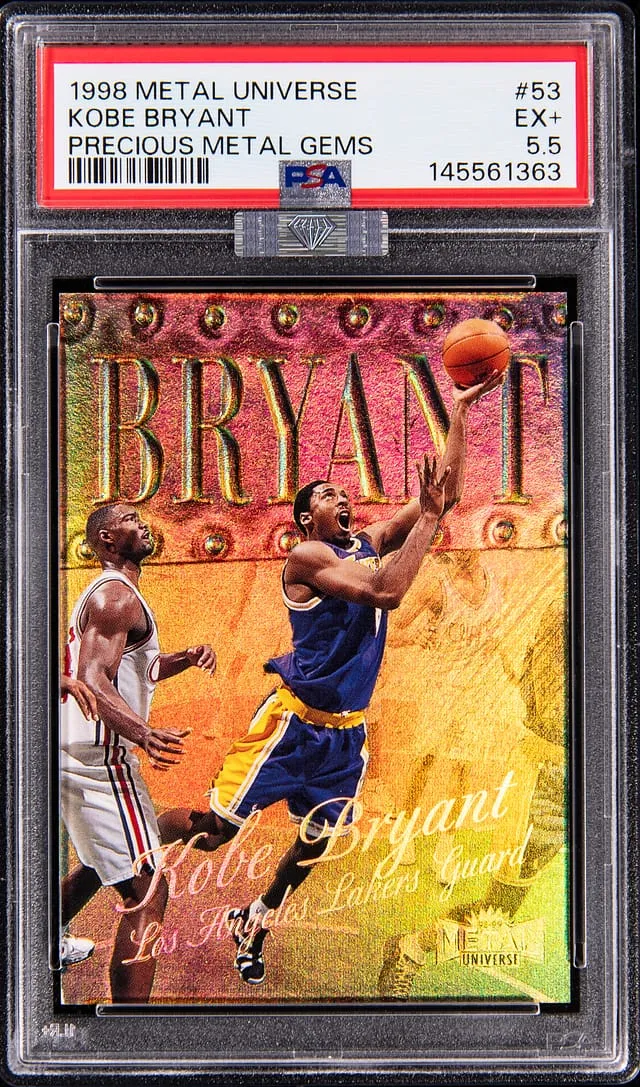
Kobe Bryant 1998-99 PMG PSA 5.5 sells for $80K
Deep dive on the $80,520 Goldin sale of the 1998-99 SkyBox Metal Universe PMG #53 Kobe Bryant PSA 5.5, MBA Silver Diamond Certified.
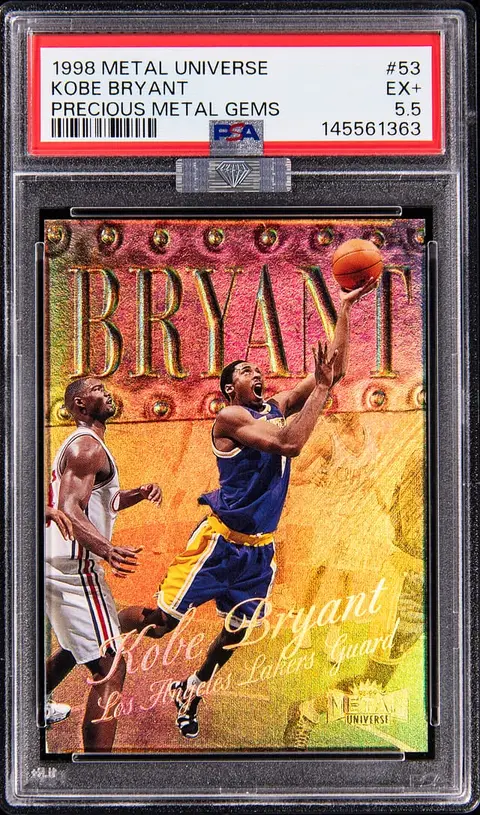
Sold Card
1998-99 SkyBox Metal Universe Precious Metal Gems (PMG) #53 Kobe Bryant (#03/50) - PSA EX+ 5.5 - MBA Silver Diamond Certified
Sale Price
Platform
Goldin1998-99 SkyBox Metal Universe Precious Metal Gems (PMG) #53 Kobe Bryant (#03/50) in PSA EX+ 5.5 with MBA Silver Diamond Certification is a card that sits at the crossroads of 1990s insert history and modern high-end collecting.
On March 8, 2026, Goldin auctioned this copy for $80,520, a meaningful data point for one of Kobe’s most respected 1990s parallels.
Card overview
- Player: Kobe Bryant
- Team: Los Angeles Lakers
- Year: 1998-99
- Set: SkyBox Metal Universe
- Insert/parallel: Precious Metal Gems (PMG)
- Card number: #53
- Serial number: #03/50
- Rookie?: No – this is a key late-90s insert, not a rookie card
- Era: 1990s insert / PMG era (post-“junk wax”)
- Grading company: PSA
- Grade: EX+ 5.5
- Additional certification: MBA Silver Diamond Certified (MBA authenticates and evaluates eye appeal)
This is a low-serial-number parallel from one of the most studied and chased insert lines in basketball: Precious Metal Gems. While Kobe’s 1997-98 PMGs are usually the hobby headliners, the 1998-99 Metal Universe PMG run still sits firmly in the “grail” category for many Kobe and 90s collectors.
Why this card matters to collectors
1. The PMG lineage
Precious Metal Gems inserts were introduced in 1997-98 Metal Universe. They helped define what we now think of as premium, low-serial, colored parallels.
Key reasons collectors care:
- Short print: Just 50 copies of this 1998-99 Kobe PMG exist. In a pre-ultra-modern era, production numbers were lower to begin with, and many cards were lost, damaged, or never graded.
- Design and brand history: Metal Universe is known for its bold, futuristic backgrounds. PMGs layer a vivid foil color treatment over that, giving them a distinct look that still influences modern parallels.
- PMG brand equity: When collectors discuss the “pillars” of 90s basketball inserts, PMGs almost always come up alongside essential sets like Jambalaya, Credentials, and Essential Credentials.
2. Kobe’s 90s insert profile
Kobe Bryant’s 1996-97 rookie cards get a lot of attention, but serious player collectors often point to his 1997-2000 inserts and parallels as the truest test of a high-end Kobe collection.
Within that world, PMG is one of the most recognizable names. While later PMG-branded releases exist, the 1997-98 and 1998-99 Metal Universe-era cards carry the most historical weight.
This 1998-99 issue is not a rookie, but it is:
- A prime-era Kobe card — just before his early-2000s championship run with the Lakers.
- Part of a low-numbered, condition-sensitive run from a set that is already difficult to find centered and clean.
3. Condition and MBA eye appeal
This copy is graded PSA EX+ 5.5, which, on the surface, is a mid-grade. For many ultra-modern releases, a 5.5 would be viewed as heavily flawed.
With 90s PMGs, the conversation is different:
- Foil chipping and edge wear: PMGs are notorious for flaking and color loss along the edges and surfaces. Even pack-fresh examples could show issues.
- Low surviving population: When serial numbering starts at 50, the long-term census (or “pop report,” which is the tally of graded copies across grades) is naturally thin.
MBA’s Silver Diamond certification adds another layer. MBA (Mike Baker Authenticated) evaluates eye appeal within a given numeric grade. A Silver Diamond tag indicates that, in their view, the card looks stronger than a typical example in that grade range. For 90s PMGs, where small print defects can drive the numeric grade down, eye appeal can matter significantly to collectors.
Market context and price positioning
This card sold at Goldin on March 8, 2026 for $80,520.
How to think about comps
In the hobby, “comps” are recent comparable sales that collectors use to gauge where a card’s current market range might sit. For a card like this, perfect comps can be rare:
- Serial numbering is limited to just 50 copies.
- Condition varies a lot from copy to copy, especially with heavy-foil 90s stock.
- Eye appeal and centering can swing prices inside the same numeric grade.
Public sales data over the last few years for 1998-99 Kobe PMGs appears relatively thin compared with his more famous 1997-98 PMG runs and major rookie cards. When these do show up, they often:
- Surface in a range of mid grades (PSA 4–6, BGS equivalents) because of typical PMG condition challenges.
- Trade infrequently enough that each auction becomes a sort of “checkpoint” for updated pricing, rather than just another routine sale.
Within that context, an $80,520 result in PSA 5.5 with MBA Silver Diamond suggests the market is still assigning strong value to:
- Low-serial, 90s era, non-rookie Kobe parallels.
- PMGs specifically, even outside the headline 1997-98 releases.
- Eye appeal certifications layered on top of standard grading.
Rather than reading this as a lone outlier, it’s more helpful to view it as one of a small set of recent benchmarks that map how collectors currently prioritize:
PMG branding + Kobe + low serial number + presentable eye appeal.
Where this fits in the Kobe and PMG hierarchies
Within Kobe’s broader card market, this card sits in a niche that appeals mostly to:
- 90s insert specialists who chase PMGs, Credentials, Jambalaya, and similar lines.
- Kobe-focused collectors building lane-specific registries or personal collections centered on rare parallels.
- Set and run builders who target PMGs across players or years, not just superstars.
Against the absolute top of the Kobe ladder (premier rookies, 1997-98 PMGs, key low-number autos), this 1998-99 PMG will generally occupy a secondary tier. But inside the 90s insert niche, it is still one of the more recognizable and important non-rookie parallels he has.
This is also a reminder that the PMG conversation is larger than a single year. As collectors continue to refine their focus from broad “Kobe collecting” into narrower lanes (by year, insert family, or color/serial combinations), cards like this 1998-99 PMG become reference points for how deep a collection actually goes.
Takeaways for collectors and small sellers
A few practical notes if you’re navigating cards like this:
- Expect limited pricing history. With only 50 copies in existence, exact comps will be spaced out over years, not months. Each auction can meaningfully shift the perceived range.
- Look beyond the grade. For 90s PMGs, corners, edges, and foil chipping are often the story. A mid-grade with strong color and clean presentation can be more desirable than a slightly higher numeric grade with obvious flaws.
- Understand set positioning. PMGs are not just another parallel line from the late 90s; they helped define what “high-end” looked like for that era. Even non-rookie, non-auto PMGs can command serious attention when paired with all-time greats.
- Context matters more than hype. Instead of treating an $80,520 sale as a prediction of what every Kobe PMG will do, it’s more useful to see it as one organized data point for this specific: year, set, player, serial numbering, grade, and eye appeal tier.
For anyone returning to the hobby or trying to understand why certain 90s inserts sit in a different price bracket, this Goldin sale on March 8, 2026 is a compact case study. It blends low print runs, brand history, player legacy, grading nuance, and eye appeal into a single card – and shows how the market is currently valuing that combination.