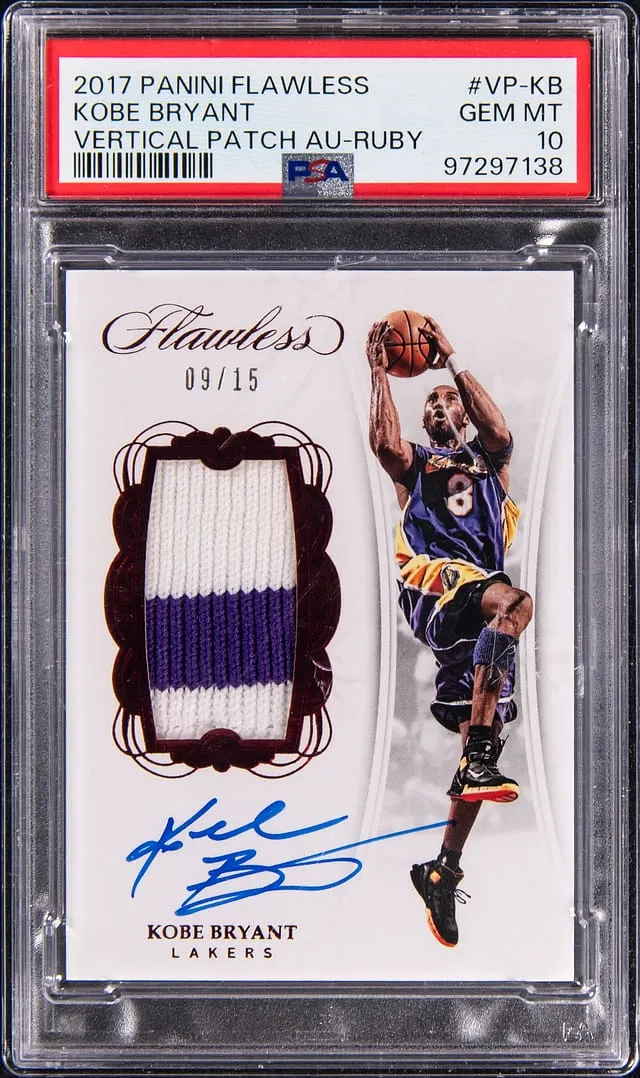
Kobe 2017-18 Flawless Ruby Patch Auto PSA 10 Sale
Goldin sold a 2017-18 Panini Flawless Ruby Kobe Bryant Vertical Patch Auto PSA 10 Pop 1 for $54,900 on March 8, 2026. Here’s the price context.
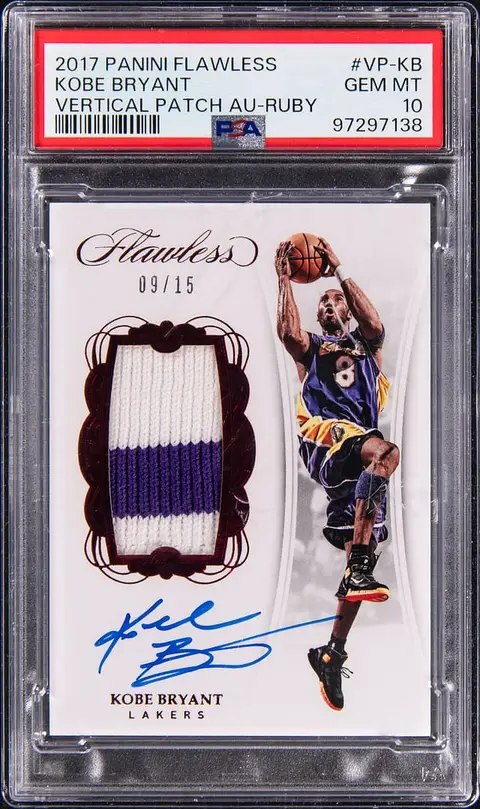
Sold Card
2017-18 Panini Flawless Vertical Patch Autographs Ruby #VP-KB Kobe Bryant Signed Game-Used Patch Card (#09/15) - PSA GEM MT 10 - Pop 1
Sale Price
Platform
Goldin2017-18 Panini Flawless Vertical Patch Autographs Ruby #VP-KB Kobe Bryant Signed Game-Used Patch Card (#09/15) - PSA GEM MT 10 - Pop 1 Sold for $54,900
On March 8, 2026, Goldin quietly closed a significant modern Kobe Bryant sale: a 2017-18 Panini Flawless Vertical Patch Autographs Ruby #VP-KB, serial numbered 09/15, graded PSA GEM MT 10 and labeled Pop 1, realized $54,900.
For a late-career, non-rookie Kobe, this is an important data point. Below, we’ll walk through what this card is, why collectors care, and how this sale fits into the broader Kobe high-end market.
Card Breakdown: What Exactly Sold?
Card details
- Player: Kobe Bryant
- Team: Los Angeles Lakers
- Year: 2017-18
- Product: Panini Flawless Basketball
- Insert: Vertical Patch Autographs
- Parallel: Ruby
- Card number: #VP-KB
- Serial number: 09/15
- Patch: Game-used memorabilia
- Autograph: On-card (signed directly on the card, not a sticker)
Grading details
- Grading company: PSA (Professional Sports Authenticator)
- Grade: GEM MT 10 (their highest standard grade)
- Population: Pop 1 (only one copy has achieved PSA 10 as of this sale)
This is not a rookie card, but it is a high-end, low-serial-number autograph patch from one of Panini’s flagship premium products. Flawless is typically positioned at the very top of Panini’s basketball line, with metal briefcase packaging, factory-sealed encased cards, and a heavy focus on patches and autographs.
The card checks several premium boxes at once:
- Game-used patch: Collectors generally place higher value on game-used material versus player-worn or event-worn.
- Hard-signed autograph: The autograph is on-card, which is usually preferred over sticker autos from a long-term collectability perspective.
- Low serial number (/15): Only 15 copies of the Ruby parallel exist.
- Gem Mint in a tough brand: Flawless patch autos often have thicker stock and foil, which can make Gem Mint grades relatively scarce.
Why 2017-18 Flawless Matters for Kobe Collectors
2017-18 Flawless is a post-retirement era product for Kobe. By this point, Kobe had already completed his Lakers career and his status as a franchise icon was fully cemented.
Key points about this set from a collector’s view:
Late-career, premium autograph content
Kobe’s earlier autograph issues from the 2000s and early 2010s span multiple brands and tiers. Flawless, however, sits firmly in the ultra-premium lane. It has fewer overall cards but a relatively high percentage of them are premium autographs and patches.Vertical Patch Autographs as a core chase
Within Flawless, Vertical Patch Autographs are a recognizable design family. They combine a large vertical patch window with a clean autograph area, making them a key chase for player collectors and set builders. Ruby is typically one of the mid-to-low print run color parallels, sitting underneath 1/1s (like Black or Platinum) and often below Emeralds, but still clearly a short print.Post-career Kobe auto scarcity dynamics
With Kobe’s tragic passing in 2020, the supply of on-card, licensed Kobe autographs is permanently fixed. High-end, game-used, on-card autograph products from Panini-era premium sets have become long-term targets for serious collectors who want late-career representation without chasing his earliest, sometimes condition-sensitive issues.
Population and Grade: Why Pop 1 PSA 10 Matters
“Pop report” (population report) refers to how many copies of a specific card have received each grade from a grading company. A Pop 1 PSA 10 means only one copy, as of this sale, has ever been graded Gem Mint 10 by PSA.
For a thick, patch-autograph card like this, a PSA 10 is far from guaranteed. Corners, edges, and surface issues are common:
- Edge chipping on colored foil borders.
- Corner wear from the thicker card stock.
- Surface dimples or print lines in areas with heavy foil or holo treatment.
When there are only 15 total Ruby copies to begin with, and only a portion of those ever get submitted to PSA, a Pop 1 Gem Mint grade becomes a defining feature. For some collectors, this makes the card effectively a “1 of 1” at the top of the grading scale, even though 14 other serial-numbered copies exist.
Market Context: Where Does $54,900 Fit?
This Goldin sale closed at $54,900 on March 8, 2026.
When looking at “comps” (recent comparable sales used for price context), collectors typically look at:
- The same exact card and parallel in different grades.
- The same card in different parallels (e.g., Emerald, Sapphire, Diamond).
- Similar-era Kobe Flawless patch autos with comparable serial numbering.
Because this is a Pop 1 PSA 10, direct apples-to-apples comps are often limited. Market behavior for ultra-low-pop, modern high-end Kobe tends to show a wide band of realized prices depending on:
- Serial number (e.g., jersey number copies often draw premiums).
- Patch quality (multi-color, visible stitching, or logo elements).
- Auction timing and platform (major events, seasonal cycles).
Within this context, a sale near the mid–five-figure range places this card among the higher tier of Kobe’s modern, post-playing-day premium issues, but usually still below:
- His iconic 1996-97 rookie autos and key parallels in high grade.
- Unique 1/1 Logoman or shield-style patch autos from premium releases.
In other words, this result is strong but not in the historical record-setting category. It fits the pattern of serious collectors and investors competing over the best-graded, low-serial, on-card patch autos from premium brands.
Factors Likely Supporting This Result
From a collector-to-collector standpoint, several forces are working in favor of a sale like this:
Consolidation into fewer, higher-quality pieces
Many experienced collectors have been gradually consolidating out of mid-tier inserts and base parallels into fewer, more significant pieces: on-card autos, game-used patches, and low-serial cards. This Kobe checks all of those boxes.PSA 10 and Pop 1 status
In the current hobby landscape, top population grades on premium cards tend to attract outsized attention. When a Pop 1 surfaces on a major platform like Goldin, that’s often seen as the benchmark-setting sale until another copy in the same grade appears—if it ever does.Kobe’s enduring collector base
Kobe has one of the most globally distributed collector bases of any modern NBA player. High-end Kobe cards see demand from U.S., Asian, and European buyers. That global demand can help sustain competition at auction, especially when the piece is clearly positioned as a long-term “centerpiece” type card.
What This Means for Collectors and Small Sellers
For active hobbyists and small sellers, a sale like this doesn’t mean every Kobe card suddenly jumps. But it does offer some useful takeaways:
Quality over quantity: High-end, low-serial, on-card auto patch cards from respected products continue to command strong results relative to lower-tier inserts and base parallels, even when the player is already established.
Pop reports matter most at the top: Population data is particularly influential at the single highest grade level (PSA 10, BGS 9.5/10, etc.). A Pop 1 can create a competitive bidding environment in a way that a more plentiful grade might not.
Late-career doesn’t mean “less important”: While rookies are often the headline pieces, late-career or post-retirement autos from premium brands can become key long-term holdings, especially when rookie content is already tightly held or out of reach price-wise.
Auction house and timing: Major auction houses like Goldin can help surface serious buyers for one-of-a-kind grade examples. Timing around hobby events, market sentiment, and player news can also shape the final hammer price, even for already-iconic players like Kobe.
Final Thoughts
The $54,900 sale of the 2017-18 Panini Flawless Vertical Patch Autographs Ruby #VP-KB Kobe Bryant, PSA GEM MT 10 (Pop 1), at Goldin on March 8, 2026, is another data point in the ongoing story of high-end Kobe collecting.
It illustrates how the market continues to differentiate between:
- Standard inserts or base parallels, and
- True premium, low-pop, game-used, on-card autograph content from respected brands.
For collectors, this card sits at the intersection of late-career Kobe nostalgia, Panini-era premium design, and grading scarcity. Whether you’re building a Kobe PC, exploring Flawless for the first time, or simply tracking modern basketball’s upper tier, this sale helps define where top-level Kobe patch autos are currently landing in the market.
As always, these results are best viewed as part of a broader pattern rather than a price guarantee. But for this specific card and grade, the Goldin sale now serves as a clear reference point going forward.