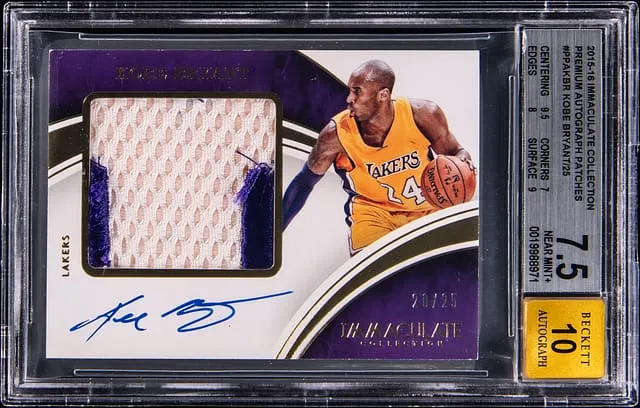
Kobe 2015-16 Immaculate Patch Auto Sells for $17.9K
Goldin sold a 2015-16 Immaculate Premium Patch Auto Kobe Bryant /25 (BGS 7.5, 10 auto) for $17,879. See how this result fits Kobe’s high-end card market.
Sold Card
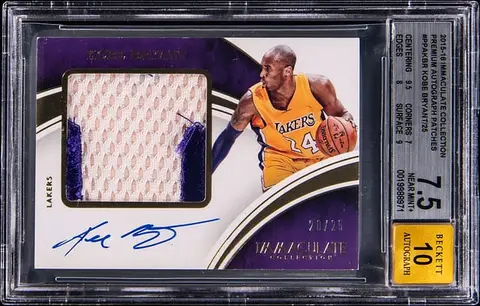
2015-16 Panini Immaculate Collection Premium Autograph Patches #PPA-KBR Kobe Bryant Signed Patch Card (#20/25) - BGS NM+ 7.5, Beckett 10
Sale Price
Platform
Goldin2015-16 Immaculate Premium Patch Auto Kobe Bryant Sells for $17,879
On June 7, 2026, Goldin closed the sale of a key modern Kobe Bryant card: a 2015-16 Panini Immaculate Collection Premium Autograph Patches #PPA-KBR, serial numbered 20/25, graded BGS NM+ 7.5 with a Beckett 10 autograph. The final price was $17,879.
For collectors who focus on high-end Kobe or 2010s patch autos, this is an important data point. Let’s break down what this card is, why it matters, and how this sale fits into the broader market.
Card overview
- Player: Kobe Bryant
- Team: Los Angeles Lakers
- Year: 2015-16
- Set: Panini Immaculate Collection – Premium Autograph Patches
- Card number: #PPA-KBR
- Serial numbering: 20/25 (only 25 copies made)
- Autograph: On-card (signed directly on the card), graded 10 by Beckett
- Memorabilia: Multicolor patch (game-worn or player-worn depending on Panini’s 2015-16 wording)
- Grading company: Beckett Grading Services (BGS)
- Card grade: 7.5 (NM+)
- Era: Modern / late playing-career Kobe (not a rookie, not a debut issue)
This is a premium, low-print-run autograph patch from one of Panini’s top-tier NBA products. While it’s not a rookie card, it occupies the lane of “high-end, on-card autograph with a substantial patch” that has become a core category for modern star and legend collectors.
Why this card matters to Kobe collectors
- Immaculate as a brand
Panini Immaculate Collection sits in the upper tier of modern basketball releases, alongside products like National Treasures and Flawless. It’s known for:
- On-card autographs (players sign directly on the card, not on a sticker).
- Large, visually prominent patches.
- Low serial-numbered premium inserts.
Within Immaculate, “Premium Autograph Patches” is one of the more desirable autograph subsets. For Kobe, on-card autos in premium Panini sets are a major collecting lane, especially after his passing in 2020 when the supply of future Kobe autographs became fixed.
- Autograph and patch combination
For many modern-era collectors, the ideal non-rookie card combines:
- A clean, on-card signature.
- A multicolor or visually strong patch.
- A low serial number.
This card checks all three boxes. Even with a BGS 7.5 card grade, the Beckett 10 auto confirms that the signature itself is strong by hobby standards—no major streaking, fading, or smudging.
- Scarcity and serial numbering
At /25, this is a relatively scarce card in the context of modern production. It isn’t a one-of-one, but it’s far from mass-printed. For premium patch autos, many Kobe collectors are comfortable with mid-double-digit serial numbers when the design and on-card auto are strong.
- Late-career snapshot
This is a late-career issue (2015-16), aligning with Kobe’s final season and farewell tour. While his flagship rookies from the 1996-97 era remain the foundational pieces, a subset of collectors specifically chase high-end, late-career autographs and patches as a way to commemorate his full legacy.
Market context and recent comps
Because this is a relatively low-print-run card, exact comps (comparable recent sales of the same card and grade) are often sparse. For cards like this, collectors and sellers typically look at a combination of:
- Same card, different grades or raw (ungraded) condition.
- Other Kobe Immaculate Premium Patch Autos from nearby years.
- Equivalent-caliber Kobe patch autos from National Treasures or Flawless.
Within that framework, here are useful context points for a sale like this:
- Impact of the grade
A BGS 7.5 is below what most modern collectors consider “investment-grade” condition for a premium card. For modern era, that usually means BGS 9 / PSA 9 (Mint) or better. Still, for thick patch-autograph cards, lower grades are more common because of:
- Corner chipping on thicker stock.
- Edge wear and surface indentations from patch windows or autograph areas.
In premium patch autos, some collectors de-emphasize the card grade relative to the autograph and eye appeal. A strong auto grade (Beckett 10) and a clean, well-centered patch can keep demand healthy even at 7.5.
- How $17,879 fits into the picture
The $17,879 price realized at Goldin on June 7, 2026, sits in the zone where:
- Top-tier Kobe rookie cards in high grades trade regularly.
- Non-rookie Kobe patch autos from premier brands command meaningful, but highly variable, premiums depending on serial, patch quality, and auto.
When comparing to other Kobe Immaculate /25-style patch autos, it’s common to see:
- Strong eye appeal and higher grades driving significantly higher prices.
- Weaker centering, corners, or surfaces (reflected in 7–8 range grades) leading to discounts.
In that context, this sale appears consistent with the idea that collectors are willing to pay up for:
- A true premium brand (Immaculate).
- On-card auto with a 10 auto grade.
- Low serial numbering.
- Kobe’s status as a core, long-term hobby cornerstone.
If you track Kobe’s market, this sale doesn’t represent a wild outlier; instead, it’s a solid reference point for how a visually strong, but technically lower-graded, premium patch auto can perform.
- What to watch for in future sales
For this specific card and closely related Immaculate Kobe autos, some useful markers going forward are:
- Higher-grade examples (BGS 8.5/9 or PSA 9/10): These will help define the premium that condition commands over a 7.5.
- Alternative parallels / print runs: Similar Premium Patch Autos at /10, /5, or 1/1 can establish a tiered price structure.
- Other 2015-16 Immaculate Kobe autos: Horizontal/vertical variations and other autograph subsets will give a broader view of how collectors value this specific season and design.
Collector significance beyond price
- Not a rookie—but still a key lane
This card is not a rookie, and for long-term set builders or historians, rookie cards often sit at the top of the pyramid. However, for Kobe specifically, there are parallel collector lanes that have matured over the last decade:
- 1996-97 rookies (Topps Chrome, Finest, SkyBox E-X2000, etc.).
- 2000s-era game-used autograph cards.
- 2010s premium Panini patch autos and on-card autographs.
The 2015-16 Immaculate Premium Autograph Patches card fits comfortably into that third lane as a high-end, late-career on-card auto with patch.
- Immaculate and the culture of “RPA-style” cards
In basketball, the term “RPA” (Rookie Patch Autograph) is usually reserved for specific rookie issues—commonly from National Treasures and similar high-end products.
While this Kobe isn’t an RPA, it borrows many of the same design elements that RPA collectors care about:
- Large patch window.
- On-card auto.
- Low serial numbering.
Because of that, this card tends to appeal not just to “Kobe-only” collectors, but also to people who chase RPA-style layouts across star players.
- Fixed autograph supply
After Kobe’s passing, the hobby collectively recognized that the supply of new, pack-pulled Kobe autographs is effectively capped. That doesn’t mean every Kobe auto rises in lockstep; demand is still nuanced, and design, brand, and scarcity matter.
However, it does mean that:
- Well-designed, on-card autos from high-end brands carry a structural appeal.
- Patch autos in strong sets like Immaculate sit in a relatively stable, focused demand lane.
In that context, the Goldin sale of this 2015-16 Immaculate Premium Autograph Patch is part of the ongoing process of the market “re-pricing” and sorting which Kobe autos become long-term reference points.
Key takeaways for collectors and small sellers
- Don’t ignore the auto grade
On premium patch autos, the autograph grade can be as important to many buyers as the card grade—sometimes more. A BGS 7.5 with a 10 auto, like this one, can be more attractive than an 8 or 8.5 with a weaker auto, especially for display-focused collectors.
- Eye appeal still rules
Even in the mid-7s, a card that:
- Presents well on the front.
- Has a strong, centered patch.
- Shows a clean signature.
can compete with higher numeric grades in terms of buyer interest. When you look at sales like this, try to find images and judge eye appeal, not just the label.
- Comps for low-pop, low-serial cards will always be thin
For ultra-modern base cards, there might be dozens of sales to use as “comps” (recent comparable sales used as price reference). For a /25 Immaculate Kobe patch auto, that’s rarely the case.
Instead of hunting for a perfect one-to-one comp, many serious buyers and sellers look at:
- The broader category (Kobe Immaculate autos, Kobe patch autos from National Treasures/Flawless).
- The serial number tier (/25 vs /10 vs /5 vs 1/1).
- The brand hierarchy (Immaculate vs mid-tier Panini products).
- Auction houses as price discovery tools
Large auction houses like Goldin often serve as price discovery venues for scarce, high-end cards. The $17,879 result on June 7, 2026, gives the market a public, time-stamped data point for this specific card and condition.
For collectors tracking Kobe’s premium autos or considering a sale of similar material, documented auction results like this are useful reference markers—especially when evaluating offers in private deals or on fixed-price marketplaces.
How this sale fits into Kobe’s long-term market story
Kobe Bryant’s market has been one of the most closely watched segments in modern basketball cards. The trajectory has gone through a few distinct phases:
- Pre-2020: Strong, steadily maturing interest centered primarily on 1996-97 rookies and select early autos.
- 2020–2021 boom: A sharp increase in prices across many Kobe cards, from rookies to modern autos and parallels.
- Post-boom normalization: A sorting period where core cards (iconic rookies, premium on-card autos from elite brands) separated from more speculative or overprinted issues.
Sales like this 2015-16 Immaculate Premium Autograph Patch at $17,879 are part of that normalization phase. They show that:
- High-end, non-rookie Kobe autos can sustain strong demand.
- Brand, design, and scarcity still matter more than pure age.
- Condition is important, but in thick-stock patch autos, it is weighed alongside autograph quality and eye appeal.
For collectors, the lesson is less about chasing a specific number and more about understanding the structure of the Kobe market:
- Rookies are foundational.
- Premium on-card autos from elite sets are long-term centerpieces.
- Within that category, serial numbering, patch quality, autograph grade, and brand all play a role in how the market responds.
Final thoughts
The Goldin sale on June 7, 2026, of the 2015-16 Panini Immaculate Collection Premium Autograph Patches #PPA-KBR Kobe Bryant, numbered 20/25 and graded BGS 7.5 with a Beckett 10 auto, at $17,879 is a clear signal of continued, focused demand for high-end Kobe patch autographs.
For Kobe collectors, it’s another data point in building out the hierarchy of his modern autos. For broader hobby participants, it’s a reminder that even in a more mature, data-aware market, truly premium designs from strong brands continue to command attention—regardless of whether they’re rookie-year issues.
As always, this information is for hobby context only, not financial advice. If you’re buying or selling, it’s worth pairing public auction results like this with careful card-by-card evaluation of condition, eye appeal, and personal collecting goals.