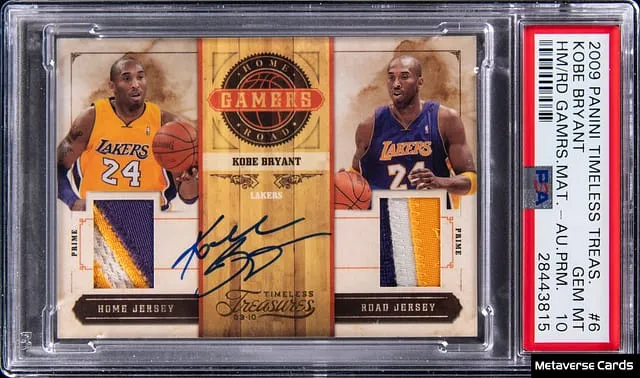
Kobe 2009 Timeless Treasures Patch Auto Sells for $22K
Deep dive on the $22,265 sale of a 2009-10 Timeless Treasures Kobe Bryant signed patch /10, PSA 10 Pop 1, sold by Goldin on March 15, 2026.
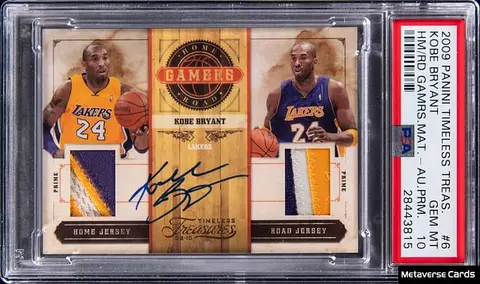
Sold Card
2009-10 Panini Timeless Treasures Home & Road Gamers Materials #6 Kobe Bryant Signed Patch Card (#08/10) - Jersey Number - PSA GEM MT 10 - Pop 1
Sale Price
Platform
GoldinA low-population Kobe Bryant patch auto from the late 2000s just quietly set an important data point for high-end collectors.
On March 15, 2026, Goldin sold a 2009-10 Panini Timeless Treasures Home & Road Gamers Materials #6 Kobe Bryant Signed Patch Card for $22,265. The card is serial-numbered 08/10, matches Kobe’s jersey number, and received a PSA GEM MT 10 grade. According to PSA’s population report at the time of this writing, this copy is a Pop 1 in that grade.
Below, we’ll break down what this card is, why it matters, and how this sale fits into the broader Kobe market.
Card overview: what exactly sold?
Key details
- Player: Kobe Bryant (Los Angeles Lakers)
- Year: 2009-10
- Set: Panini Timeless Treasures
- Insert/Subset: Home & Road Gamers Materials
- Card number: #6
- Features: Signed patch card (autograph plus multi-color game-used memorabilia)
- Serial numbering: 08/10 (jersey number match)
- Grading company: PSA
- Grade: GEM MT 10
- Population: PSA Pop 1 in this grade
- Auction house: Goldin
- Sale date (UTC): March 15, 2026
- Sale price: $22,265 USD
This is not a rookie card—Kobe’s rookie year is 1996-97—but it is a high-end autograph patch from Panini’s early NBA license era. Timeless Treasures in 2009-10 sat in the mid-to-high-end lane, positioned as a product focused on autographs, memorabilia, and low-serial-numbered hits rather than large base sets.
The “Home & Road Gamers Materials” subset combined a game-used jersey patch with an on-card signature (signed directly on the card surface rather than on a sticker). With only 10 copies of this specific version produced, it is already a scarce issue. The fact that this particular copy is numbered 08/10—Kobe’s jersey number with the Lakers—adds another layer of desirability for many collectors.
Why this card matters to collectors
1. Early Panini-era Kobe patch auto
2009-10 marked Panini’s first season holding the NBA trading card license. That shift from Topps/Upper Deck to Panini is a dividing line in modern basketball cards. Cards like this Timeless Treasures patch auto sit at the start of Panini’s long run of Kobe content.
For collectors who focus on:
- Key eras (first-year Panini NBA cards), or
- Kobe’s game-used autograph portfolio across brands,
this card hits both checkboxes. It’s not as historically foundational as his 1996-97 rookie issues, but it’s part of an important transition point in the hobby.
2. Low serial number plus “jersey number” copy
Cards numbered to 10 are already in the high-end, low-supply tier. Within that small print run, certain serial numbers often receive extra attention, especially:
- 1/1 (one-of-one)
- 1st or last in the print run (e.g., 01/10 or 10/10)
- Jersey-number matches (in this case, 08/10 for Kobe’s No. 8 era, or 24 on other issues)
This copy is numbered 08/10, which many collectors treat as a premium nuance for Kobe. While not everyone values serial numbers the same way, there is consistent evidence across multiple players that “jersey number” copies can command a noticeable premium versus other serials from the same run.
3. PSA GEM MT 10 and population data
A population report (often shortened to “pop report”) is a grading company’s public count of how many copies of a card they have graded at each grade level. According to PSA’s data, this Kobe is a Pop 1 as a PSA 10 at the time of this sale.
For modern and ultra-modern cards, PSA 10s can be common if the card stock is forgiving and many copies are submitted. That’s not always the case with thick, patch-based autograph cards like this one. These cards are prone to:
- Edge and corner chipping
- Surface scratches
- Problems around the patch window
All of that makes GEM MT 10 copies tougher and more meaningful when they do appear.
In other words, you’re not just looking at a card limited to 10 copies—you’re looking at the only one (so far) in PSA’s top grade.
4. Kobe’s long-term collector profile
Kobe is firmly in the “all-time great” category, and his market behaves differently from active-player speculation. Key traits that shape demand:
- Five NBA championships
- Global fanbase, especially in the U.S. and Asia
- Strong presence across late-1990s and 2000s insert and parallel sets
- Ongoing tributes and post-career storytelling around his “Mamba Mentality”
Because of that, demand tends to cluster around:
- High-end rookie cards (Topps Chrome and key 1996-97 parallels)
- Important inserts from the late-90s/early-2000s
- Low-serial-number autograph and patch cards from premium brands
This Timeless Treasures Home & Road Gamers fits squarely into that third category.
Market context and price comparison
The sale price comes in at $22,265 via Goldin on March 15, 2026.
When we talk about “comps”, we mean comparable recent sales of the same card or very similar cards, used as a rough reference for market value. For ultra-rare, low-population items like this, direct comps are often thin or non-existent.
Direct comps: same card, different copies
At the time of writing, public sales data for this exact card (2009-10 Timeless Treasures Home & Road Gamers #6 Kobe /10, PSA 10, jersey number) is extremely limited. This specific serial number (08/10) and Pop 1 grade combination appears to be hitting public auction for the first time in a while, if ever.
More commonly, we see:
- Raw copies (ungraded) of similar Timeless Treasures Kobe patch autos
- Lower grades (PSA 8–9, BGS 8.5–9.5)
Those have generally traded at a significantly lower level than this $22K result, which is consistent with:
- The PSA 10 bump on thick, condition-sensitive cards
- The added premium for jersey-numbered copies
Because public records for this specific configuration (PSA 10, 08/10) are scarce, it’s more helpful to look at broader categories of Kobe patch autos rather than trying to force a narrow comp.
Broader comps: other Kobe high-end patch autos
If we widen the lens to other Kobe Bryant patch autos numbered to 10 or lower, especially in PSA 10 or BGS 9.5/10, we typically see:
- Premium brands (e.g., Exquisite, National Treasures) in the five-figure and sometimes six-figure range
- Mid/high-tier brands like Timeless Treasures, Limited, Absolute, and Gold Standard in the mid-four to low-five-figure range depending on design, patch quality, autograph type, and grade
In that context, a $22,265 sale for:
- A first-year Panini NBA product
- On-card signature
- Multi-color patch
- /10 serial number
- Jersey number match
- PSA GEM MT 10 Pop 1
is elevated but not out of character for high-end Kobe material. It sits as a notable but not market-breaking result, reinforcing that well-graded, low-serial, on-card Kobe autos remain in strong demand.
Is this a record?
This is not approaching Kobe’s overall record sales, which are dominated by his top rookie cards and certain ultra-rare Exquisite and high-end Panini issues. Instead, this sale functions as:
- A strong benchmark for this specific card in its best-known grade
- A data point that helps define the upper range for first-year Panini Kobe patch autos at the very top of the condition and numbering spectrum
For collectors tracking the mid-to-high-tier Panini Kobe autos from 2009–2012, this is a useful number to keep in mind.
What this sale suggests about the Kobe market
1. Stable demand for quality over quantity
Kobe has a large number of autograph and memorabilia cards across many brands. Not all of them command five-figure prices, even with patches or autos. What this sale underlines is that collectors are selective:
- On-card autos are preferred over stickers
- Multi-color, visually strong patches tend to outperform plain swatches
- Low serial numbers and clean designs matter
- Best-in-class grades (PSA 10, BGS 9.5/10) can justify clear premiums
This card checks all of those boxes. The result is consistent with the idea that collectors are willing to pay up for top examples, rather than chasing everything with a signature.
2. Early Panini-era Kobe remains a meaningful niche
While the hobby’s highest Kobe prices are usually concentrated in 1990s and early-2000s releases, this sale shows that serious collectors assign real weight to first-wave Panini issues. Timeless Treasures, Limited, and early National Treasures Kobe cards from 2009–2011 continue to be used as reference points for Panini-era Kobe values.
For returning collectors who left the hobby before 2009, this is a reminder that not all post-2000 cards are equal. Scarce, well-designed Panini autos from this period form their own collecting lane.
3. The role of grade scarcity
With only 10 copies printed and just one in PSA 10, the difference between this card and a similar PSA 8 or 9 is not just cosmetic. For some collectors and investors, the combination of:
- True scarcity (print run of 10)
- Condition scarcity (Pop 1)
is what justifies stretching on price. This sale is a clear example of that principle playing out in the open market.
Takeaways for collectors and small sellers
If you’re newer to the hobby or returning after a long break, here are a few practical lessons from this sale:
Learn the context of the set. Knowing that 2009-10 Timeless Treasures was an early Panini product focused on hits helps explain why a non-rookie card can still sell above $20,000.
Pay attention to serial numbering. Print runs to 10, 25, or 99 matter, and jersey-numbered copies (like 08/10 for Kobe) often carry a real premium.
Condition is magnified on thick patch autos. On a card like this, a PSA 10 is not a formality. Checking edges, corners, and surfaces carefully can make the difference between a mid-four-figure and a five-figure card.
Use comps as a guide, not a promise. For ultra-rare cards, recent sales give useful context but are not guarantees of what the next copy will fetch.
Document provenance when you can. Knowing that this copy sold at Goldin on March 15, 2026, adds a clear checkpoint to its history, which some high-end buyers appreciate.
Final thoughts
The 2009-10 Panini Timeless Treasures Home & Road Gamers Materials #6 Kobe Bryant Signed Patch #08/10, PSA GEM MT 10 Pop 1, selling for $22,265 at Goldin on March 15, 2026, is not just a headline sale—it’s a compact lesson in how the modern high-end basketball market works.
Scarcity, condition, era, and eye appeal all converged here. For Kobe collectors, it reinforces the value of premium, low-serial patch autos from across his career, not only his rookie season. For broader basketball collectors, it’s a reminder that understanding set history and pop reports can be just as important as knowing the player on the front of the card.