Kobe 1998-99 SkyBox Thunder Rave PSA 8 Sells
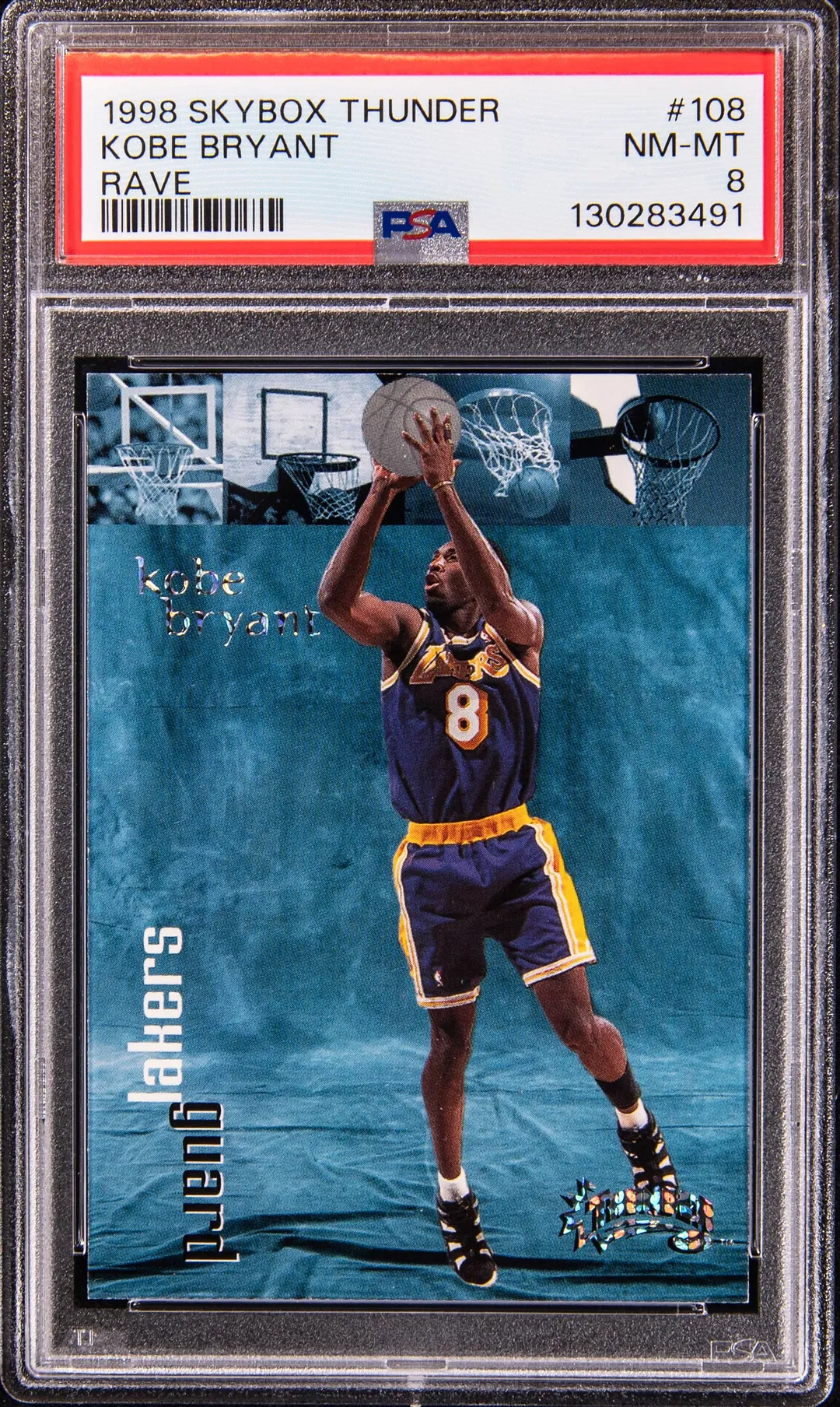
Goldin sells a 1998-99 SkyBox Thunder Rave Kobe Bryant #108 PSA 8 /150 for $14,762. figoca breaks down the card, comps, and 90s Kobe market context.
Sold Card
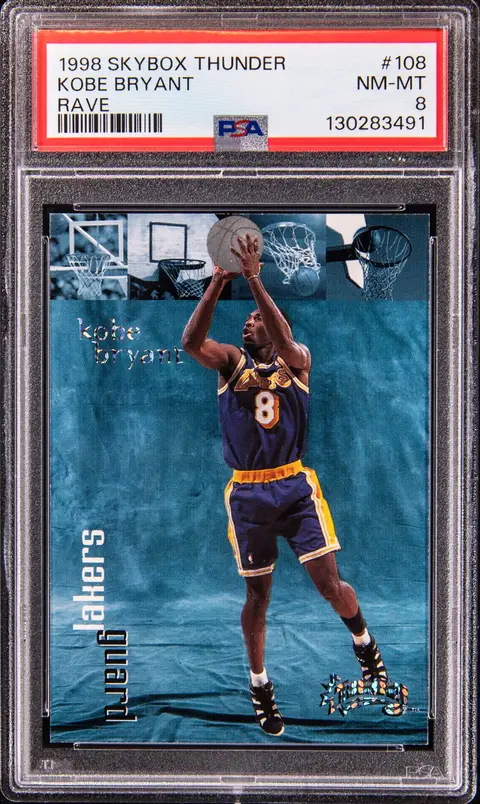
1998-99 SkyBox Thunder Rave #108 Kobe Bryant (#007/150) - PSA NM-MT 8
Sale Price
Platform
Goldin1998-99 SkyBox Thunder Rave #108 Kobe Bryant (#007/150) - PSA 8 Sells for $14,762
On January 23, 2026, Goldin closed a notable late‑90s Kobe Bryant parallel: a 1998-99 SkyBox Thunder Rave #108, serial numbered 007/150, graded PSA NM-MT 8, hammering for $14,762.
For collectors who focus on 1990s inserts and parallels, this is a meaningful data point. It sits at the intersection of three powerful themes in the hobby: low-numbered 90s parallels, a Hall of Fame legend, and a set that has slowly been getting more recognition as collectors dig deeper into the SkyBox catalog.
Card overview
Let’s break down what this card is:
- Player: Kobe Bryant (Los Angeles Lakers)
- Year: 1998-99 NBA season
- Set: 1998-99 SkyBox Thunder
- Card number: #108
- Parallel: Rave (/150), serial numbered 007/150
- Rookie card? No. Kobe’s rookies are 1996-97 issues. This is an important late-90s parallel, not a rookie.
- Grading: PSA NM-MT 8 (Near Mint-Mint 8) by Professional Sports Authenticator (PSA)
- Attributes: Low-serial numbered parallel (only 150 copies produced), with the added collector appeal of a single-digit serial number (007).
The Rave parallels are the first-tier numbered parallel in 1998-99 SkyBox Thunder, with the Super Rave (/25) sitting above them. The /150 print run was low for the era, especially compared to base cards and common inserts.
Set and parallel significance
1998-99 SkyBox Thunder is a late-90s product that doesn’t have the mainstream name recognition of, say, Topps Chrome or Flair Showcase, but it fits into the broader story of how SkyBox experimented with colorful, layered designs and parallel structures.
The Rave cards are:
- Serial-numbered: Each card is hand-numbered out of 150 copies, which was a meaningful level of scarcity in the late 90s.
- Parallel to the base: Same design as the base Thunder card, but with a distinctive foil treatment and the serial stamp.
- Chase pieces: For player collectors and 90s insert enthusiasts, Raves are a key chase from this release, especially for stars like Kobe.
While they may not be as headline-grabbing as some of Kobe’s ultra-premium inserts (like Credentials, PMG, or high-end autographs), Raves are part of the “second tier” of serious 90s parallels that have held steady interest among focused collectors.
PSA 8 in the context of 90s parallels
A PSA 8 grade indicates Near Mint-Mint condition: the card is clean overall with only minor wear (slight corner or edge touches, or very light surface issues). For thin, foil-based 90s parallels, PSA 8 can actually be a fairly respectable grade, given how many copies show chipping or surface scratches straight out of packs.
Key points to consider with PSA 8 for this card:
- Print and handling challenges: Many 90s foil/parallels suffer from edge wear, chipping, and scratching. This can suppress high grades.
- Grade distribution: In similar 90s serial-numbered parallels, PSA 8 often sits near the middle of the graded population, with fewer copies achieving PSA 9 or 10.
- Collector behavior: Player and set collectors will often chase the card first and the grade second, especially if total supply is firmly capped (150 copies total in any condition).
The exact PSA population report (the count of how many copies exist in each grade) for this specific card can shift over time as more cards are submitted or re-submitted. But as with most low-serial 90s Kobe parallels, the total number of graded copies is typically modest compared to modern print runs.
Market context and recent comps
In hobby language, “comps” are comparable recent sales—data points that help collectors understand the current price range for a particular card.
For 1998-99 SkyBox Thunder Rave Kobe cards, a few patterns generally hold in the marketplace:
- Higher grades (PSA 9, BGS 9.5) usually command a clear premium over PSA 8, reflecting the difficulty of landing sharp copies.
- Raw (ungraded) or lower grades tend to trail PSA 8, unless a copy has strong eye appeal that could justify a future regrade.
- Super Rave (/25) and other rarer parallels from the same era typically sell at significantly higher price points than the standard Rave /150.
For this specific card—1998-99 Thunder Rave #108 Kobe, PSA 8—recent public data is relatively thin compared to mass-produced modern issues. That’s common for low-serial 90s parallels: many copies are locked away in player collections or long-term holdings, so auction appearances are sporadic.
Within that context, the $14,762 result at Goldin on January 23, 2026, suggests a few reasonable interpretations:
- It recognizes the card as a serious 90s Kobe piece, but still a step below the most famous grails (like key rookies, PMGs, or Credentials).
- It reflects the broader premium that the market continues to place on serial-numbered 1990s parallels of all-time greats, especially when the print run is under 200.
Without a deep run of PSA 8 sales for this precise card in the immediate months prior, it’s better to treat this as a fresh reference point rather than a strict “market average.” It’s a useful marker for any future sales of the same card in comparable condition.
Why collectors care about this card
Even though this isn’t a rookie card, it checks several boxes that matter to 90s-focused collectors:
Kobe Bryant, Hall of Famer and global icon
Kobe remains one of the most collected basketball players of all time. His late-90s cards capture the transition from “young prodigy” to established superstar.Low serial numbering (/150)
In 1998-99, a print run of 150 was legitimately scarce. Unlike modern serial-numbered cards that sometimes come from products with multiple parallel tiers, this Rave run is finite and straightforward.Insert/parallel era nostalgia
Many collectors who grew up in the 90s remember SkyBox, Fleer, and other brands experimenting with wild designs and creative parallels. Raves fit squarely into that nostalgia lane.Set and player collecting
Some hobbyists build player runs (chasing as many cards of a specific player as possible) or set runs (building every card or every parallel from a product). For both groups, a numbered Kobe from SkyBox Thunder is a key puzzle piece.Rarity of appearance
Unlike base cards that appear constantly on resale platforms, a serial-numbered, graded Rave parallel—especially of Kobe—doesn’t hit major auction houses every week. When one appears at Goldin or other large venues, it naturally draws attention.
How this sale fits into the broader Kobe market
Kobe’s market has seen several distinct phases over the past decade:
- Pre-retirement and early post-retirement: Strong demand for core rookies and major inserts.
- Posthumous surge: A sharp increase in attention and prices across nearly all of his cards, from base to grails.
- Normalization phase: A cooling from peak levels, followed by a sorting-out process where the scarcest and most historically important pieces tend to hold more relative strength.
This Thunder Rave sale sits in that normalization phase, where:
- Quality and scarcity matter more than volume.
- Low-serial 1990s parallels are being treated as semi-blue-chip pieces within a player’s portfolio, especially for icons like Kobe, Jordan, and other Hall of Famers.
The $14,762 result doesn’t tell us that every Kobe parallel is moving in lockstep, but it does reinforce how collectors are willing to pay a meaningful premium for:
- A defined, limited print run (150 total).
- A respected grading company’s assessment (PSA 8).
- A named, chase-worthy parallel (Rave) from the heart of the 90s insert era.
What small sellers and returning collectors can take from this
If you’re a small seller, a returning collector, or someone just getting serious about 90s inserts, this sale offers a few practical takeaways:
Know the parallel, not just the player.
The difference between a base 1998-99 SkyBox Thunder Kobe and a Thunder Rave Kobe is massive. Serial numbering and parallel names matter.Look up comps carefully.
When you research “comps” (recent comparable sales), make sure you’re matching:- The exact parallel (Thunder vs. Thunder Rave vs. Super Rave)
- The exact serial tier (/150 vs. /25, etc.)
- The grade and grading company (PSA 8 vs. PSA 9, BGS 9.5, SGC, etc.)
Condition sensitivity in 90s foil cards is real.
Tiny differences in edges, corners, and surfaces can separate a PSA 7 from a PSA 8 or 9. If you’re evaluating raw copies, paying attention to these details is crucial.Auction house results are useful reference points.
A major auction house like Goldin typically brings strong visibility and a wide bidder base. The $14,762 price realized on January 23, 2026, is a solid mark to reference when you see future sales of the same card or adjacent parallels.Focus on long-term appeal, not short-term spikes.
Kobe’s standing in basketball history is secure. While short-term market moves will always happen, cards like this Thunder Rave tend to be collected for what they represent: a finite, visually distinctive piece of a Hall of Famer’s 90s portfolio.
Final thoughts
The 1998-99 SkyBox Thunder Rave #108 Kobe Bryant (#007/150) in PSA NM-MT 8 earning $14,762 at Goldin on January 23, 2026, is another proof point that serious collectors continue to prioritize:
- Scarce, numbered 90s parallels
- Historically significant players
- Recognized grading and clear card definitions
For figoca users tracking the market, this sale is a useful benchmark in the ongoing story of how the hobby values Kobe’s non-rookie, 1990s-era chase cards. It’s not a record-shattering headline, but it is a clear, data-backed signal: well-defined, low-serial 90s Kobe parallels remain firmly on the hobby’s radar.