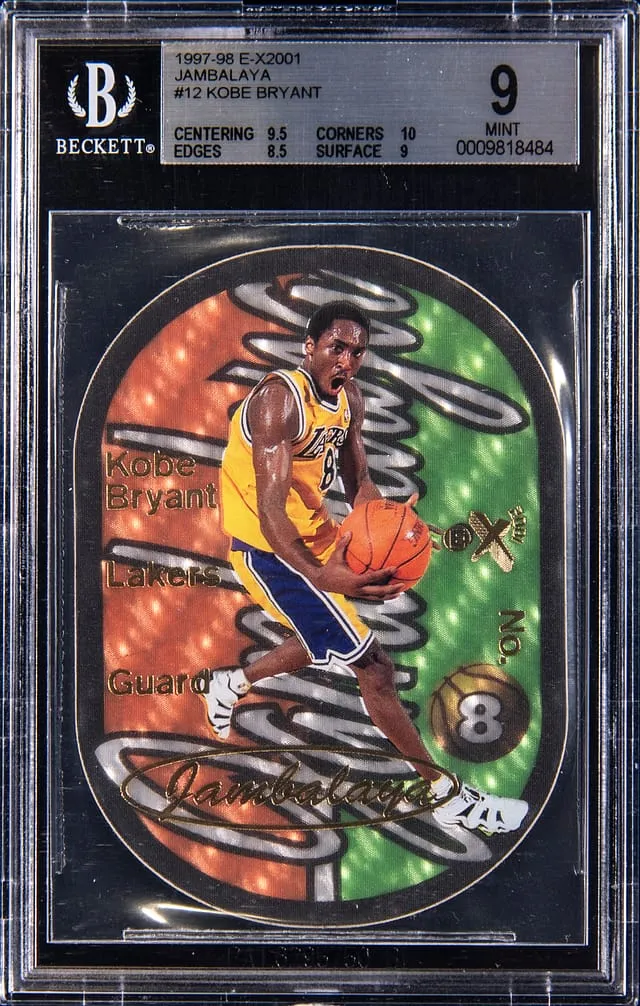
Kobe 1997-98 Jambalaya BGS 9 sells for $21,960
Goldin sold a 1997-98 SkyBox E-X2001 Jambalaya #12 Kobe Bryant BGS 9 for $21,960 on March 27, 2026. figoca breaks down the card and price context.
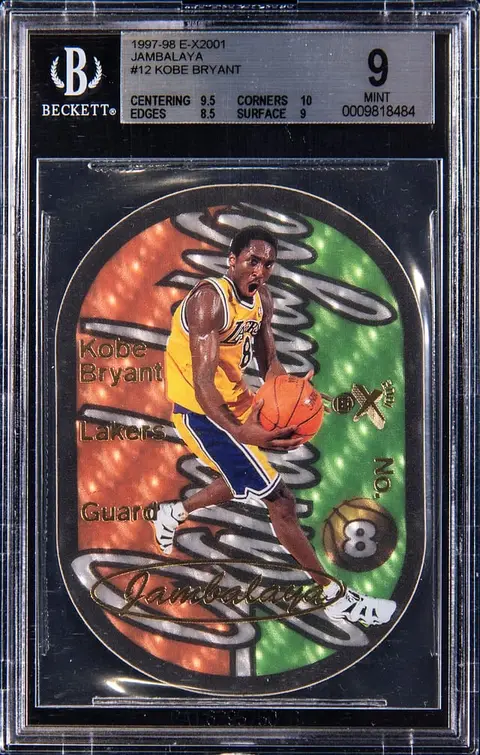
Sold Card
1997-98 SkyBox E-X2001 Jambalaya #12 Kobe Bryant - BGS MINT 9
Sale Price
Platform
Goldin1997-98 SkyBox E-X2001 Jambalaya #12 Kobe Bryant BGS 9 Sells for $21,960
On March 27, 2026, Goldin sold a 1997-98 SkyBox E-X2001 Jambalaya #12 Kobe Bryant graded BGS MINT 9 for $21,960. For collectors who follow 1990s inserts, this is a key card from a landmark set, and this sale offers a useful datapoint for understanding where high-grade Jambalayas are sitting right now.
Card overview
- Player: Kobe Bryant (Los Angeles Lakers)
- Year / Set: 1997-98 SkyBox E-X2001
- Insert: Jambalaya
- Card number: #12
- Rookie status: Not a rookie card (Kobe’s rookies are 1996-97), but widely viewed as one of his most important 1990s inserts.
- Grading: Beckett Grading Services (BGS) MINT 9
- Attributes: Die-cut, lenticular-style finish, tough condition-sensitive insert from a short-printed insert run.
The 1997-98 E-X2001 Jambalaya checklist includes stars like Michael Jordan, Kobe Bryant, and other top names of the era. Within Kobe’s non-rookie catalog, this insert is often mentioned alongside his best 1990s chase cards.
Why the Jambalaya insert matters
Among 1990s basketball inserts, Jambalaya has a strong reputation because of three core factors:
Design and technology
The cards combine die-cut edges with a bold, rounded shape and a textured, lenticular-style surface. That combination makes them eye-catching but also makes them difficult to keep in high grade; edges and corners are especially vulnerable.Scarcity for the era
Exact print run numbers for Jambalaya were never widely printed on the cards, but hobby consensus has long treated them as a short print for the late-1990s. Pulling one out of packs was a genuine event, and specific player copies do not flood auction sites the way many later-era inserts do.Player selection
Jambalaya focused on high-level stars. Kobe’s card benefits from being an early-career insert from his rise with the Lakers, roughly between his rookie campaigns and his later championship years.
Taken together, those points help explain why this card is often grouped with other premium 1990s Kobe inserts that many collectors treat as long-term “core” pieces in a Kobe collection.
Grading context: BGS MINT 9
Grading companies evaluate surface, corners, edges, and centering, then assign an overall grade. A BGS MINT 9 indicates a high-end copy with only minor flaws.
Jambalayas are notoriously condition-sensitive. The die-cut format and colored borders can exaggerate even small defects. As a result, gem mint grades (BGS 9.5 / PSA 10) tend to be scarce, and many copies sit in the BGS 8–9 or PSA 7–9 range instead.
While exact population (“pop”) figures can change as new cards are submitted for grading, the broader pattern is consistent: high-grade Kobe Jambalayas do not appear frequently compared to many modern inserts.
Market context from recent sales
"Comps" is shorthand for comparable recent sales. They provide a snapshot of where the market has been for a card, without guaranteeing where it will go.
For the 1997-98 E-X2001 Kobe Jambalaya specifically, public auction records over the past few years show:
- Higher grades (BGS 9.5 / PSA 10): These rarely come to market and have historically commanded a significant premium over MINT 9 copies due to scarcity at the very top of the grading scale.
- BGS 9 / PSA 9 range: Most sales for strong but not gem copies have clustered in a band that reflects the balance between scarcity, demand, and the natural ceiling created by gem mint sales.
- Lower grades and raw (ungraded): These typically sell at a noticeable discount to BGS 9 and PSA 9 examples, especially when edge and surface wear is obvious.
This Goldin result at $21,960 on March 27, 2026, lands in line with the idea that:
- Jambalaya remains a respected 1990s insert brand.
- Kobe’s card holds a place as one of the more chased non-rookie inserts of that era.
- A BGS 9, while not the absolute top grade available, is still in the "investment-grade" tier for condition-focused collectors who care about sharp edges and overall eye appeal.
Because the 1997-98 Jambalaya insert doesn’t appear for sale in volume—especially in higher grades—individual auction results can move around depending on timing, bidder pool, and what else is on the market at the same time. Instead of trying to read a single sale as a “signal,” it’s more helpful to view this Goldin price as one more data point along a longer-term trend line.
Where this card fits in Kobe’s hobby legacy
For many collectors, Kobe’s card catalog breaks into a few broad lanes:
- Rookie cards (1996-97): Traditional base rookies and their parallels.
- Key mid-to-late 1990s inserts and parallels: Cards like Jambalaya, essential credentials, and other tough pulls.
- Autographs and memorabilia: On-card autos, patches, and later high-end releases.
The 1997-98 E-X2001 Jambalaya #12 sits firmly in the second lane: not a rookie, not an autograph, but a cornerstone 1990s insert that serious Kobe collectors at least consider.
Its significance is helped by the broader 1990s insert movement. Many collectors who grew up in that era remember how hard it was to pull cards like this, and that nostalgia has been reinforced by modern recognition of how short-printed and condition-sensitive these inserts were.
How collectors might use this sale
For newcomers, returning collectors, and small sellers, this sale can be useful in a few ways:
Benchmarking:
The $21,960 BGS 9 result at Goldin provides a clear, time-stamped benchmark. If you own a Kobe Jambalaya in another grade—or are considering one—this figure helps you anchor expectations relative to condition and grading company.Understanding grade gaps:
Watching how BGS 9 results compare with BGS 8.5, PSA 8, PSA 9, and any gem mint copies helps you see how much the market currently values each step up or down the grading ladder.Comparing across 1990s inserts:
Looking at this Kobe Jambalaya sale alongside results for other key 1990s Kobe inserts (even from different sets) can help you understand which designs and brands the market is prioritizing.Planning submissions:
If you own raw 1997-98 E-X2001 inserts, seeing what strong graded copies achieve may guide whether you choose to grade. It also highlights why pre-grading inspection is important—die-cut edges and surface scuffs can dramatically affect the final grade and therefore the card’s position relative to comps like this one.
Final thoughts
The March 27, 2026 Goldin sale of the 1997-98 SkyBox E-X2001 Jambalaya #12 Kobe Bryant in BGS MINT 9 at $21,960 underscores the ongoing respect that collectors have for premium 1990s inserts.
This is not a newly discovered card, and it’s not part of a sudden trend. Instead, it’s a steady, data-rich example of how a well-known, condition-sensitive insert of an all-time player continues to find willing bidders at the high end of the hobby.
For anyone building a Kobe collection, studying this sale alongside other graded Jambalayas—and comparable 1990s inserts—offers a grounded way to understand how design, scarcity, grade, and player legacy come together in today’s market.
If you track sales like this regularly, you’ll develop a more complete picture of where key 1990s inserts sit over time, without needing to rely on single headline numbers or short-term spikes.