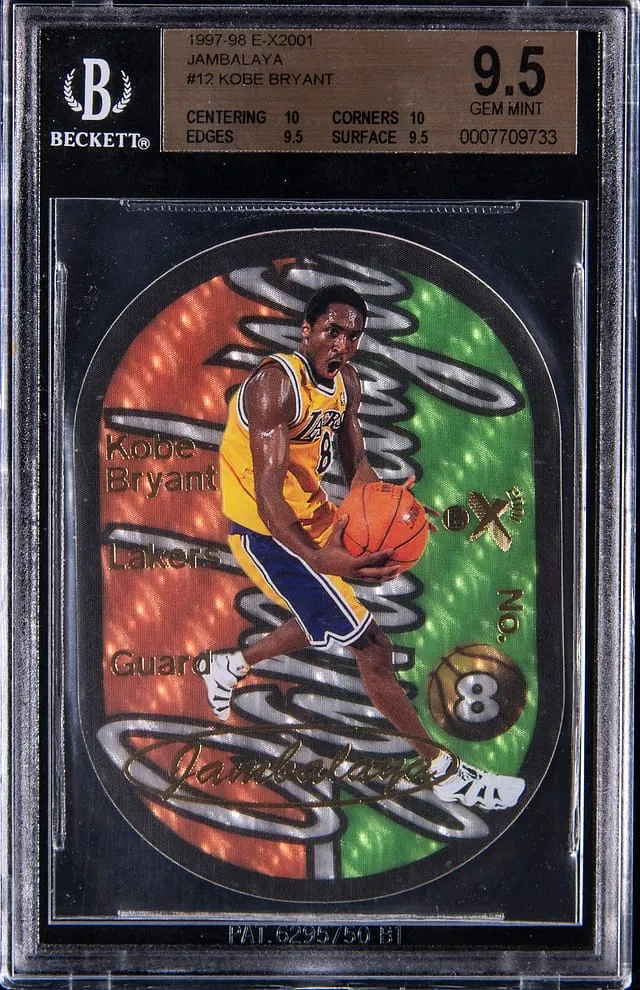
Kobe 1997-98 Jambalaya BGS 9.5 sells for $51,850
Goldin sold a 1997-98 SkyBox E-X2001 Jambalaya #12 Kobe Bryant BGS 9.5 True Gem+ for $51,850. See why this iconic 90s insert matters to collectors.
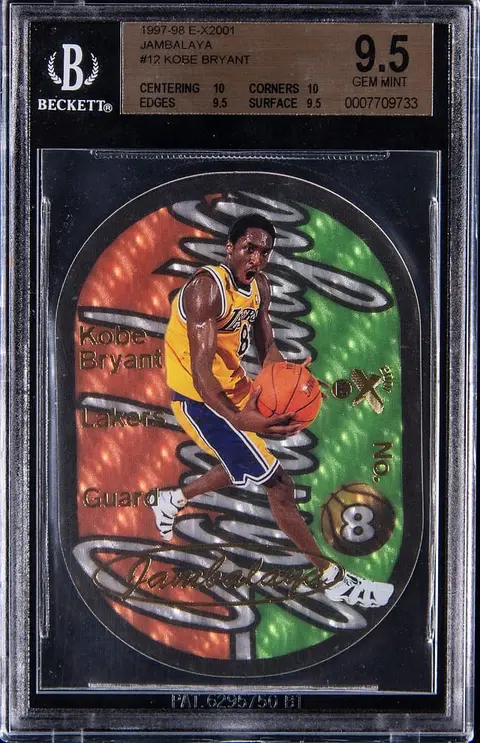
Sold Card
1997-98 SkyBox E-X2001 Jambalaya #12 Kobe Bryant - BGS GEM MINT 9.5 - True Gem+
Sale Price
Platform
Goldin1997-98 SkyBox E-X2001 Jambalaya #12 Kobe Bryant BGS 9.5 True Gem+ Sells for $51,850
On March 15, 2026, Goldin closed a notable sale for one of the hobby’s key late‑1990s inserts: a 1997-98 SkyBox E-X2001 Jambalaya #12 Kobe Bryant graded BGS GEM MINT 9.5 True Gem+. The final price landed at $51,850, a result that fits into the growing recognition of Jambalaya as a cornerstone insert for both Kobe and 1990s basketball collectors.
In this breakdown, we’ll look at what this card is, why it matters, and how this sale compares to recent market activity.
Card Overview: 1997-98 SkyBox E-X2001 Jambalaya Kobe Bryant
- Player: Kobe Bryant
- Team (on card): Los Angeles Lakers
- Year: 1997-98
- Set: SkyBox E-X2001 Jambalaya
- Card number: #12
- Type: Premium die-cut insert (not a rookie, but a key early‑career Kobe issue)
- Parallel/variant: Jambalaya insert (core design, not a parallel)
- Autograph / memorabilia: None – this is a non-auto, non-patch insert
- Serial numbering: Not serial-numbered, but understood to be a low‑print, short‑printed insert
- Grading company: Beckett Grading Services (BGS)
- Grade: GEM MINT 9.5 – True Gem+ (all four subgrades 9.5 or higher, with at least one 10)
“True Gem+” is a hobby shorthand for a BGS 9.5 where all four subgrades (centering, corners, edges, surface) are 9.5 or higher, and at least one is a perfect 10. Among BGS‑graded copies, these are often treated as the top of the 9.5 tier.
Why Jambalaya Matters to Collectors
For collectors who came back to the hobby in the last few years, Jambalaya can feel like a modern insert. In reality, it is one of the true foundational designs of the late 1990s.
Key points about the 1997-98 Jambalaya insert:
- Design and innovation: The cards feature an oval, layered, die‑cut design with a bold color gradient and a very 90s graphic style. At the time, this look and construction were unusually premium compared with standard base cards.
- Short print nature: While not serial‑numbered, Jambalaya is widely understood as a tough pull. It was inserted at very low rates in SkyBox E-X2001, making complete sets and high‑grade copies difficult to assemble.
- Player checklist: The 1997-98 run includes many key 90s stars—Michael Jordan, Kobe Bryant, Allen Iverson, Grant Hill, and others. Kobe and Jordan are generally the headliners.
- Era context: The late 1990s are often viewed as the transition from the overproduced “junk wax” era into more deliberately scarce, premium products. Jambalaya sits near the center of that transition.
For Kobe specifically, this card is considered one of his top early inserts. It is not a rookie card (Kobe rookies are in 1996-97 products), but it is a second‑year issue from a heavily collected, visually distinct insert set. In many Kobe PC (personal collection) hierarchies, Jambalaya stands alongside the most desirable 1990s inserts.
Grading: BGS 9.5 True Gem+ in Context
Condition is a major part of the story for Jambalaya:
- Die‑cut vulnerability: The intricate die‑cut edges make these cards prone to soft corners, chipping, and edge flaws. Clean copies are hard to find raw and harder still in high grade.
- Surface complexity: The layered foil and textured finish can pick up scratches or print defects, which grading companies penalize heavily.
A BGS GEM MINT 9.5 is already a strong grade for this card. A True Gem+ adds another layer of scarcity within the 9.5 population. While exact current population numbers can shift as more cards are submitted, the overall pool of high‑grade Jambalaya Kobes is small relative to demand.
In practice, the hobby often places a pricing premium on:
- BGS 9.5 True Gem+ over regular BGS 9.5s with weaker subgrade distributions, and
- Top‑tier PSA 10 copies, which are typically even rarer on condition‑sensitive cards like this.
Market Context and Recent Comps
In hobby language, “comps” are comparable recent sales used to gauge current market levels. For a card like this, helpful comps include:
- The same card, same grade (BGS 9.5) sold recently at major auction houses or marketplaces
- The same card in PSA 10, BGS 9.5 (non–True Gem), BGS 9, or PSA 9
- Other premium 1990s Kobe inserts in similar condition
Based on recent public auction results and marketplace listings up through early 2026:
- High‑grade Jambalaya Kobes (BGS 9.5 and PSA 10) have generally traded in a strong, but somewhat range‑bound band, reflecting both steady demand and the thin supply of top copies.
- PSA 10 copies have tended to command a notable premium over BGS 9.5s, consistent with broader vintage and 90s trends where PSA 10 population is very low.
- Lower‑grade copies (BGS 9, PSA 9, and below) show a wider price range depending on eye appeal, centering, and edge quality.
Within that context, the $51,850 result at Goldin for a BGS 9.5 True Gem+ is best understood as:
- A strong outcome within the BGS 9.5 tier,
- Reflective of heightened interest in key Kobe inserts post‑career and post‑Hall of Fame induction,
- In line with the broader pattern where elite 1990s inserts, especially of Hall of Famers, continue to hold collector attention even when the broader modern market cycles.
Because supply is thin and sales are relatively infrequent at this grade level, each auction can land slightly above or below previous results depending on timing, visibility, and under‑bidder depth. The Goldin platform typically brings a concentrated audience of high‑end basketball collectors, which can help premium examples realize strong prices.
Collector Significance Beyond the Price
Several factors make this card important in a Kobe or 1990s insert collection:
Era‑defining insert: Jambalaya is regularly mentioned in the same breath as other top 90s basketball inserts like Precious Metal Gems (PMG), Credentials, and Star Rubies. It represents a shift toward experiential, design‑forward cards.
Early‑career Kobe snapshot: This is Kobe in the early stages of what became a 20‑year Lakers run. For collectors who focus on narrative—early‑career, mid‑career, and late‑career pieces—Jambalaya occupies the early/high‑upside chapter of his story.
Set prestige: The 1997-98 SkyBox E-X2001 line is well regarded among advanced basketball collectors. The Jambalaya subset sits at the top of that pyramid as a tough, visually striking chase.
Condition scarcity: The die‑cut nature and age of the card mean that many surviving copies have issues. A high‑end BGS 9.5 True Gem+ is not just a numerical grade—it indicates a copy that escaped the common flaws that plague the set.
How This Sale Fits into the Broader Kobe Market
Kobe’s market has gone through several distinct phases: active playing years, late‑career appreciation, retirement, Hall of Fame induction, and a more mature phase where key cards are treated as long‑term collection anchors rather than quick flips.
Within that arc:
- Flagship rookies (like Topps Chrome and high‑end 1996 inserts) remain the entry point for many collectors.
- High‑tier inserts such as Jambalaya, PMG, and Credentials have gradually separated from the rest of the market, often attracting focused collectors rather than casual buyers.
- Grading nuance (PSA 10 vs BGS 9.5 vs subgrade distribution) matters more at the high end, which helps explain why a True Gem+ label can influence bidding.
The Goldin sale on March 15, 2026, reinforces the idea that the hobby continues to recognize Jambalaya as a key category for premium Kobe collectors. While price levels can and do move with broader market sentiment, the hierarchy of importance—rookies, iconic inserts, and scarce parallels—has remained fairly consistent.
Takeaways for Collectors and Small Sellers
A few practical notes for anyone watching or participating in this segment of the market:
- Don’t assume all Jambalaya copies are equal. Eye appeal, centering, and edge cleanliness matter a lot on a complex die‑cut design. Two cards with the same numerical grade can feel very different in hand.
- Grading path is strategic. For raw copies, deciding between PSA and BGS depends on your goals. PSA 10s tend to be fewer and can command a premium, while BGS subgrades give more detail and can highlight exceptionally balanced copies (like True Gem+).
- Use multiple comps. When estimating value, look at more than one recent sale and adjust for grade, subgrades, and auction setting. A single outlier auction doesn’t define the entire market.
- Collect what fits your lane. For many Kobe fans, a lower‑grade Jambalaya can still be a centerpiece. For advanced 90s insert collectors, high‑end BGS 9.5 or PSA 10 examples like this Goldin sale may be the ultimate target.
As always, treat any sale—even a strong one like this $51,850 result—as one data point among many. The real value for most collectors comes from finding the piece that fits their budget, their collection story, and their connection to the player.
Quick Facts: 1997-98 SkyBox E-X2001 Jambalaya #12 Kobe Bryant
- Sold for: $51,850
- Auction house: Goldin
- Sale date (UTC): March 15, 2026
- Grading: BGS GEM MINT 9.5 – True Gem+
- Type: Non‑auto, non‑patch, die‑cut insert
- Era: Late 1990s premium insert
- Status: Key early‑career Kobe insert and flagship 90s design
For collectors tracking the evolution of Kobe’s 1990s market, this Goldin sale is a clear reminder: iconic design, meaningful scarcity, and top‑tier condition continue to command serious attention.