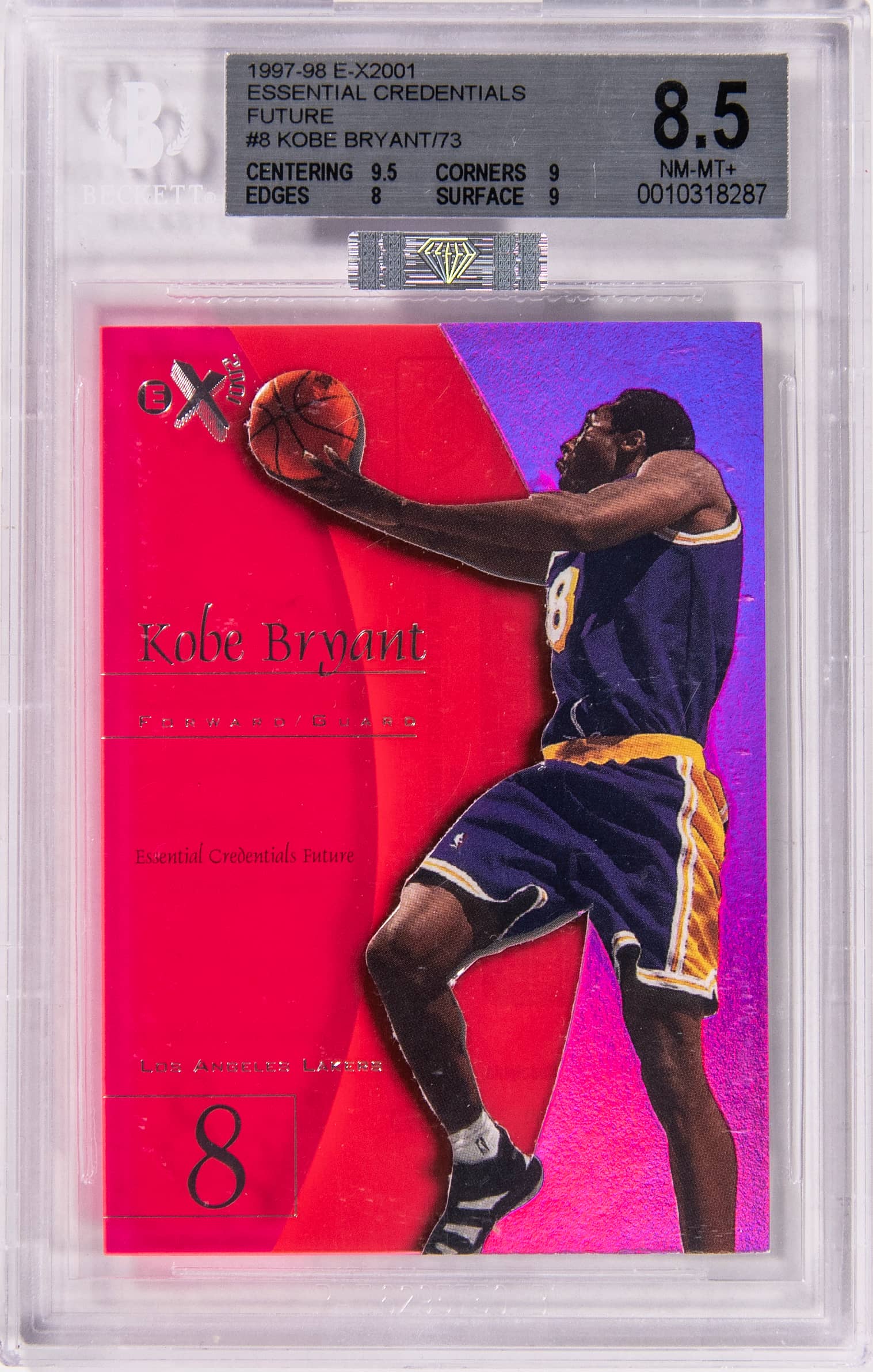
Kobe 1997-98 E-X2001 Essential Credentials Sale
Goldin sold a 1997-98 E-X2001 Essential Credentials Future Kobe Bryant #/73 BGS 8.5 for $73,200. See the card’s context in the 90s insert market.
Sold Card
1997-98 SkyBox E-X2001 Essential Credentials Future #8 Kobe Bryant (#50/73) - BGS NM-MT+ 8.5 - MBA Silver Diamond Certified
Sale Price
Platform
Goldin1997-98 SkyBox E-X2001 Essential Credentials Future #8 Kobe Bryant (#50/73) - BGS NM-MT+ 8.5 - MBA Silver Diamond Certified
On February 8, 2026, Goldin closed a notable sale for one of the key 90s Kobe Bryant grails: a 1997-98 SkyBox E-X2001 Essential Credentials Future #8 Kobe Bryant, serial numbered #50/73, graded BGS 8.5 (NM-MT+) with MBA Silver Diamond certification. The final price was $73,200.
For collectors who care about the evolution of high-end basketball cards, this card sits near the center of the conversation: second-year Kobe, iconic late-90s insert technology, and one of the most respected serial-numbered parallels of the era.
Card overview: why this Kobe matters
Let’s break down exactly what sold:
- Player: Kobe Bryant (Los Angeles Lakers)
- Year/Set: 1997-98 SkyBox E-X2001
- Card: Essential Credentials Future #8
- Serial number: #50/73 (only 73 copies made)
- Rookie? No – this is Kobe’s second year, but widely treated as a key 1990s issue
- Grading company: Beckett Grading Services (BGS)
- Grade: NM-MT+ 8.5
- Additional authentication: MBA Silver Diamond Certified (eye appeal review)
The Essential Credentials cards are parallels of the base E-X2001 set. For many 90s collectors, they represent some of the most important serial-numbered parallels ever produced, right alongside PMGs (Precious Metal Gems) and other cornerstone inserts.
The "Future" and "Now" versions in this set are both highly regarded. Each has a different print run tied to the player’s jersey number, which is part of what made the concept so innovative in the 90s.
Essential Credentials and 90s scarcity
In the late 1990s, most cards were still mass-produced compared to today’s ultra-modern hobby, but a small group of sets experimented with true scarcity and premium materials. 1997-98 E-X2001 is one of the standout examples:
- Construction: Acetate and foil design, with layered, almost 3D visual appeal
- Serial numbering: Essential Credentials parallels are individually numbered, which was still relatively new for basketball at the time
- Two parallel types: "Now" and "Future," each with its own serial run
This Kobe is from the Essential Credentials Future run, limited to just 73 copies. For context, in an era when base cards could be printed in the tens or hundreds of thousands, a run of fewer than 100 cards made this feel truly scarce.
Even today, many copies are locked away in long-term collections, so the number that actually trades hands publicly in a given year tends to be small.
Grading, condition, and eye appeal
This copy graded BGS 8.5 (NM-MT+). For a premium 1990s acetate/foil card, that’s a strong grade:
- Acetate cards often show edge chipping, surface scratches, and printing defects
- Foil and colored borders can magnify even minor flaws
While we don’t have the full subgrade breakdown here, an 8.5 on this issue typically indicates above-average condition for the era, especially given how condition-sensitive these cards are.
The card also carries MBA Silver Diamond Certification. MBA (Memorabilia Authentication & Grading’s Eye Appeal division) evaluates the visual quality of already-graded cards. Their labels are an additional layer of assurance that the card looks strong for the assigned grade, which some collectors pay a premium for when eye appeal is a priority.
Market context and recent sales
Any discussion of price needs to be grounded in context and recent sales data. Here is what is generally observed for this card and closely related versions:
- Lower-grade copies (BGS/PSA 7–8 range) have historically sold at a noticeable discount to high-end examples, reflecting both condition and eye appeal
- Stronger grades (BGS 9, PSA 9, and above) can bring a clear premium due to the combination of scarcity and the difficulty of achieving high grades on this issue
- Signature 90s Kobe inserts and parallels, including Essential Credentials, PMGs, and other low-serial, visually distinctive cards, have tended to be more stable over time relative to mass-produced 2000s and 2010s issues
This particular sale at $73,200 sits in the established high-end range for serious 1990s Kobe parallels. When comparing to prior public sales of the same card in different grades:
- Copies in similar condition have often landed in a comparable tier, though exact numbers vary with overall market conditions and timing
- Higher-grade examples, especially PSA 9/BGS 9 or better, can push meaningfully higher when they surface, reflecting both grade scarcity and increasing demand for “museum-level” condition
Because only 73 copies exist, and only a portion of those are graded, sales can be infrequent and somewhat lumpy. That means a single auction result should be read as one data point in a thin market rather than a definitive, permanent value level.
How this sale fits into Kobe’s broader card market
Kobe Bryant’s market has gone through several distinct waves:
- Playing years and early titles: A steady build as he became a perennial All-Star and champion
- Post-retirement: Renewed interest as collectors revisited his key rookie and 90s inserts
- After his passing: A sharp surge in demand and pricing across almost all Kobe cards, followed by a settling period and more focused interest on true blue-chip pieces
Today, there is a clearer separation between:
- Core, historically important cards (low-serial 90s inserts/parallels, key rookies, rare autographs)
- Mass-produced or less significant issues from across his long career
Essential Credentials sits in the first category. It is a recognized, limited, and visually distinctive parallel from a major 90s brand. Within that lane, collectors tend to focus on:
- Overall card scarcity (print run of 73)
- Grade and eye appeal
- Provenance, especially if a card has appeared in notable auctions
The Goldin sale on February 8, 2026, reinforces that serious 90s Kobe grails continue to command strong, data-supported interest even as the broader market cycles through periods of cooling and recovery.
What collectors can take away from this result
For newcomers, returning collectors, and small sellers, here are a few practical observations drawn from this sale:
Serial numbering still matters
Cards with clearly stated, low print runs (like /73) tend to hold collectors’ attention over time, especially when combined with an important player and a respected set.Set reputation is crucial
Not every numbered parallel is equal. Essential Credentials has a long-established reputation among 90s specialists. That history often matters as much as the number on the back.Grade is only part of the story
A BGS 8.5 on a difficult 1990s acetate issue can be more desirable than a higher raw grade on a modern, easy-to-gem card. Eye appeal certifications like MBA’s Silver Diamond label underscore how much weight collectors place on how a card actually looks in hand.Thin markets create wide ranges
With only 73 copies made and relatively few hitting the market, price movement can look jumpy. Each auction is influenced by who shows up, competing opportunities, and overall sentiment at that moment.Key 90s inserts are increasingly viewed as historical pieces
Cards like this are less about short-term speculation and more about long-term collecting. Many buyers are treating them as centerpiece items rather than quick flips.
Final thoughts
The $73,200 Goldin sale of the 1997-98 SkyBox E-X2001 Essential Credentials Future #8 Kobe Bryant (#50/73), BGS 8.5 with MBA Silver Diamond Certification, underlines the enduring respect collectors have for high-end 90s Kobe cards.
As always, any decision to buy, sell, or hold should be grounded in your own goals, budget, and comfort with risk. Recent sales like this provide helpful price context, but they are not predictions. For most collectors, the real value in tracking results like this is understanding where certain cards sit in the hobby’s long-term hierarchy—and this card sits very near the top of the 1990s Kobe landscape.