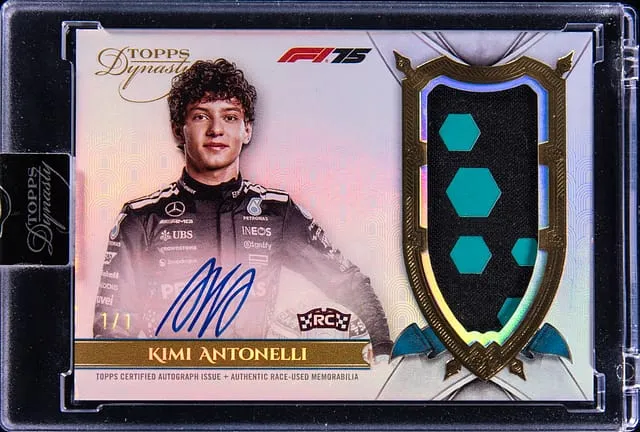
Kimi Antonelli 2025 Topps Dynasty F1 Gold 1/1 Sale
Breakdown of the $64,050 Goldin sale of the 2025 Topps Dynasty F1 Kimi Antonelli Gold 1/1 rookie patch autograph, with context for F1 collectors.
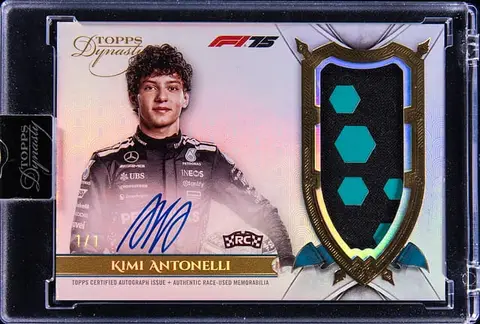
Sold Card
2025 Topps Dynasty F1 Patch Autograph Gold #DAP-AANII Kimi Antonelli Signed Race-Used Patch Rookie Card (#1/1) - Topps Encased
Sale Price
Platform
Goldin2025 Topps Dynasty F1 Kimi Antonelli Patch Auto Gold 1/1 Sells for $64,050 at Goldin
On March 20, 2026, Goldin closed a notable modern Formula 1 sale: a 2025 Topps Dynasty F1 Patch Autograph Gold #DAP-AANII featuring Kimi Antonelli, a signed race‑used patch rookie card, serial‑numbered 1/1 and still in the original Topps encased holder. The final price was $64,050.
For an ultra‑modern F1 card, this is a significant result and helps frame where high‑end Kimi Antonelli pieces are starting to land as his first true rookie issues reach the market.
Card overview
Let’s break down exactly what this card is:
- Player: Kimi Antonelli
- Team: At the time of his F1 arrival, Antonelli is part of the Mercedes driver pipeline; this Topps Dynasty issue ties into that early‑career buzz.
- Year: 2025
- Set: 2025 Topps Dynasty Formula 1
- Card: Patch Autograph Gold
- Card number: #DAP-AANII
- Serial numbering: 1-of-1 (one‑of‑one)
- Rookie status: Treated by collectors as a true rookie card (first high‑end, licensed Antonelli auto/patch in a flagship premium F1 product)
- Autograph: On‑card (signed directly on the card surface, not on a sticker)
- Memorabilia: Signed, race‑used patch
- Parallel / variant: Gold 1/1
- Encapsulation: Topps factory encased (not third‑party graded)
Topps Dynasty is Topps’s premium, low‑print‑run autograph–memorabilia line for F1. Every card is serial‑numbered, and most are on‑card autographs with multi‑color race‑used patches. Within that, a Gold 1/1 rookie patch auto is effectively the top of the ladder for a single player’s non‑cut‑signature card.
Where this sale sits in the market
Because this is a one‑of‑one and still very new to the market, there is no long trail of identical prior sales to compare directly. Instead, we look at:
- Other Kimi Antonelli high‑end rookies (from Dynasty and comparable premium products)
- Early‑career 1/1 patch autos for other young F1 drivers
- The broader pattern for ultra‑modern F1 grails (Hamilton, Verstappen, Leclerc, Russell, Piastri, etc.)
Recent public comps (comparable sales) for ultra‑modern F1 cards show that:
- Topps Dynasty 1/1 rookie patch autos of top drivers have historically cleared into the mid‑five and six‑figure range when the driver is already proven (for example, Verstappen and Hamilton grails from earlier Dynasty years).
- Emerging‑star rookies tend to land lower initially, then move as performance and narrative develop.
Within that context, $64,050 for Antonelli’s 2025 Dynasty Gold 1/1 RPA (rookie patch autograph) lands in the upper tier for a prospect‑age F1 driver, but below the historic heights reached by established world champions. That makes sense for where Antonelli sits in the F1 story: a highly regarded prospect with strong expectations but not yet the résumé of a multi‑time champion.
Because this specific Gold 1/1 had not previously traded in public auction before the March 20, 2026 Goldin sale, the result effectively sets the first widely visible benchmark for this exact card.
Why collectors care about this card
Several factors combine to make this one of the key early‑career Antonelli cards:
1. True rookie status in a premier product
Collectors generally treat the first licensed, widely recognized appearance of a player—especially with an autograph or patch—as a rookie card. In F1, that often means:
- The first flagship Topps Chrome or paper issue
- The first premium autograph and patch auto in Topps Dynasty
This 2025 Topps Dynasty card checks both high‑end boxes: it is a rookie, and it lives in Topps’s marquee low‑print premium F1 line.
2. One‑of‑one Gold parallel
A one‑of‑one (1/1) means there is literally a single copy of this exact card in existence. The Gold 1/1 parallel in Dynasty typically sits above the lower‑numbered (to 10, 5, etc.) color variations; for player‑focused collectors, the Gold 1/1 is often treated as one of the key “grails” in the run.
That scarcity means:
- There is no population report in the traditional sense (you don’t track how many are graded, because there is only one).
- Future price discussions become more about who controls this specific card and whether it ever re‑enters the market, rather than how many examples exist.
3. On‑card autograph and race‑used patch
Two hobby terms worth briefly defining:
- On‑card auto: the player signs the actual card surface. Many collectors prefer this to sticker autographs.
- Race‑used patch: the swatch embedded in the card comes from material used in real race activity (suit, glove, or team item), not generic event‑worn or manufactured fabric.
In Dynasty F1, multi‑color, clearly identifiable patches are particularly prized. While patch aesthetics (colors, stitching, logo fragments) are subjective, a strong patch plus an on‑card signature is generally seen as the complete premium package.
4. Antonelli’s prospect profile
Kimi Antonelli enters F1 as one of the more closely watched Mercedes‑linked prospects in recent memory. For collectors, that means:
- A narrative similar to other pipeline drivers (like George Russell before his Mercedes promotion): strong junior formula performance, early attention, and a direct link to a top team.
- Cards that release before or near his first full F1 seasons carry both risk and upside in hobby terms—performance on track tends to feed directly into demand.
Recent hobby interest has followed that story line: as news and speculation around Antonelli’s role within Mercedes and the broader grid pick up, the earliest, scarcest, and most premium cards are the ones that get the most attention.
How this sale compares to related cards
Because this is a 1/1, we look side‑to‑side rather than one‑to‑one:
- Lower‑numbered Antonelli Dynasty patch autos (non‑1/1): Early, smaller‑patch, higher‑serial versions (for example /10 or /5) have been trading meaningfully below the $64,050 level, which is expected given the drastic difference in scarcity.
- Other F1 rookie Dynasty 1/1s: For drivers who later became champions or consistent podium threats, their rookie Dynasty 1/1 patch autos have, over time, reached six‑figure results in some cases. Others have stayed comfortably lower if the on‑track results didn’t match early expectations.
Against that backdrop, the Goldin sale looks like a strong but not irrational outcome for a prospect with significant buzz: high enough to stand out among prospect‑age F1 cards, but still below the historic prices reserved for all‑time drivers.
Set and era: ultra‑modern F1
This card sits squarely in the ultra‑modern era:
- Print runs are lower but more structured than in older F1 releases; every card in Dynasty is numbered, and many are autographed.
- Collectors pay close attention to serial numbering (how many exist) and whether the card is from a key product line (Dynasty, Chrome, etc.).
- Grading is common for flagship rookies, but high‑end encased products like Dynasty are often kept in the original manufacturer case, especially for 1/1s.
Topps Dynasty has quickly become the de facto high‑end autograph/patch line for F1, much like National Treasures or Flawless in other sports. For player‑collectors, a Dynasty 1/1 rookie patch auto is usually considered a must‑target if budget allows.
What this means for collectors and small sellers
A few practical takeaways:
Benchmarking Antonelli’s high‑end market
With this Goldin result, collectors now have a public reference point for Antonelli’s absolute top‑end rookie patch auto. Future sales of his /5, /10, or /25 Dynasty cards can be viewed relative to this 1/1 outcome, while keeping in mind that 1/1s are in their own category.Reading comps carefully
"Comps" (comparable recent sales) are a standard tool for pricing, but comparing a /10 patch auto to a 1/1 Gold is an apples‑and‑oranges exercise. When you’re trying to value more accessible Antonelli cards:- Match set to set (2025 Dynasty vs other 2025 Dynasty cards).
- Match serial tier to serial tier (/10 with other /10s, /5 with other /5s) as closely as possible.
- Factor in whether the card is also a rookie, or from a later season.
Understanding one‑of‑one dynamics
A 1/1 sale often reflects not just the broader market, but also the preferences and budgets of the top two or three bidders who really wanted that specific card. That can push prices above what lower‑tier parallels might suggest.For small sellers holding numbered Antonelli cards, this result is still useful as a signal of overall demand, but it shouldn’t be applied as a simple ratio (for example, “my /10 should be worth one‑tenth of the 1/1”). Markets rarely move in neat fractions.
Staying grounded in performance
For ultra‑modern, still‑active drivers, card values often track a mix of hype and actual race results—wins, podiums, and title contention. Rather than treating any single sale as a forecast, it can be more useful to view it as a snapshot of sentiment at a particular point in time.
Final thoughts
The 2025 Topps Dynasty F1 Patch Autograph Gold #DAP-AANII Kimi Antonelli rookie—1/1, on‑card auto, race‑used patch, Topps encased—landing at $64,050 in Goldin’s March 20, 2026 auction gives collectors a clear early marker for Antonelli’s highest‑end cardboard.
For player‑collectors, it’s likely to remain one of the cornerstone Antonelli pieces in the hobby. For the broader F1 market, it’s another data point in how collectors are valuing ultra‑modern, prospect‑age Dynasty 1/1s: premium, selective, and closely tied to what happens on track in the seasons ahead.