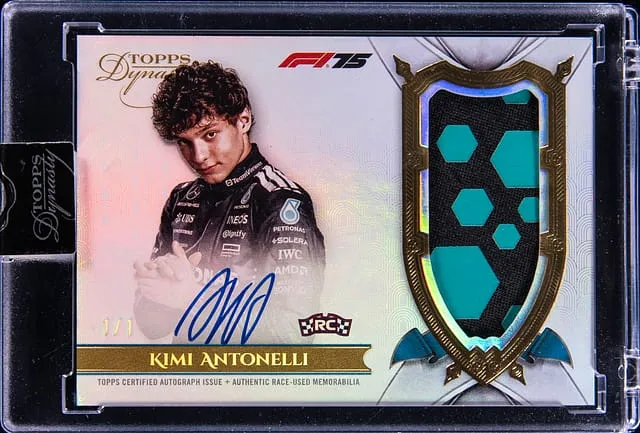
Kimi Antonelli 2025 Dynasty F1 Gold 1/1 Sells for $51K
Goldin sold a 2025 Topps Dynasty F1 Kimi Antonelli Gold 1/1 rookie auto patch for $51,240. Here’s what it means for F1 card collectors.
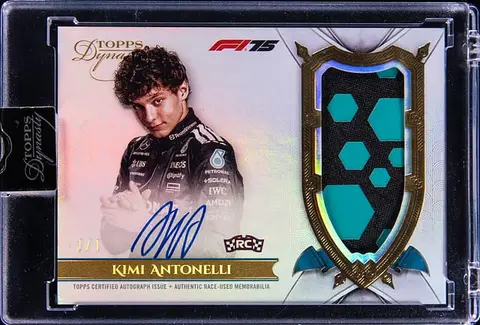
Sold Card
2025 Topps Dynasty F1 Autograph Patch Gold #DAP-AANIII Kimi Antonelli Signed Race-Used Patch Rookie Card (#1/1) - Topps Encased
Sale Price
Platform
Goldin2025 Topps Dynasty F1 Antonelli Gold 1/1 Auto Patch Sells for $51,240
On March 6, 2026, Goldin closed a notable ultra‑modern Formula 1 sale: a 2025 Topps Dynasty F1 Autograph Patch Gold #DAP‑AANIII Kimi Antonelli Signed Race‑Used Patch Rookie Card, serial‑numbered 1/1, Topps‑encased, realized $51,240.
For an emerging F1 talent who has not yet built the kind of statistical résumé we associate with long‑term hobby staples, this result is an important market signal. Below, we’ll break down what the card is, why it matters, and how this sale fits into the broader F1 card landscape.
Card Breakdown: What Exactly Sold?
Let’s unpack the full title and what each part means for collectors:
- Year & Product: 2025 Topps Dynasty F1
- Dynasty is Topps’ high‑end, low‑print‑run brand for premium autograph and patch cards. In F1, it functions as a key ultra‑modern “luxury” release.
- Player: Kimi Antonelli
- Highly rated young Mercedes‑linked driver, widely discussed as a potential future star in F1.
- Card Name & Number: Autograph Patch Gold #DAP‑AANIII
- “Autograph Patch” indicates a signed card that also contains a piece of memorabilia.
- The card number (DAP‑AANIII) is the checklist ID within the Dynasty set.
- Parallel: Gold, serial‑numbered 1/1
- A 1/1 (one‑of‑one) means there is only a single copy of this exact card. Gold is one of the premium parallels in Dynasty.
- Rookie Status: Rookie card (RC)
- Within F1 cards, early‑career and first‑Dynasty issues often function as a player’s key rookie or first‑premium auto patch.
- Autograph & Patch:
- On‑card signature (signed directly on the card, not on a sticker).
- Race‑used patch, indicating the swatch is from gear used in actual race activity, not just photo‑shoot or event‑worn.
- Encapsulation: Topps Encased
- Dynasty cards typically leave the factory in a sealed Topps holder with a sticker, which acts as the original manufacturer’s seal. This is different from third‑party grading (PSA, BGS, SGC) and doesn’t include a numerical grade.
Taken together, this is a true premium rookie‑era piece: on‑card auto, race‑used patch, 1/1 parallel, and factory sealed by Topps.
Market Context: How Does $51,240 Compare?
The hammer price for this card at Goldin was $51,240 USD. To understand that number, it helps to look at how comparable cards have behaved historically.
Because this specific card is a 1/1, there are no direct duplicate comps (short for “comparables,” meaning past sales of the same or very similar cards used as price references). Instead, collectors usually look at:
- Other Kimi Antonelli premium autos (especially from Dynasty or similarly high‑end sets)
- Other young F1 driver 1/1 Dynasty rookies
- Historical Dynasty F1 1/1s for established stars
Within those lanes, recent years have shown:
- Top‑tier established drivers (for example, champion‑level stars) see their 1/1 Dynasty auto patch rookies or early‑career cards reach well into five figures and, in some cases, significantly higher.
- Secondary or emerging drivers’ 1/1 Dynasty cards often land in a much wider and more volatile range, depending on performance, team context, and collector sentiment at the time of auction.
In that framework, $51,240 sits toward the upper end of what we’ve seen for young, not‑yet‑fully‑proven F1 talents, especially for a Topps‑encased but ungraded copy. That suggests a few things:
- Strong confidence in Antonelli’s upside from at least two determined bidders.
- Continued respect for Dynasty F1 as the go‑to high‑end brand for ultra‑modern F1 rookies.
- Ongoing demand for 1/1 auto patch rookies as centerpiece cards in F1 player (or driver) collections.
Because this is a one‑of‑one, future sales will likely be private if the card changes hands again. Public auction results like this Goldin sale therefore serve as key reference points for the hobby.
Why Collectors Care About This Card
Several factors converge to make this card important for both player collectors and broader F1 hobby watchers.
1. Early‑Career / Rookie‑Era Keystone
In modern trading cards, a player’s flagship rookie and their first premium auto‑patch cards tend to become long‑term reference pieces if the career pans out. For F1 specifically:
- 2025 Dynasty represents one of the earliest high‑end, on‑card auto patch issues for Kimi Antonelli.
- A Gold 1/1 is the top of the ladder for that card’s parallel hierarchy.
If Antonelli grows into a front‑running or championship‑caliber driver, this card will likely be mentioned whenever collectors talk about his earliest and most important cardboard.
2. Dynasty F1’s Role in the Ultra‑Modern Era
The ultra‑modern era (roughly mid‑2010s onward) is defined by:
- Limited print runs
- High‑end inserts and parallels
- Autograph and memorabilia combinations
Within F1, Topps Dynasty is one of the flag bearers of this approach. Dynasty is known for:
- Low‑serial autographs and autograph patch cards
- Strong checklist curation
- Factory encasing that positions the cards as premium collectibles from the start
Because of that, a Dynasty 1/1 rookie auto patch functions almost like a combined RPA (rookie patch auto) and “grail” parallel in one.
3. On‑Card Autograph + Race‑Used Patch
Collectors often prefer on‑card autographs over sticker autos because the player actually signed the surface of the card itself. Coupled with a race‑used patch, this card has two layers of authenticity:
- The signature ties directly to the driver.
- The patch connects the card to real track activity.
That combination typically places an auto patch card at or near the top of a player’s hierarchy in any given release.
4. Serial‑Numbered 1/1
A 1/1 has no direct peers. For player collectors, this often becomes:
- A centerpiece for a player‑focused collection.
- A key display piece at shows or in hobby content.
For broader market watchers, a 1/1 sale offers insight into how much top bidders currently value the player’s long‑term potential.
What This Sale Tells Us About the F1 Card Market
While we should avoid reading too much into any single auction, this Goldin result lines up with a few ongoing themes in F1 cards:
High‑End, Low‑Supply Cards Still Draw Bidders
- Even in periods when the broader market feels more selective, truly scarce, premium pieces continue to attract competition. This card checks almost every box: 1/1, on‑card auto, race‑used patch, rookie‑era, Dynasty branding.
Prospect‑Style Risk/Reward Is Now Part of F1 Collecting
- Historically, prospecting (buying early cards of unproven players) was more associated with sports like baseball. Modern F1 cards now show similar patterns: collectors are willing to pay up early for drivers they believe can anchor a collection later.
Auction Houses Remain the Venue for Trophy Cards
- A card like this tends to surface in major auction houses (Goldin, in this case) rather than fixed‑price marketplaces. That visibility helps establish public price context for the top end of a driver’s market.
Things to Watch Going Forward
For collectors and small sellers tracking this segment of the market, here are a few practical takeaways:
Follow related Antonelli cards:
- Watch sales of non‑1/1 2025 Dynasty Antonelli autos and patches.
- Keep an eye on more accessible issues (e.g., Chrome, paper rookies) to see how interest filters down from the high‑end headlines.
Compare across drivers:
- When other young F1 drivers’ Dynasty 1/1 rookies sell, note whether they come in above, in line with, or below this $51,240 result.
Condition and Grading Decisions:
- This card is Topps‑encased, not third‑party graded. Some collectors crack and submit Dynasty cards to PSA, BGS, or SGC; others prefer the original seal.
- If you own similar high‑end Dynasty pieces, it can be useful to follow sales both in original Topps encasement and in graded slabs to understand how the market values each presentation.
Final Thoughts
The March 6, 2026 Goldin sale of the 2025 Topps Dynasty F1 Autograph Patch Gold #DAP‑AANIII Kimi Antonelli 1/1 rookie‑era auto patch at $51,240 is a clear marker for how the market currently views:
- Top‑end Dynasty F1 rookies
- Early‑career bets on highly regarded young drivers
- The combination of 1/1 scarcity, on‑card autos, and race‑used memorabilia
For collectors, it’s one more data point in a still‑evolving F1 landscape—and a reminder that, even in an information‑rich hobby, the very top cards are often decided one auction at a time, when two determined bidders meet on the same night.
If you’re tracking F1 cards or planning your own collecting strategy around new drivers, sales like this are worth bookmarking—not as predictions, but as context for how the market is currently thinking about risk, rarity, and long‑term potential.