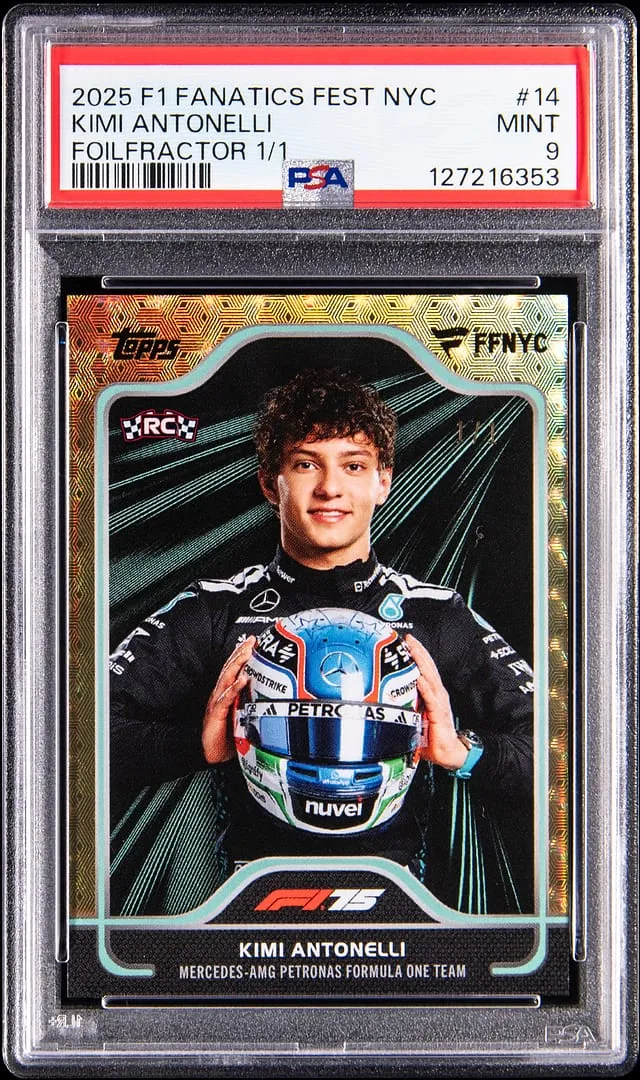
Kimi Antonelli 1/1 FoilFractor Rookie Sells for $22K
Deep dive on the 2025 Topps F1 Fanatics Fest NYC 1/1 Kimi Antonelli FoilFractor Rookie PSA 9 that sold for $22,265 at Goldin on May 15, 2026.
Sold Card
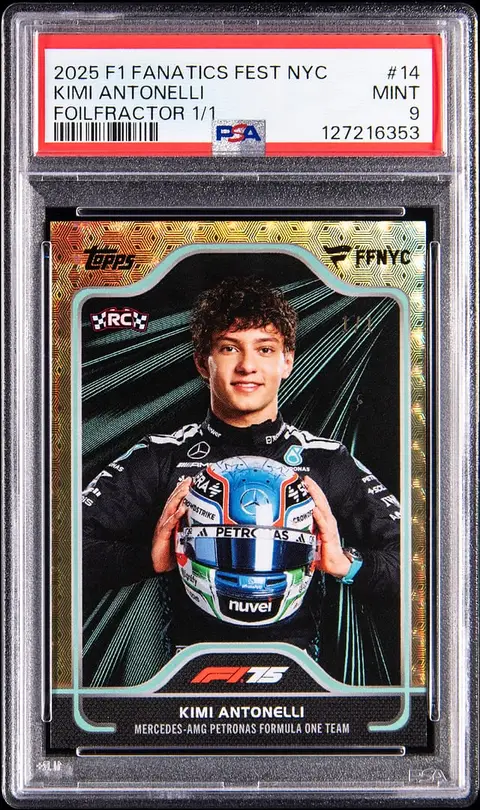
2025 Topps F1 Fanatics Fest NYC FoilFractor #14 Kimi Antonelli Rookie Card (#1/1) - PSA MINT 9
Sale Price
Platform
GoldinThe 2025 Topps F1 Fanatics Fest NYC FoilFractor #14 Kimi Antonelli Rookie Card (#1/1) in a PSA MINT 9 holder just changed hands at Goldin on May 15, 2026 for $22,265.
For an ultra-modern Formula 1 card, this sale checks a lot of hobby boxes: a key rookie, a true 1/1 parallel, an early special-event release, and a strong third‑party grade.
Card overview
Let’s break down exactly what this card is:
- Player: Kimi Antonelli
- Team (at time of issue): Mercedes junior system (highly touted prospect connected to Mercedes F1)
- Year: 2025
- Product: Topps F1 Fanatics Fest NYC (event-based release)
- Subset: FoilFractor parallel
- Card number: #14
- Serial numbering: 1/1 (the only copy of this FoilFractor)
- Rookie designation: Rookie Card (early Antonelli F1‑licensed issue)
- Grading company: PSA
- Grade: PSA MINT 9
- Attributes: Non‑auto, non‑patch, but a true 1/1 parallel from a special event release
Ultra-modern F1 collectors will recognize FoilFractor as one of Topps’ premium, rainbow‑style parallels. In this case, it is the lone copy for this specific Antonelli card.
Why this card matters for collectors
1. Early Kimi Antonelli F1 rookie
Kimi Antonelli is one of the most closely watched young drivers tied to Mercedes’ future. Any early, licensed card with a rookie designation is going to draw attention, especially when it’s tied to a recognizable Topps F1 release.
In card terms, this is:
- A rookie card (one of his first mainstream F1 cards).
- A premium rookie parallel (FoilFractor, 1/1) rather than a base card.
For collectors who like to focus on a player’s “key issues” (their most important and chased cards), a 1/1 rookie parallel from an official Topps F1 release will usually sit near the top of any Antonelli-focused checklist.
2. 1/1 FoilFractor from an event release
The “Fanatics Fest NYC” branding tells us this is not a mass‑market hobby box release; it’s tied to a specific event. Event-based Topps releases are typically shorter‑printed than flagship sets and often use exclusive parallels to make them stand out.
Key factors:
- True 1/1: The serial number 1/1 confirms there should be only one FoilFractor of this card.
- Special event origin: Cards issued around Fanatics or hobby events can become historical markers of where the hobby was at a given moment, especially in ultra‑modern sports like F1.
Because the run is so limited, collectors can’t rely on a population report (the count of graded copies) the way they would with a base or numbered parallel. For a 1/1, the pop report will usually never get large; the real question is what grade that single copy receives.
3. PSA MINT 9 on a foil 1/1
Foil-based cards are often prone to:
- Surface scratching
- Edge and corner chipping
- Print lines
A PSA MINT 9 is a strong outcome for a modern foil 1/1, especially one that likely came straight from a non-traditional distribution channel (event packs or on‑site product).
When collectors compare high‑end 1/1s, the grade often acts as a tiebreaker. A lone copy in PSA 9 has a clear condition benchmark: you’re not just buying scarcity, you’re locking in a quality standard that’s already been vetted.
Market context and price discussion
This card sold at Goldin on May 15, 2026 for $22,265.
Because this is a serial‑numbered 1/1 rookie parallel, there are no identical recent sales to line up as direct comparisons. A true 1/1 doesn’t have traditional “comps” (short for comparables, or similar recent sales) the way a /50 or /99 card does.
Instead, collectors usually look at:
- Other Kimi Antonelli rookies in high‑end parallels (e.g., Superfractor, Gold /50, Red /5) and their realized prices.
- Premium 1/1 rookies from other modern F1 prospects or stars in comparable Topps F1 products.
- Big‑name 1/1 rookies in other sports to get a directional sense of what serious prospecting collectors have been willing to pay.
From recent ultra‑modern F1 trends:
- Early 1/1 or Superfractor rookies for top drivers (or heavily hyped prospects) have often realized five‑figure prices when they surface at major auction houses.
- Event‑based and special‑release Topps F1 cards don’t always match the visibility of flagship Chrome or Dynasty, but unique designs and parallels can still attract strong bidding when they’re a player’s earliest or rarest issues.
Within that broader context, $22,265 for a PSA 9 1/1 rookie parallel of a heavily watched Mercedes prospect is consistent with how the modern F1 market has treated similar “only copy in existence” rookie cards for high‑ceiling drivers.
Because this is a very new 2025 release, there is not yet a long track record of repeat sales or resale cycles to analyze. That means we can talk about where this fits among early ultra‑modern F1 prospect cards, but we can’t yet place it against a decade of market history the way we can with early Lewis Hamilton or Max Verstappen issues.
Where it fits in the ultra-modern F1 landscape
F1 cards as a mainstream hobby category are still relatively young, with Topps’ recent run of F1 products defining the “ultra-modern” era. In that context, this card sits at the intersection of a few important trends:
Prospect-driven collecting:
More collectors now treat F1 closer to how they treat baseball prospects—targeting key rookies and early parallels of drivers before or as they enter the top series.Event and alternative releases:
Instead of focusing only on flagship sets, collectors are paying more attention to special‑event issues, Fanatics collaborations, and limited drops, especially when they feature notable parallels like FoilFractors.Third‑party grading as a standard:
High‑end modern buyers increasingly prefer PSA‑graded copies, particularly in the PSA 9–10 range, because it reduces ambiguity about condition on sensitive foil stock.
This 2025 Topps F1 Fanatics Fest NYC Antonelli FoilFractor combines all three: prospect, event-based release, and a strong PSA grade.
What collectors can take away from this sale
For newcomers, returning collectors, and small sellers watching F1 cards, here are a few practical observations:
1/1s behave differently from numbered parallels.
- You won’t find a neat chart of recent comps because there is only one copy.
- Auction results are more about how many serious bidders show up at a given time than about a stable, repeatable price range.
Context matters more than just “1/1.”
- Player trajectory, team association, and how widely recognized the product is all feed into the final number.
- A 1/1 of a marginal driver from a fringe release won’t behave like a 1/1 rookie of a high‑profile Mercedes prospect.
Grading can be a separator even for 1/1s.
- Technically, whoever wants this specific card has no alternative.
- But condition still matters when someone decides whether to bid aggressively, especially for modern foils. A PSA MINT 9 gives this card a clean, marketable anchor.
Auction houses set the stage for visibility.
- A sale at Goldin on May 15, 2026, means the card was shown in front of an audience that tracks high‑end modern and ultra‑modern cards.
- That visibility can help establish an early reference point for future Antonelli 1/1 and low‑numbered rookie sales.
Final thoughts
The 2025 Topps F1 Fanatics Fest NYC FoilFractor #14 Kimi Antonelli Rookie Card (#1/1) in PSA MINT 9 is a good snapshot of where the ultra‑modern F1 market is today: focused on prospects, tuned into event‑based releases, and comfortable paying five‑figure sums for true 1/1 rookies that check the right boxes.
For collectors, it doesn’t need to be read as a prediction or guarantee—just as a clear, documented data point for how the market valued an early, unique Antonelli rookie at a specific moment in time. Future sales of his other rookies, parallels, and graded copies will help fill in the longer-term picture.
If you track F1 prospects or build driver‑focused collections, this Goldin sale on May 15, 2026 is one worth bookmarking—both for the card itself and for what it says about how collectors are approaching the next wave of F1 talent.