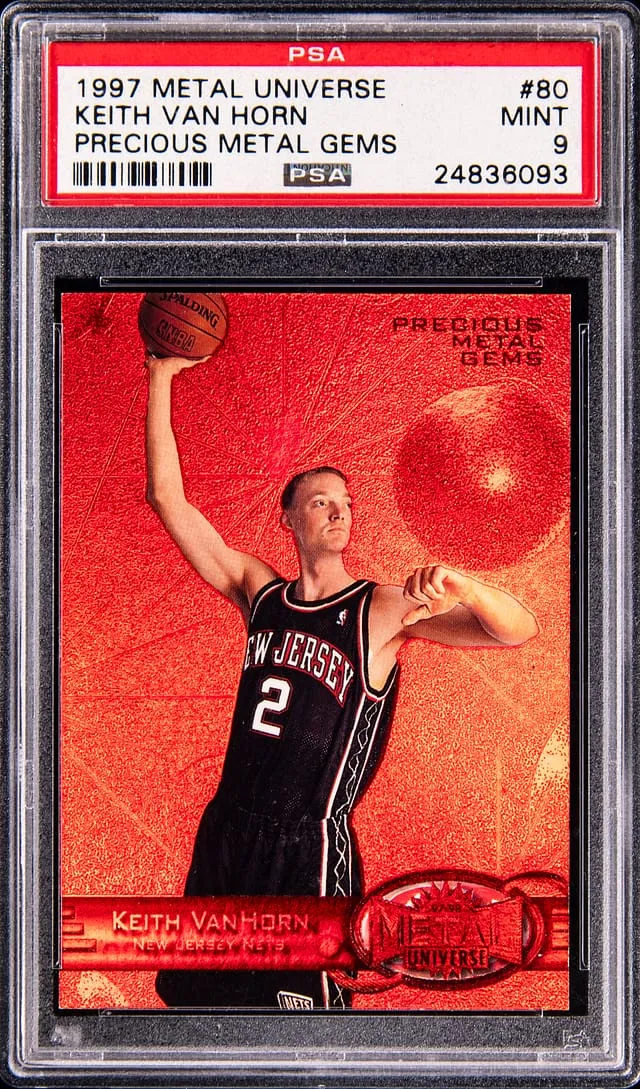
Keith Van Horn 1997 PMG Red PSA 9 Sells for $41K
Breaking down the $41,480 goldin sale of the 1997-98 Metal Universe PMG Red Keith Van Horn Rookie PSA 9, a Pop 1 gem from a landmark 1990s set.
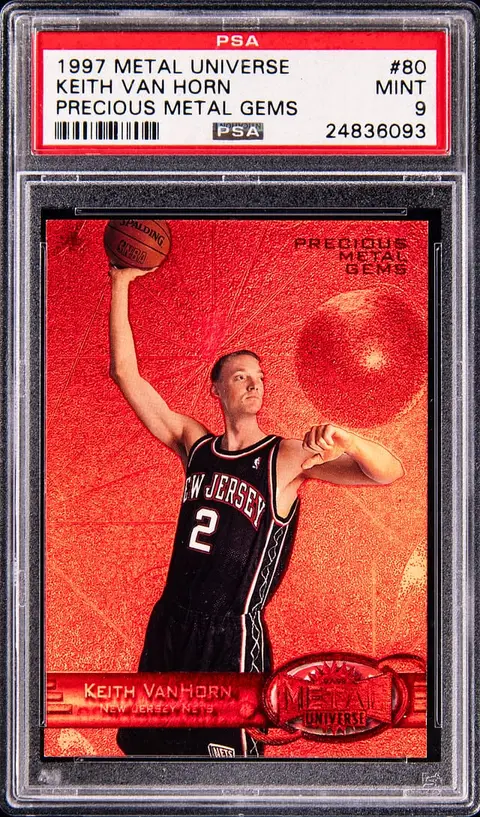
Sold Card
1997-98 SkyBox Metal Universe Precious Metal Gems (PMG) Red #80 Keith Van Horn Rookie Card (#026/100) - PSA MINT 9 - Pop 1
Sale Price
Platform
Goldin1997-98 SkyBox Metal Universe Precious Metal Gems (PMG) Red cards sit near the top of 1990s basketball collecting, and a recent result at goldin on 2026-03-15 put a spotlight on one of the more under-discussed names in that iconic checklist: Keith Van Horn.
The card: a 1997-98 SkyBox Metal Universe Precious Metal Gems Red #80 Keith Van Horn Rookie Card, serial numbered 026/100 and graded PSA MINT 9. It realized $41,480 at auction.
In this post, we’ll walk through what this card is, why PMG Reds matter so much to collectors, and how this sale fits into the broader market for 1990s high-end inserts.
Card overview
Here are the basics of the card:
- Player: Keith Van Horn (rookie year)
- Team: New Jersey Nets
- Season: 1997-98
- Set: SkyBox Metal Universe
- Parallel: Precious Metal Gems Red
- Card number: #80
- Serial numbering: 026/100
- Grading company: PSA (Professional Sports Authenticator)
- Grade: PSA MINT 9
- Population: Pop 1 (only one copy in PSA 9, with none higher at the time of sale)
Van Horn’s 1997-98 Metal Universe PMG Red is a true rookie-year parallel from one of the defining insert/parallel lines of the 1990s. The PMG format combines bold, etched-metal style graphics with a strict serial number run that has become a blueprint for modern low-numbered parallels.
What makes PMG Reds important
For newer or returning collectors, it helps to place this sale within the context of the PMG brand.
Short print and configuration
In 1997-98 SkyBox Metal Universe basketball, the Precious Metal Gems cards are split across:
- Green PMG: serial numbered to 10
- Red PMG: serial numbered from 11 to 100 (90 copies)
That means the Reds have a maximum of 90 copies, less any that were damaged, lost, or never survived the late-1990s hobby.
Add in condition sensitivity—edge chipping, surface scratching, and easily-damaged foil—and high-grade examples are significantly tougher than the raw serial number suggests. A PSA 9 in this parallel typically reflects strong centering and very limited edge or surface wear.
Set and era significance
The 1997-98 Metal Universe PMGs are widely viewed as a cornerstone of the 1990s insert era:
- Era: Late 1990s “inserts & parallels” boom
- Aesthetic: Loud, futuristic designs combined with bright colors and intricate backgrounds
- Influence: Helped shape how modern low-serial, color-based parallels are designed and collected
While the headliners of the set are names like Michael Jordan, Kobe Bryant, Tim Duncan, and other Hall of Famers, player collectors and PMG set-builders also chase rookies and secondary stars. That creates a deeper market than you might expect for non-superstar names.
Keith Van Horn, the No. 2 overall pick in the 1997 NBA Draft, sits firmly in that second tier—important to Nets-focused collectors, 1997 draft class collectors, and 1990s-era enthusiasts building PMG runs.
Grading, pop report, and scarcity
When collectors talk about “pop report,” they mean the population data that grading companies publish—how many copies of a specific card they’ve graded at each grade level. In this case:
- The featured card is a PSA 9 (MINT)
- At the time of sale, this copy carried a Pop 1 designation in PSA’s population report
Pop 1 simply means this is the only known copy in that grade in the PSA system. Combined with:
- Very low original print run (max 90 Reds)
- Known condition sensitivity
- 1990s survivorship issues (peeling, chipping, storage damage)
…a Pop 1 in PSA 9 underlines how rarely this card appears at the top end of the condition curve.
There may be ungraded copies or examples in other grading company slabs, but within PSA’s ecosystem, this sale involved the single highest-graded Van Horn PMG Red at the time.
Market context and recent sales
The card sold at goldin on 2026-03-15 for $41,480. To understand what that means, it helps to look at broader context rather than any single comp.
Because this is a Pop 1 PSA 9 with a scarce, 1990s limited-production parallel, direct “apples-to-apples” recent sales are limited or nonexistent. Instead, collectors typically triangulate value using:
- Sales of the same card in lower grades or raw
- Sales of similar-tier PMG Reds from the same set (other rookies or comparable names)
- Sales of other 1997-98 PMG Reds in PSA 9 to understand how the market generally prices this grade for the parallel
From public auction and marketplace records up through early 2026, patterns around 1997-98 PMG Reds show:
- Superstar PMGs (Jordan, Kobe, Duncan, etc.) often command very significant premiums, especially in high grade.
- Mid-tier stars and key rookies can still reach strong five-figure levels when:
- Population is extremely low in top grades
- The card appeals to set builders and player collectors
- Lower-grade PMG Reds (PSA 6–8) for non-superstar names trade at noticeably lower levels, reflecting both condition and broader demand differences.
With this specific Keith Van Horn PMG Red PSA 9 being a Pop 1, there is little precise, recent sales history that pins down an “expected” price. Instead, the $41,480 result positions the card as a premium-level 1990s insert for an important draft-class name rather than a headlining franchise legend.
For collectors and small sellers, that’s useful as a directional data point: high-grade, low-pop 1990s PMG Reds—even for non-Hall-of-Fame names—can reach serious price territory when they surface in strong condition through a major auction house.
How this sale fits into the PMG market
This goldin result reinforces a few ongoing themes in the 1990s insert and parallel segment:
Grade drives separation
For condition-sensitive 1990s issues, PSA 9 and higher can behave almost like a different asset class from PSA 7–8. That gap often widens as the pop report tightens.Set matters as much as the player
PMG branding, 1997-98 Metal Universe design history, and the parallel’s reputation all contribute to demand. Even though Van Horn is not a hobby headliner on the level of Jordan or Kobe, the set itself commands attention.Supply is structurally limited
With a maximum of 90 serial-numbered copies (and fewer surviving in strong condition), there is built-in scarcity. Once a Pop 1 PSA 9 lands in a long-term collection, it may not resurface for years.Nostalgia for 1990s basketball remains strong
Collectors who grew up in the 1990s often focus on this era when they return to the hobby. PMGs are near the top of the list of cards they remember reading about in old price guides and hobby magazines.
What this means for different types of collectors
Every collector approaches a card like this differently. Here are a few ways to interpret the sale, depending on where you are in the hobby.
New or returning collectors
If you’re just getting into 1990s inserts, the $41,480 result for a Keith Van Horn PMG Red PSA 9 serves as a reminder that:
- PMGs sit in the “high-end, low-supply” category of 1990s cards.
- Even non-superstar names can achieve strong prices when the card is rare, condition-sensitive, and historically important.
You don’t need to start at this price tier. Many collectors begin with:
- Later-year PMG-style releases
- Lower-grade or less iconic inserts from the same era
- Base rookies and more common parallels before moving into serial-numbered 1990s issues
Active hobbyists
For experienced collectors and small sellers, this sale at goldin on 2026-03-15:
- Adds one more data point to the pricing curve of non-superstar 1997-98 PMG Reds in high grade.
- Suggests that set builders and 1997-98 specialists remain active at the higher end of the market.
- Highlights that grade plus pop report can elevate a card into a different budget tier than its raw or lower-grade counterparts.
If you’re evaluating similar cards, consider tracking:
- Grading company population reports over time
- Auction archives across multiple houses (not just one marketplace)
- How prices move for other PMG Reds of similar player tiers and grades
Sellers and small dealers
For small sellers or dealers who might encounter 1990s inserts in collections:
- This sale illustrates why it’s worth carefully reviewing condition-sensitive 1990s parallels before assuming they’re low-value.
- Checking the serial numbering, surface, and edges, then cross-referencing with population reports, can uncover sleepers in old boxes.
- For very low-pop, high-grade cards, major auction houses like goldin can provide reach and visibility that smaller platforms may not.
Player and hobby context
Keith Van Horn’s career included:
- Selection as the No. 2 overall pick in the 1997 NBA Draft
- Productive early seasons with the New Jersey Nets
- A role in several playoff runs during the early 2000s
While he’s not typically grouped with Hall-of-Fame-level names from his era, he is firmly part of the late-1990s NBA story. For collectors who focus on the 1997 draft class, the Nets, or 1990s rookie parallels, cards like this PMG Red form the high end of a PC (personal collection).
In the broader hobby, interest in 1990s inserts and parallels has remained steady, with periodic spikes when:
- High-grade examples surface at public auction
- Record prices for Jordan, Kobe, or Duncan PMGs draw new attention to the set as a whole
This particular result doesn’t rewrite the PMG market on its own, but it does confirm ongoing demand for high-grade, low-pop PMGs across the entire checklist—not just the biggest stars.
Key takeaways
Summing up the goldin sale on 2026-03-15:
- Card: 1997-98 SkyBox Metal Universe Precious Metal Gems Red #80 Keith Van Horn Rookie Card (#026/100)
- Grade: PSA MINT 9
- Population: Pop 1 at the time of sale
- Realized price: $41,480 (USD)
- Context: High-end, 1990s serial-numbered parallel from a landmark insert/parallel line, with extremely limited high-grade supply.
For collectors watching the 1990s high-end market, this sale supports the view that:
- PMG Reds remain a reference point for scarcity and design in the era.
- Grade, pop report, and set prestige can significantly affect outcomes, even for non-headliner players.
- Carefully curated 1990s collections with PMGs may hold more depth and value than surface-level star power suggests.
At figoca, we track sales like this to help collectors understand not just what a card sold for, but why it reached that level—so you can place your own 1990s inserts and parallels in a clearer, data-aware context.