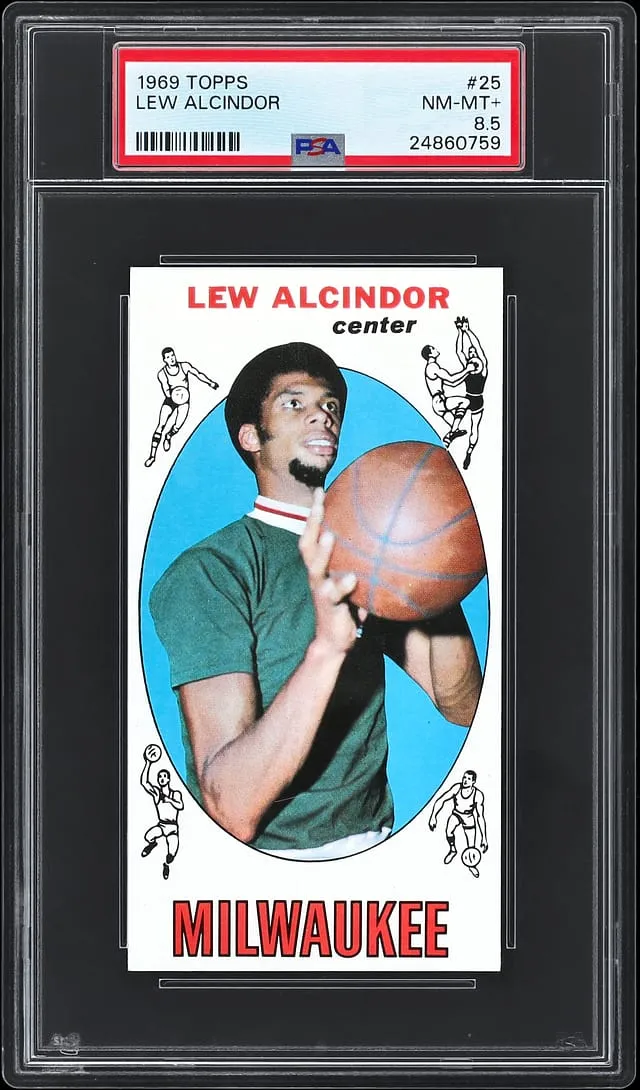
Kareem 1969 Topps Rookie PSA 8.5 Sells for $81K
Goldin sold a 1969-70 Topps #25 Lew Alcindor (Kareem) rookie PSA 8.5 for $81,740. See the market context and what it means for collectors.
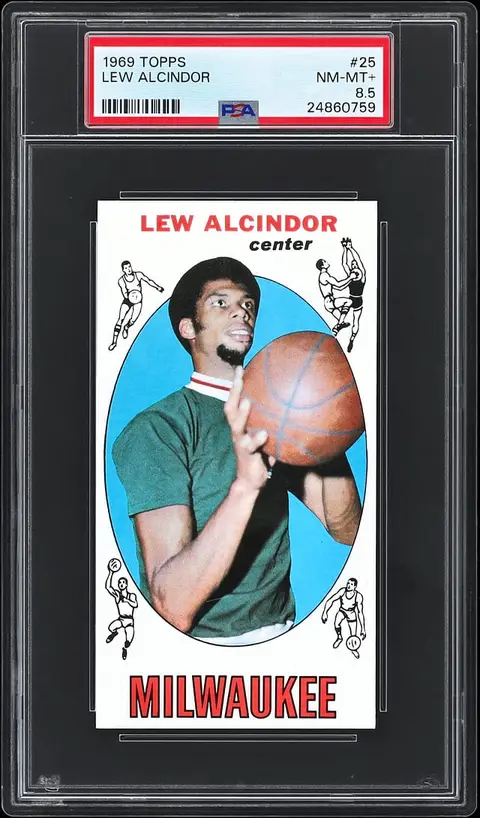
Sold Card
1969-70 Topps #25 Lew Alcindor (Kareem Abdul-Jabbar) Rookie Card - PSA NM-MT+ 8.5
Sale Price
Platform
Goldin1969-70 Topps #25 Lew Alcindor (Kareem Abdul-Jabbar) Rookie Card - PSA NM-MT+ 8.5 Sells for $81,740
On March 8, 2026, Goldin sold a 1969-70 Topps #25 Lew Alcindor (Kareem Abdul-Jabbar) rookie card graded PSA NM-MT+ 8.5 for $81,740. For vintage basketball collectors, this is one of the hobby’s foundational cards, and this result offers a useful check-in on where high-end Kareem rookies are trading today.
The card: Kareem’s flagship rookie in high grade
Key details:
- Player: Lew Alcindor (Kareem Abdul-Jabbar)
- Team: Milwaukee Bucks
- Year / Set: 1969-70 Topps Basketball
- Card number: #25
- Type: True flagship rookie card (widely recognized key issue)
- Era: Vintage
- Grading company: PSA (Professional Sports Authenticator)
- Grade: NM-MT+ 8.5 (near mint-mint plus)
- Attributes: Standard base rookie (no autograph, no patch, no serial numbering)
The 1969-70 Topps set is known for its oversized “tall boy” format and for anchoring the early modern era of basketball cards. Within that checklist, the Lew Alcindor rookie is the headliner, serving the same role in vintage basketball that the 1957 Topps Bill Russell or 1961 Fleer Wilt Chamberlain do in their respective issues.
A PSA 8.5 sits in a narrow band between the more common PSA 8 and the far more expensive PSA 9. These half grades matter in vintage because surface, centering, and print issues are common, and each small bump up the grading scale can come with a meaningful change in price.
Why this card matters to collectors
Several factors give this card long-term importance in the hobby:
All-time great player
Kareem Abdul-Jabbar is consistently ranked near the very top of all-time NBA lists. He held the all-time scoring record for decades, won six NBA titles, and collected six MVP awards. For many collectors, his rookie card is a cornerstone of any serious basketball collection.Era and scarcity
As a vintage (pre-1980) issue, this card was printed in significantly smaller numbers than modern and ultra-modern cards. Survival in high grade is a challenge because:- The tall-boy size leads to edge and corner wear.
- Centering can be inconsistent.
- Many copies were handled as toys, not collectibles.
While PSA’s population report (often called the “pop report,” which is simply a count of how many copies exist in each grade) shows that the card is not rare in low to mid grades, high-grade examples (PSA 8 and above) are comparatively limited relative to demand.
Flagship rookie status
A “flagship rookie” is the main, widely recognized rookie card for a player in a primary base set, as opposed to a niche regional or oddball release. For Kareem, this is it. There is no parallel, short-print, or serial-numbered variant to complicate the picture. That simplicity keeps demand focused on this card.Set reputation
1969-70 Topps anchors a key transition period for basketball cards. It’s a short, star-heavy set with several important rookies and stars, and its design is instantly recognizable. This combination tends to support long-term collector interest.
Market context: how $81,740 fits in
To understand this sale, it helps to look at recent comps—short for comparables, meaning recent sales of the same card or very similar cards in nearby grades.
PSA 8.5 vs nearby grades
Public auction records over the past few years show a consistent hierarchy:
- PSA 9: Commands a large premium as a true high-end investor/collector grade, with prices often well into six figures depending on timing and market conditions.
- PSA 8.5: Sits as a bridge between 8 and 9, typically trading at a notable premium to PSA 8 but still at a discount to PSA 9.
- PSA 8: More frequently transacted, providing a stable reference point for market trends.
Across major auction houses and marketplaces, PSA 8.5 copies of this card have commonly sold for amounts that place them clearly above PSA 8 sales but below the sometimes volatile PSA 9 results. While exact figures vary with the broader market cycle, the $81,740 realized at Goldin on March 8, 2026 is broadly consistent with the idea of 8.5 as a premium grade without crossing into the rarified air of 9s.
When looking at prior high-water marks, the strongest record prices for this card have typically been for PSA 9 examples and, at the very top, exceptionally strong sales of PSA 10s (which are extremely scarce). Against that backdrop, this $81,740 result does not signal a new all-time record for the card overall, but it does help define the current band for strong PSA 8.5 copies.
Vintage basketball environment
Vintage basketball has been relatively steadier than some segments of modern and ultra-modern, which can swing sharply on short-term player performance or hype cycles. Kareem’s place in history is established, and his on-court résumé is complete, which often leads to more measured moves in his market.
Broader hobby trends that can influence this card include:
- Renewed attention on all-time greats as collectors diversify beyond modern prospects.
- Interest in completing iconic vintage runs (Russell, Wilt, Oscar Robertson, Jerry West, Kareem, Julius Erving, Larry Bird, Magic Johnson, Michael Jordan) where the Kareem rookie is a key puzzle piece.
Recent hobby conversation around all-time rankings and the passing of the all-time scoring torch has also kept Kareem’s name in circulation, which can support steady demand for his major cards even without any new on-court achievements.
Reading this sale without overreacting
For collectors and small sellers, it’s useful to see this sale as one data point among many, not a guarantee of future prices.
Some practical takeaways:
- Grade sensitivity is real. The gap between PSA 8, 8.5, and 9 can be large enough to justify the cost of careful screening and, in some cases, professional review before grading or regrading.
- Eye appeal still matters. Even within the same numerical grade, centering, print quality, and overall presentation can influence bidding. Strong results like this often reflect a combination of numerical grade and visual appeal.
- PSA 8 and below remain the entry path. While PSA 8.5 and above have moved into a higher price tier, there are still opportunities in lower grades for collectors who value owning the card more than chasing the top of the pop report.
What this means for different types of collectors
New or returning collectors:
This sale underscores why Kareem’s 1969-70 Topps rookie is considered a “must-know” card. Even if you are looking in lower grades or raw (ungraded) copies, understanding where high-grade examples trade can help you evaluate whether an asking price for a mid-grade card feels in line with the broader market.Active hobbyists and small sellers:
Watching PSA 8.5 and 9 sales can help you benchmark your own copies. When you see a strong, well-photographed auction like this one at Goldin, it’s a useful reference point for how buyers are currently valuing centering and condition at the high end.Long-term vintage collectors:
For those building comprehensive vintage basketball runs, this sale reinforces the continued liquidity and relevance of the Kareem rookie in strong grades. While the card’s biggest record prices sit in PSA 9 and 10, solid mid- to high-grade results like this help define the “middle tiers” of the market.
Final thoughts
The $81,740 sale of a 1969-70 Topps #25 Lew Alcindor rookie card in PSA NM-MT+ 8.5 at Goldin on March 8, 2026 fits neatly into the established story of this card: a cornerstone vintage basketball rookie that continues to attract serious bidding at the top end of the grading scale.
For collectors, the lesson is less about chasing records and more about understanding how condition, grade scarcity, and set history work together. Whether you’re holding a lower-grade copy, considering an upgrade, or simply studying the market, this sale is a clear snapshot of where a premium but not ultra-elite grade currently stands for one of basketball’s most important rookie cards.