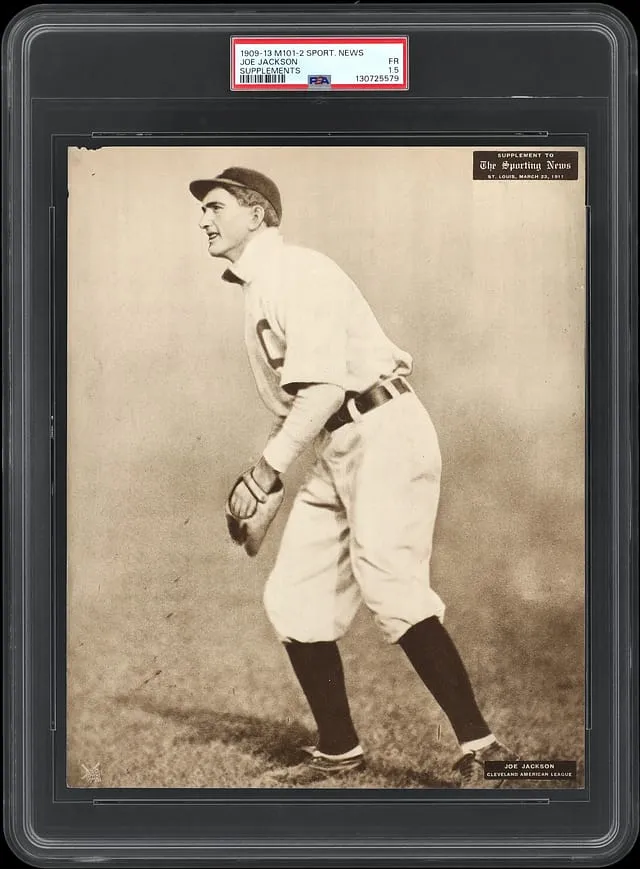
Joe Jackson M101-2 PSA 1.5 Sells for $16,477 at Goldin
Figoca breaks down the $16,477 sale of a PSA 1.5 1909-13 M101-2 Sporting News Supplements Joe Jackson at Goldin on February 22, 2026.
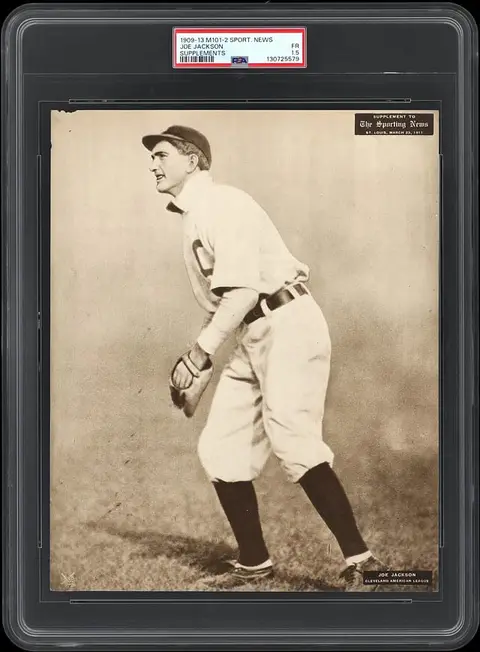
Sold Card
1909-13 M101-2 Sporting News Supplements Joe Jackson - PSA FR 1.5 - POP 3; Only 2 Higher PSA Copies
Sale Price
Platform
Goldin1909-13 M101-2 Sporting News Supplements Joe Jackson (PSA FR 1.5) Sells for $16,477 at Goldin
The vintage baseball market continues to show quiet strength at the very top end of pre-war issues. On February 22, 2026, Goldin closed the sale of a 1909-13 M101-2 Sporting News Supplements Joe Jackson graded PSA FR 1.5 for $16,477.
For a supplement that’s well over a century old, sitting near the top of the population report, this sale offers a useful snapshot of how advanced collectors are currently valuing one of “Shoeless” Joe Jackson’s most important early appearances.
Card overview: what exactly sold?
- Player: Joe Jackson ("Shoeless" Joe Jackson)
- Team (pictured): Cleveland Naps (Cleveland’s American League club before they became the Indians/Guardians)
- Years issued: 1909–1913
- Set: M101-2 Sporting News Supplements
- Format: Large paper supplement (roughly 7.5" x 10" range, depending on trimming/handling)
- Publisher: The Sporting News
- Grading company: PSA (Professional Sports Authenticator)
- Grade: FR 1.5 (Fair)
- Population: PSA pop 3 in FR 1.5, with only 2 higher-graded copies on record at PSA at the time of sale
- Attributes: Oversized, thin paper stock; not a standard card, but a period premium issued with The Sporting News
The M101-2 Joe Jackson is not traditionally labeled a “rookie card” in the strict hobby sense, but it is an early-career, pre-war Joe Jackson piece from the era when he was establishing himself as one of the game’s premier hitters. For many advanced vintage collectors, this supplement functions as a key early Jackson collectible on par with some of his better-known card issues.
Why M101-2 Sporting News Supplements matter
The M101-2 Sporting News Supplements are a run of large photographic premiums that The Sporting News issued between 1909 and 1913. They depict many of the deadball era’s most important players and are widely respected in the vintage community for several reasons:
- Era significance: They capture stars from one of baseball’s most collectible time periods: the deadball era, overlapping with iconic tobacco issues like T206.
- Display appeal: The larger format and strong photography make them ideal for display compared to small tobacco cards.
- Survivability: Being thin paper supplements, they were not designed to be preserved long‑term. Many were tacked to walls, folded, creased, or discarded, which leaves relatively few high-grade survivors more than a century later.
- Historical mix: The checklist includes Hall of Famers and other legends, making the set a snapshot of early 1900s baseball’s key figures.
Within this context, the Joe Jackson supplement is one of the set’s headline pieces. Jackson remains one of the most collected pre-war players due to his hitting ability, his shortened career, and his role in the 1919 Black Sox scandal, which keeps him out of the Hall of Fame but firmly in the center of vintage hobby conversation.
Understanding the PSA FR 1.5 grade
PSA’s FR 1.5 (Fair) grade signals significant wear but a card or supplement that still presents as complete and authentic:
- Noticeable creasing, staining, or surface wear
- Edge chipping or small tears consistent with handling and age
- No major portions missing, and no alterations that would result in an "Authentic/Altered" label
For century-old paper supplements like M101-2, even low numeric grades can be highly desirable, especially when:
- The subject is an all-time great (like Jackson)
- The PSA population is tiny
- The card has a relatively strong eye appeal for the assigned grade
In this case, PSA reports only 3 copies at FR 1.5, with just 2 examples graded higher. That effectively makes this a near top-of-the-line option for collectors who prioritize PSA-graded examples and want a census-backed sense of scarcity.
Market context and comps
Because M101-2 supplements are:
- Oversized
- Thin and fragile
- Printed more than a century ago
…they do not trade as frequently as standard-size vintage cards. That means "comps" (recent comparable sales used to benchmark value) can be sparse and somewhat scattered.
Based on publicly available auction records and marketplace data for Joe Jackson M101-2 pieces in recent years:
- Lower-grade raw or authenticated-only examples (no numeric grade, just “Authentic”) have tended to sell at a discount to numerically graded copies, often heavily influenced by eye appeal.
- Numeric graded PSA or SGC copies in comparable low grades have generally attracted strong bidding when they appear, given how rarely they come to market.
- Higher-grade or unusually clean examples can see significant premiums when they do surface, because the step up in condition is so rare.
The $16,477 realized price at Goldin on February 22, 2026 appears consistent with this broader pattern: the market places a substantial premium on:
- Early Joe Jackson material
- PSA-graded examples with documented scarcity
- Key deadball-era issues with visual presence and strong brand recognition (The Sporting News)
While individual auction results can move up or down depending on the specific copy’s eye appeal, timing, and bidder interest, this sale aligns with the idea that demand for premium early Jackson pieces remains steady among serious vintage buyers.
Population report and scarcity
When collectors talk about a card’s "pop report" (population report), they mean the grading company’s census showing how many copies have been graded at each grade level.
For this card:
- PSA shows 3 copies in FR 1.5
- Only 2 copies are graded higher by PSA
That puts the total PSA-graded population at a very low number, especially for a player of Jackson’s stature. There may be additional ungraded or raw examples in collections, but the certified, encapsulated population is undeniably small.
Scarcity in this context is driven by:
- Original issue format (thin, fragile paper)
- Age (printed between 1909 and 1913)
- Historic handling (often displayed, folded, or pinned)
- Limited reason to preserve supplements at the time they were issued
For collectors who prefer to track condition and rarity through PSA’s data, the "only 2 higher" note is significant: it effectively means you are very close to the top of what the grading registry can currently offer.
Why collectors care about this Jackson
Several factors combine to give this specific piece outsized significance:
Early-career Shoeless Joe
Early Jackson items are among the most pursued pre-war pieces, because they provide a window into his career before it was cut short. His statistical peak and mystique both enhance demand for his pre-1920s material.Deadball-era premium, not a reprint
This is a contemporary issue from Jackson’s playing days, not a later tribute or reprint. Collectors generally place the highest priority on playing-days items.Respected issue line
M101-2 is a known and cataloged Sporting News supplement set, often discussed in the same breath as better-known card issues when building a serious pre-war collection.Display-friendly format
The larger photo makes it a standout piece visually. Even in a Fair 1.5, many collectors appreciate the way a century-old supplement looks framed or displayed alongside smaller cards.Limited graded supply
With only a handful of PSA-graded copies known, each auction appearance draws interest simply because chances to acquire one are so rare.
What this sale may signal for the market
A single auction never tells the full story of a card’s value, but it can offer useful price context:
- A $16,477 sale price in PSA FR 1.5 underscores that demand for elite pre-war legends remains solid, even in lower numeric grades.
- The result fits a broader pattern where historically important, genuinely scarce vintage items tend to hold collector attention despite short-term hobby cycles.
- When the PSA population is this thin, even small shifts in bidder competition can lead to noticeable differences between one sale and the next. That’s a normal feature of low-supply markets.
For newcomers or returning collectors, it’s helpful to see how the market separates:
- Early playing-days items of true icons (like Jackson)
- From later commemorative or mass-produced issues
This result is one more data point showing that age, era, subject, and true scarcity still matter deeply when serious collectors allocate their budgets.
Takeaways for collectors and small sellers
Whether you own vintage baseball or are just learning the landscape, this sale highlights a few practical points:
- Condition tolerance is higher for true antiques. A Fair 1.5 from 1909–13 can be more desirable than a Near Mint card from a much more common later set.
- Documented scarcity matters. Population reports are useful tools. When you see “POP 3; Only 2 Higher,” it’s a signal you’re dealing with something the market cannot easily replace.
- Context beats comps alone. Recent sales (comps) are valuable, but for cards that trade infrequently, understanding the set, the player, and how often examples surface is just as important as a price graph.
- Oversized and oddball issues deserve a second look. Key supplements and premiums like M101-2 can be central pillars of a vintage collection, not just side pieces.
The 1909-13 M101-2 Sporting News Supplements Joe Jackson PSA FR 1.5 that sold for $16,477 at Goldin on February 22, 2026 is a strong reminder that foundational pre-war pieces with real historical weight still command serious attention in today’s hobby.
As always, treat results like this as information, not a promise of what any individual copy will sell for. Eye appeal, timing, and bidder interest vary from auction to auction—but the story of this card, and the era it represents, continues to resonate with collectors who value baseball history as much as cardboard.