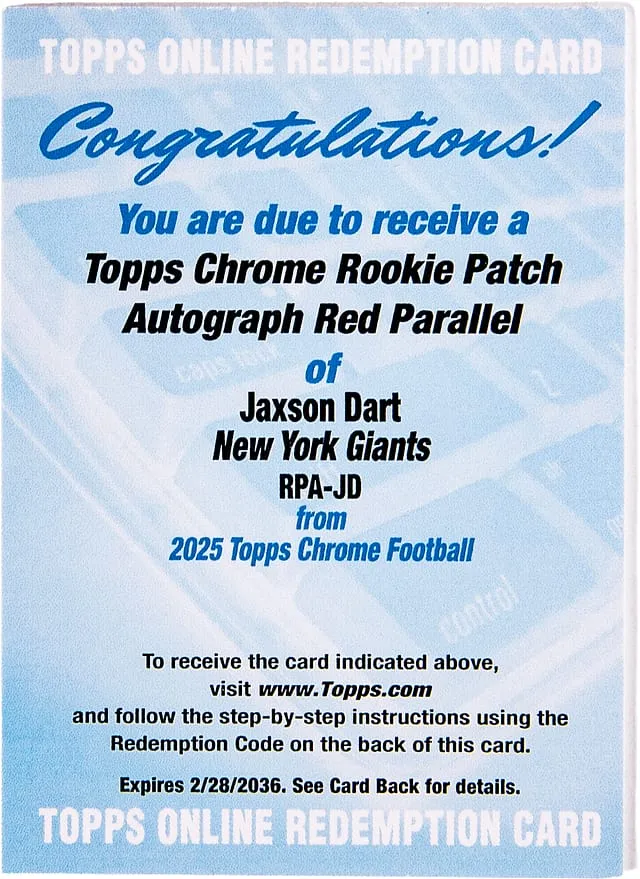
Jaxson Dart 2025 Topps Chrome Red RPA #/5 Goldin Sale
A data-focused look at the $22,570 Goldin sale of the 2025 Topps Chrome Jaxson Dart Red RPA #/5 unused redemption and what it means for collectors.
Sold Card
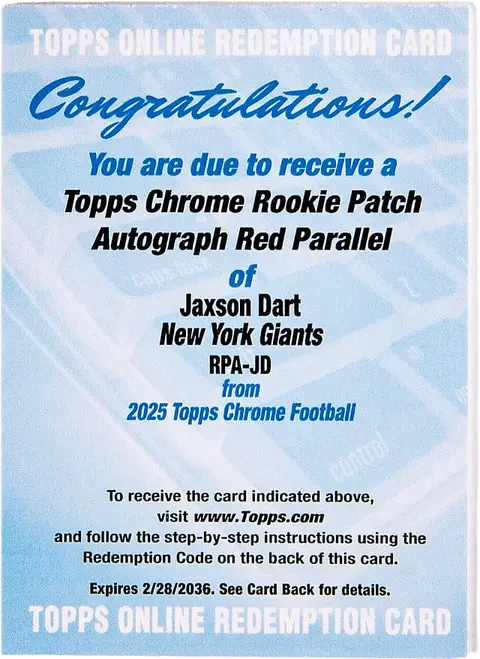
2025 Topps Chrome Rookie Patch Autograph Red #RPA-JD Jaxson Dart Signed Patch Rookie Card (#/5) Unused Redemption Card
Sale Price
Platform
GoldinThe 2025 Topps Chrome Rookie Patch Autograph Red #RPA-JD Jaxson Dart is the kind of ultra-modern football card that gets both prospectors and team collectors to sit up and look at the data.
On June 7, 2026, Goldin sold an unused redemption for this card for $22,570 USD. That price level, the print run, and the format of the card itself (a high-end rookie patch auto) make this a useful case study in how the football market is currently valuing early Jaxson Dart pieces.
What exactly sold at Goldin?
Card details
- Player: Jaxson Dart
- Year / Product: 2025 Topps Chrome
- Card type: Rookie Patch Autograph (RPA) – a rookie card that combines a patch and an autograph
- Card number: #RPA-JD
- Parallel: Red
- Serial numbering: Limited to 5 copies (#/5)
- Autograph: Signed (stated on the redemption; typically on-card or sticker as issued by Topps)
- Patch: Rookie patch (multi-color or prime patch is typical for RPA-level cards, but exact swatch will depend on Topps’ fulfillment)
- Format: Unused Topps redemption – the physical card has not yet been redeemed/fulfilled
- Grading: Ungraded at the time of sale (no third‑party grade yet)
Instead of the physical RPA already in a slab, the lot is the redemption itself. The buyer still needs to submit the code to Topps to receive the actual card. That creates a different risk/reward profile than buying a slabbed copy, but it also means the card has a clean path to grading once fulfilled.
Why this card matters to collectors
1. True rookie patch auto from a flagship chrome line
For modern football, collectors usually look for a player’s “true” RPA or main rookie autograph from a major chromium set. Here, we have:
- A rookie-year patch autograph (RPA), which many collectors treat as a cornerstone rookie for a player.
- From Topps Chrome, a long-running chrome brand that helped define modern refractor-based collecting in multiple sports.
- The Red parallel is a recognizable color match to other Chrome products, typically representing a very low print run.
In other words, this is not a fringe insert. It’s one of the key early Jaxson Dart cards in the hobby checklist.
2. Extremely low serial numbering (#/5)
A serial number like #/5 means there are only five copies of this specific Red RPA version. In practical hobby terms:
- There are not enough copies for every team or player collector who might want one.
- Any public sale becomes useful data because comps (short for comparable sales, or similar recent sales used as price references) will be rare.
- Population reports ("pop reports" – counts of how many copies a grading company has seen at each grade) will take time to develop, but even then, the maximum possible population is five.
With ultra-low numbered cards like this, especially RPAs, prices can move significantly between each auction because each sale may feature a different patch, signature quality, or grade.
3. Modern, prospect-driven demand
This card lives firmly in the ultra-modern era: limited print runs, serial numbering, and premium autograph/patch content are the norm in high-end football products.
In this segment of the hobby, demand is often driven by:
- Projected upside: what collectors think a player might become rather than what they have already accomplished.
- Key moments in a player’s development: big games, draft position, or early-season performances.
- Hype cycles: attention spikes around the draft, training camp, or a hot start to a season.
When a player’s career is still unfolding, a single strong season or major game can shift how collectors view their best RPAs.
Market context and price positioning
The Goldin result for this unused redemption was $22,570 on June 7, 2026.
Because this is a very specific card and an extremely low print run, recent publicly visible comps for the exact 2025 Topps Chrome Rookie Patch Autograph Red #RPA-JD Jaxson Dart #/5 are limited. That lack of direct comparables is common for /5 RPAs, especially in a newer release.
To frame the sale more realistically, collectors often look at:
Other parallels of the same card
- Higher-numbered versions (for example, /99 or /50 if they exist in the checklist) may trade more often and can provide a loose range.
- Lower-numbered or 1/1 versions might set ceiling expectations when they appear.
For this card, there have not yet been many public, repeatable sales of different parallels across major auction houses, so the data set is still thin.
Comparable RPAs from the same product
- Other 2025 Topps Chrome Rookie Patch Autos for similar prospect-tier players can show how the product is being valued overall.
- Results from the same auction house (Goldin) can be particularly useful because they share similar bidder audiences and marketing reach.
Key Jaxson Dart rookie autos in other brands
- Early rookie autographs and RPAs from other flagship products (for example, high-end Panini or Topps releases if and when they exist for Dart) will gradually create a hierarchy of “top cards” for the player.
- Comparing price levels helps collectors decide whether this Topps Chrome Red RPA sits closer to the top, middle, or lower end of his overall rookie market.
Given the limited data currently available for this exact card and serial level, the $22,570 result at Goldin stands out as an early marker rather than a well-established average. With only five copies in existence, the next sale—possibly with a different patch quality, signature placement, or grade—could land higher or lower without necessarily contradicting this result.
The redemption factor: risk and opportunity
One key detail here is that this was an unused redemption, not a live, graded card. That matters because:
- Fulfillment risk: Until the code is redeemed and Topps ships the card, there is some uncertainty. Timelines and condition upon arrival can vary.
- Condition uncertainty: Some buyers prefer to see centering, surface, corners, and autograph quality before paying a premium, especially at high price points.
- Path to grading: On the positive side, the buyer gets a fresh shot at pulling a high-grade copy if the card arrives clean.
Different collectors will value that trade-off differently. Some are comfortable paying for the upside of receiving a strong, gradable copy; others prefer the certainty of a known grade.
How this sale fits into the broader hobby landscape
A few broader takeaways for collectors watching this market:
RPAs remain central for premium rookie collecting
Even as checklists get more complex, the hobby still gravitates toward patch autos and low-numbered rookie signatures as key long-term pieces for players they believe in.Ultra-low serial cards create thin but meaningful data points
With only five copies, each public sale becomes a reference for future negotiations. When you look at a result like this, it is more of a marker than a stable average, but it still informs collectors and sellers.Auction houses provide early price discovery
Large platforms like Goldin often see the first big sales of new, high-end parallels. Those early results can shape expectations when the same card, or similar cards, surface later on marketplaces like eBay or direct private deals.
What this means if you collect Jaxson Dart or 2025 Topps Chrome
For collectors and small sellers, here are some practical takeaways:
If you collect Dart: This Red RPA at $22,570 sets an early benchmark for his most limited rookie patch autos in a major chrome product. As more of his rookie cards hit the market, you can compare other sales (for example, higher-numbered RPAs or non-patch autos) against this result to understand relative pricing tiers.
If you break 2025 Topps Chrome: This sale supports the idea that the top-end rookie patch autos in this product can command significant attention and strong prices, especially in low-numbered parallels.
If you’re new to RPAs: Watching how low-serial RPAs trade over time is a good way to learn the difference between base rookies, numbered parallels, patch autos, and true scarcity. Start by tracking a few players and products in a spreadsheet with sale dates, serial numbers, and auction houses.
As always, each collector’s situation and goals are different. The Goldin sale on June 7, 2026 doesn’t guarantee what the next Jaxson Dart RPA will sell for, but it does add a concrete data point to a very small pool of information. For an ultra-modern, /5 rookie patch autograph from a long-standing chrome line, that kind of data is exactly what helps the hobby calibrate expectations over time.
At figoca, we’ll continue tracking these low-pop, high-impact sales so collectors can see not just the headlines, but the context behind them.