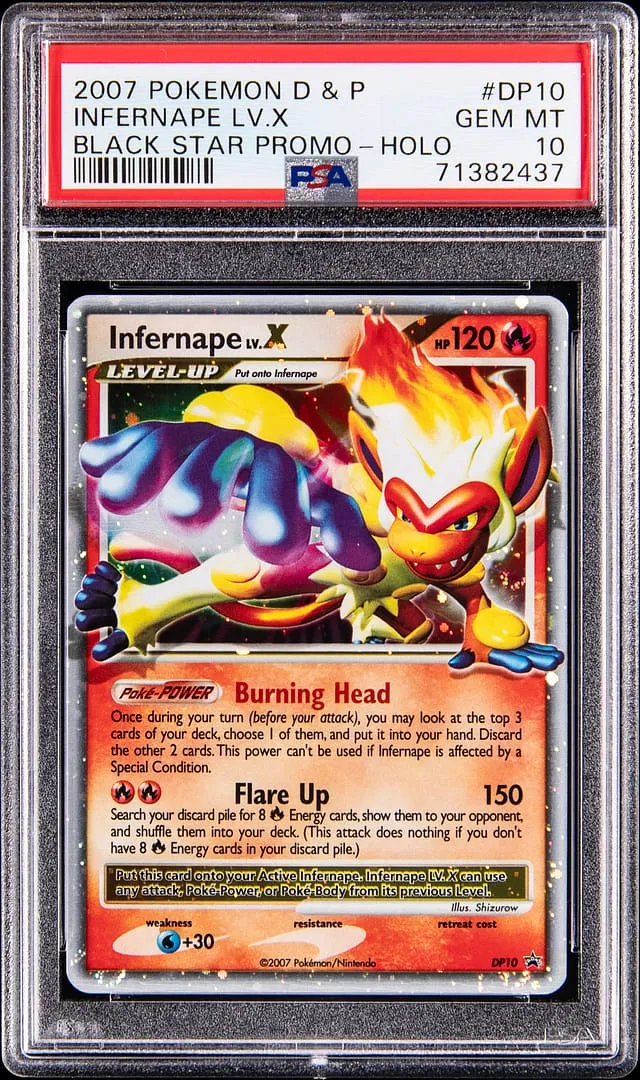
Infernape Lv.X DP10 PSA 10: Goldin Sale Breakdown
How a 2007 Infernape Lv.X DP10 Black Star Promo PSA 10 reached $29,890 at Goldin and what it means for Diamond & Pearl Pokémon collectors.
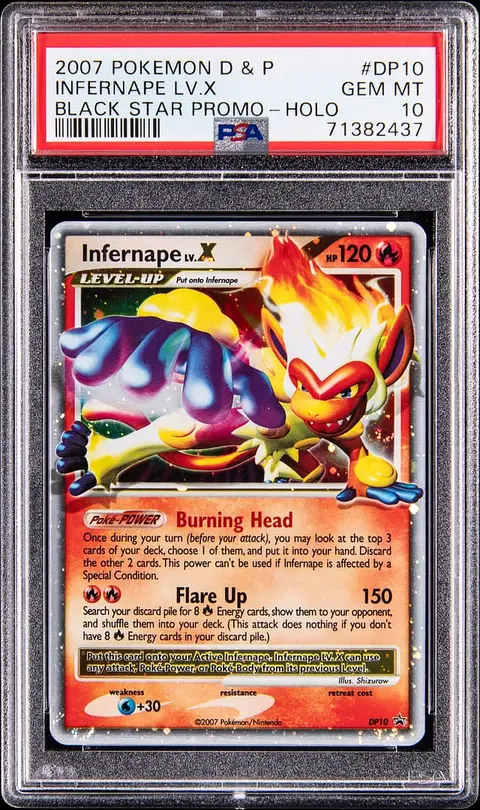
Sold Card
2007 Pokemon Diamond & Pearl Black Star Promo Holo #DP10 Infernape Lv.X - PSA GEM MT 10
Sale Price
Platform
Goldin2007 Pokémon Diamond & Pearl Black Star Promo Holo #DP10 Infernape Lv.X in a PSA GEM MT 10 just changed hands at Goldin on 2026-05-18 for $29,890. For a mid‑2000s promo card, that is a serious result and a useful data point for anyone tracking early Diamond & Pearl–era Pokémon.
In this article, we’ll break down what this card is, why collectors care about it, and how this sale fits into the broader market for Infernape Lv.X and 2007 promo cards.
The card at a glance
- Character: Infernape Lv.X
- Year: 2007
- Set / Issue: Pokémon Diamond & Pearl Black Star Promo
- Card number: DP10
- Finish: Holofoil
- Type: Black Star promotional card (non-pack, distributed as a promo)
- Grading company: PSA (Professional Sports Authenticator)
- Grade: GEM MT 10 (PSA’s highest standard grade)
- Other attributes: No autograph, no serial numbering; value is driven by condition, era, and character appeal rather than a patch or signature.
This is not a rookie card in the sports sense, but within the Pokémon hobby it’s an early Infernape appearance from the Diamond & Pearl era and a key promo issue for collectors who focus on Generation 4.
Why Infernape Lv.X DP10 matters to collectors
1. Diamond & Pearl era nostalgia
The Diamond & Pearl (DP) era marked a transition for the Pokémon TCG in the mid‑2000s. Print runs were generally lower than during the peak Wizards of the Coast years, and the player base had changed. For many collectors who grew up with the Nintendo-era games, DP is their nostalgia anchor.
Black Star promo cards from this period are a bridge between casual players and dedicated collectors. They were often tied to events, products, or special releases rather than standard booster packs, which can make clean, gradable copies harder to find years later.
2. Infernape as a Gen 4 starter evolution
Infernape is the final evolution of Chimchar, one of the three Sinnoh starter Pokémon. Starter evolutions tend to attract long‑term interest: players see them on box art, in the games, and in the anime. While Infernape may not have the broad, cross‑generational pull of Charizard or Pikachu, it is a core character for collectors who identify with the Sinnoh region.
Lv.X cards, introduced during the DP era, were the premium versions of key Pokémon within the game’s mechanics. They functioned a bit like today’s chase variants: more powerful, more visually striking, and immediately recognizable in a binder or display.
3. Promo distribution and condition sensitivity
As a Black Star promo, DP10 was not pulled from regular packs. Copies often came from products where cards could be jostled, handled, or left unprotected. Over time, that leads to edge whitening, surface scratches, and other defects that hold many examples back from top grades.
That context helps explain why PSA GEM MT 10 examples command a strong premium: they represent the highest-condition survivors from a distribution channel that wasn’t tailored to long‑term preservation.
Understanding the PSA 10 premium
PSA uses a 1–10 grading scale, with PSA 10 GEM MT reserved for cards that are essentially pack‑fresh: sharp corners, strong centering, and clean surfaces. For a mid‑2000s promo like this, the pop (short for "population report," PSA’s count of how many copies exist in each grade) is often relatively modest.
While exact pop report figures can change as more cards are graded, the general pattern for DP‑era promos is:
- A cluster of cards in PSA 8–9, reflecting typical light handling.
- A much smaller group of PSA 10s, where centering and surface defects did not creep in.
The $29,890 sale result at Goldin reflects the market’s focus on top‑pop condition. In many non‑serial‑numbered Pokémon cards, the PSA 10 price can be several multiples of the PSA 9 price, even when visual differences are subtle.
Market context and recent trends
When collectors talk about “comps” (short for comparable sales), they mean recent, publicly recorded transactions for the same card or closely related versions. Comps help set expectations, but they’re not guarantees of future prices.
For this Infernape Lv.X DP10:
- Public sales data for PSA 10 copies appear relatively thin compared with more mainstream chase cards. That’s typical for niche, era‑specific promos.
- PSA 9 and raw (ungraded) copies generally transact at much lower price points, reflecting both higher supply and lower condition standards.
- Goldin’s $29,890 result on 2026-05-18 stands at the top end of what we see for DP‑era Infernape cards overall, highlighting how concentrated demand is at the highest grade.
Because data is limited for this exact grade and promo, it’s better to frame this Goldin sale as a strong benchmark rather than a routine, repeatable price. A single high‑end auction can sit well above everyday marketplace activity, especially when two or more determined bidders are involved.
How this sale compares within the era
Within the broader Diamond & Pearl ecosystem:
- Flagship chase cards from the era’s main sets (for example, certain Lv.X or secret rares) often dominate headline prices.
- Select promos, especially for starter evolutions and fan‑favorite Pokémon, have been carving out their own tier among focused collectors.
- PSA 10 promos that are not mass‑submitted can show significant price jumps once a few key sales are recorded, simply because there are so few examples available at any given time.
Seen through that lens, this Infernape Lv.X DP10 PSA 10 sale is less about the card suddenly "spiking" and more about the market recognizing a scarce, high‑grade example and pricing it accordingly.
What this means for collectors and small sellers
A few practical takeaways:
Condition truly matters in this lane
For DP‑era promos, the gap between near‑mint and gem‑mint can be wide. If you own raw DP promos, careful inspection for centering, corners, and print lines is essential before you consider grading.Know your lane: promo vs pack‑issued
Promos like DP10 don’t behave exactly like pack‑pulled chase cards. Supply, distribution, and grading patterns differ. When you look at comps, compare promo to promo, and be cautious about extrapolating from unrelated cards.Use high‑end auctions as reference points, not promises
Goldin is a major auction house that tends to attract serious bidders. A $29,890 result there on 2026-05-18 tells you what one top‑end buyer (or set of bidders) was prepared to pay under those conditions, but smaller marketplaces can clear at different levels.Track population reports over time
As more copies are graded, PSA’s population report can change. A low pop today may look different in a few years. For non‑serial‑numbered cards, that evolution is part of the story.
Final thoughts
The 2007 Pokémon Diamond & Pearl Black Star Promo Holo #DP10 Infernape Lv.X in PSA GEM MT 10 that sold at Goldin on 2026-05-18 for $29,890 is a clear signal that focused collectors are paying close attention to high‑grade, Gen 4‑era promos.
For Infernape fans, Sinnoh nostalgists, and anyone tracking the mid‑2000s Pokémon market, this sale is a useful marker. It underscores how specific, condition‑sensitive cards from the DP era can carve out meaningful positions in today’s hobby—without needing to be the absolute top headline card in the franchise.
As always, treat this result as one point in a larger data set. Watch how other PSA 10 and PSA 9 examples move across platforms, follow the population reports, and consider where this piece fits within your own collecting goals and budget rather than chasing a single auction headline.