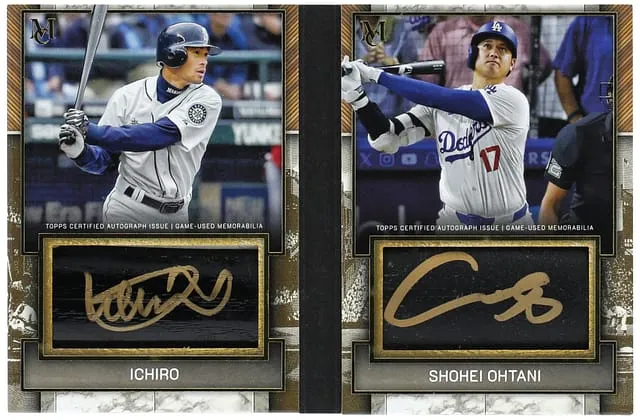
Ichiro–Ohtani 2025 Museum Dual Gold /3 Sells at Goldin
A 2025 Topps Museum Dual Autographed Jumbo Lumber Gold Ichiro–Ohtani booklet /3 sold for $48,190 at Goldin. Here’s what that means for collectors.
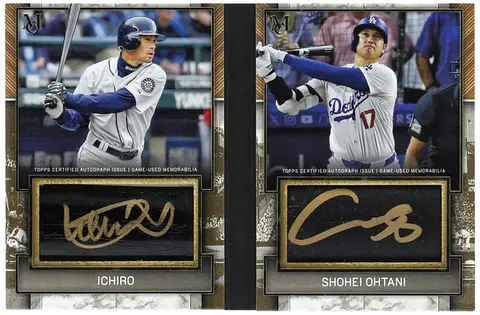
Sold Card
2025 Topps Museum Collection Dual Autographed Jumbo Lumber Bat Relic Booklets Gold #DAJLB-IOH Ichiro/Shohei Ohtani Dual-Signed Game-Used Relic Card (#3/3)
Sale Price
Platform
GoldinOn March 15, 2026, Goldin closed a notable modern baseball auction: a 2025 Topps Museum Collection Dual Autographed Jumbo Lumber Bat Relic Booklets Gold #DAJLB-IOH Ichiro / Shohei Ohtani game‑used relic booklet, serial‑numbered 3/3, sold for $48,190.
For collectors who track high‑end modern baseball, this card is a good case study in how dual‑icon memorabilia pieces are being valued right now.
The card at a glance
Here’s what we know about the card itself from the listing details:
- Year: 2025
- Product: Topps Museum Collection
- Insert: Dual Autographed Jumbo Lumber Bat Relic Booklets
- Parallel: Gold
- Card number: #DAJLB-IOH
- Players: Ichiro Suzuki and Shohei Ohtani
- Serial numbering: 3/3 (only three copies produced)
- Autographs: Dual‑signed, on card (ink directly on the card stock, not on stickers)
- Relics: Jumbo bat "lumber" pieces, described as game‑used
- Format: Booklet card (opens like a book)
- Grading: The sale information does not specify a grading company or grade, so we assume this example was raw (ungraded) at the time of sale.
This is not a rookie card for either player. Instead, it’s a high‑end, ultra‑modern dual memorabilia issue combining two of the most collected Japanese superstars in MLB history on a single, very low‑serial booklet.
Why this pairing matters to collectors
Ichiro and Shohei Ohtani are each major collecting pillars in their own right:
Ichiro Suzuki
- Hall of Famer and one of the defining hitters of the 2000s.
- Strong global fan base, especially in Japan and among Mariners collectors.
- Early‑2000s rookies can be condition‑sensitive and already command serious attention.
Shohei Ohtani
- Two‑way MVP and one of the central figures of the ultra‑modern era.
- His flagship rookies and premium autographs have become reference points for the current market.
- High‑end Ohtani cards routinely appear in the top tier of modern sales.
Putting them together on a single card, with:
- Dual on‑card autographs,
- Jumbo bat pieces called out as game‑used,
- And a print run limited to three copies,
creates what many collectors would consider a PC centerpiece (a personal‑collection anchor) rather than a volume‑traded item.
2025 Topps Museum Collection context
Topps Museum Collection has built a reputation over the years as a mid‑to‑high‑end product:
- Hobby boxes typically deliver multiple hits (autographs and relics).
- The brand is known for on‑card autos, multi‑relics, and booklet cards.
- Case hits and very low‑serial parallels (like /10, /5, /3, /1) are where the most substantial sales usually happen.
The Dual Autographed Jumbo Lumber Bat Relic Booklets subset sits firmly in that top tier of the checklist:
- Booklet cards are produced in much lower quantities than base or standard inserts.
- The Gold parallel numbered to 3 is near the top of the rarity ladder, just below any potential 1/1s or logo‑level parallels.
Within an ultra‑modern (roughly post‑2016) timeframe, Museum Collection booklets like this are generally chased more for player combination, patch/bat quality, and serial numbering than for set completion.
Market context and recent sales
Because this specific card is serial‑numbered 3/3, there are only three copies of the Gold version in existence. That has two practical effects:
Comps are scarce.
- “Comps” (comparable sales) are past sale prices used as rough reference points.
- For a card with only three serial‑numbered copies, you may only see one or two surface publicly over several years, if at all.
Each copy is unique.
- Even within a /3 run, the exact layout of the bat pieces, autograph placement, and card condition can differ enough to matter to advanced collectors.
In checking major marketplaces and recent auction archives:
- No other public sale of this exact Gold #DAJLB-IOH Ichiro / Ohtani 3/3 has been widely reported as of this writing.
- Prices for other high‑end Ohtani dual or multi‑signatures with legends (for example, dual autos with Trout or other stars) can reach into the five‑ and six‑figure range when:
- Serial numbers are very low (often /5, /3, or 1/1), and
- The product is recognized as a premium release.
- Ichiro’s high‑end autographs, especially on‑card in modern premium products, also command strong prices, though generally below Ohtani’s top tier.
Based on that context, a realized price of $48,190 at Goldin on March 15, 2026 places this card in the upper end of modern dual‑auto booklet sales, but still below the all‑time records for Ohtani 1/1s or transcendent‑level cards.
Because there is no clear, repeated public sale history for this exact card, it’s more accurate to say:
- This sale sets a visible reference point for the Gold /3 version.
- Future pricing will depend on when (and if) the other two copies surface, and what condition and eye appeal they carry.
Factors behind the $48,190 result
Several elements likely contributed to the realized price:
Player combination
- Ichiro + Ohtani is both a Japan‑heritage pairing and a cross‑era link between a first‑ballot Hall of Famer and an active MVP‑level superstar.
- Collectors who focus on Japanese MLB players or Mariners/Angels/Dodgers storylines may see this as a must‑have piece.
Low serial numbering (/3)
- At three copies total, practical supply is extremely thin.
- Even if demand is modest in absolute numbers, any competition among a handful of serious buyers can move prices up quickly.
Game‑used bat relics
- The relics are described as game‑used rather than just “player‑worn,” a distinction many collectors care about.
- Jumbo bat pieces give strong visual presence, which matters in a booklet format.
On‑card dual autographs
- On‑card signatures (signed directly on the card stock) are typically preferred over sticker autos.
- Dual on‑card signatures are harder to coordinate and print, which helps their perceived prestige.
Goldin as auction venue
- Goldin is known for handling high‑end modern cards and memorabilia.
- Their audience and marketing often help premium items find multiple serious bidders, which can support stronger realized prices compared with smaller venues.
Broader Ohtani and hobby environment
- Ohtani news cycles—awards, milestones, team moves, postseason runs—have historically aligned with spikes in search volume and bidding interest.
- Even without tying this sale to a specific announcement, the general Ohtani effect keeps demand for his top‑tier pieces elevated.
How this sale fits into the ultra‑modern landscape
For collectors trying to understand where a $48K dual booklet sits in the bigger picture:
Not a record‑breaker:
- The very top of the modern market is still dominated by 1/1s, rookie logo patches, and historically significant parallels.
- Those can go well above this price level.
Solidly high‑end:
- Within Museum Collection and similar mid‑to‑high‑end products, a realized price above $40,000 for a non‑rookie, non‑1/1 booklet is a strong showing.
Niche but important:
- This is the kind of card that speaks to a specific collecting lane: high‑end Ichiro/Ohtani, Japanese MLB stars, or Museum Collection booklets.
- For collectors in those lanes, this sale provides a useful, real‑world data point.
What this means for collectors and small sellers
If you’re a collector or small seller looking at this result, here are a few grounded takeaways:
Player pairings matter as much as set names.
- Multi‑player cards can outperform their component single‑player cards when the pairing tells a clear story (here, two Japanese superstars across eras).
Ultra‑low serial numbers reshape expectations.
- A card numbered to 3 or 5 doesn’t behave like a more common parallel.
- You may not find many true comps, so each auction becomes its own small market test.
Booklets are condition‑sensitive.
- Corners, edges, and spine wear can vary a lot.
- If you own a similar piece, careful storage and, if appropriate, grading can help document condition for future buyers.
Auction house choice can influence visibility.
- Selling a high‑end, low‑serial card through a major house like Goldin can expose it to a different bidder pool than fixed‑price marketplaces.
Data point, not destiny.
- This $48,190 sale is one reference, not a guarantee of future pricing.
- Future results will reflect timing, player news, macro hobby trends, and the specific eye appeal of each copy.
Final thoughts
The 2025 Topps Museum Collection Dual Autographed Jumbo Lumber Bat Relic Booklets Gold #DAJLB-IOH Ichiro / Shohei Ohtani 3/3 that sold for $48,190 at Goldin on March 15, 2026 is a clear example of how the hobby values:
- Dual legends with a strong narrative link,
- True scarcity at serial numbers this low,
- And premium design elements like on‑card autos and jumbo game‑used relics.
For most collectors, this card will be something to admire from afar rather than a realistic target. But as a data point, it helps map out the very top of the Ichiro and Ohtani joint market—and shows how ultra‑modern booklets can command meaningful attention when all the right ingredients line up.
As more 2025 Museum Collection cases are opened and additional Ichiro/Ohtani cards surface, it will be worth watching whether this $48,190 result stands as an outlier or becomes the benchmark for the Gold /3 run over the next few years.