Hank Aaron & Willie Mays Co-Signers PSA 10 Sale
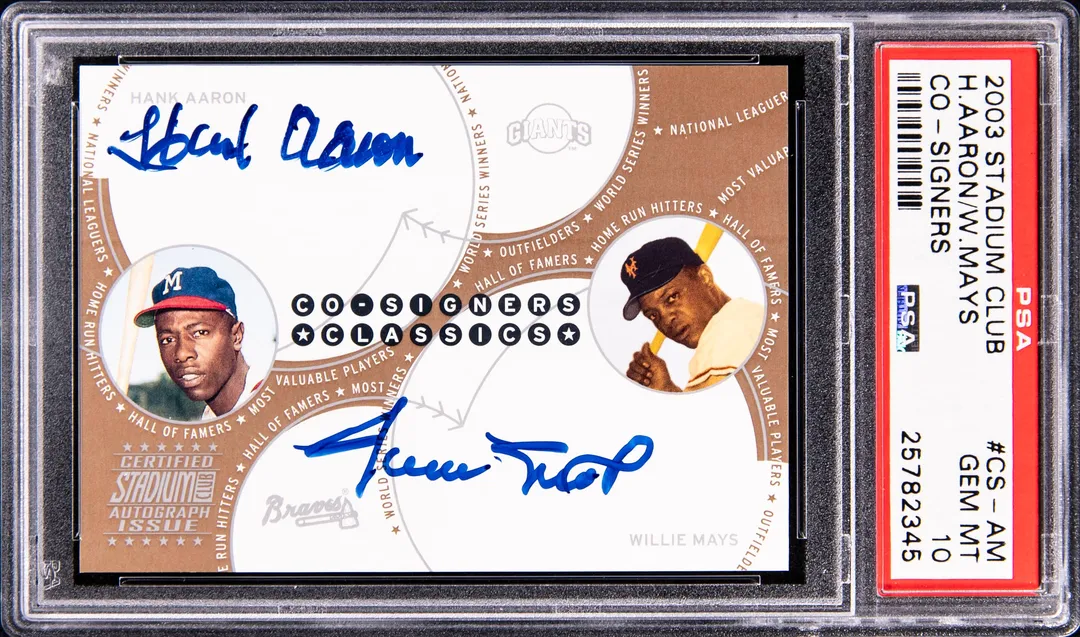
A look at the $20,603 Goldin sale of the 2003 Topps Stadium Club Co-Signers Hank Aaron/Willie Mays dual auto, PSA 10 Pop 3.
Sold Card
2003 Topps Stadium Club Co-Signers #CS-AM Hank Aaron/Willie Mays Dual-Signed Card - PSA GEM MT 10 - Pop 3
Sale Price
Platform
GoldinWhen a dual-signed card featuring Hank Aaron and Willie Mays surfaces in a top grade, collectors tend to stop and look closely. That’s exactly what happened with the recent sale of a 2003 Topps Stadium Club Co-Signers #CS-AM Hank Aaron/Willie Mays dual-autograph card, graded PSA GEM MT 10, which realized $20,603 at Goldin on 2026-02-08.
In this breakdown, we’ll walk through what this card is, why it matters, and how this sale fits into the broader market for high-end Aaron and Mays autographs.
The card at a glance
- Year / Product: 2003 Topps Stadium Club
- Subset: Co-Signers (dual autographs)
- Card number: #CS-AM
- Players: Hank Aaron (Atlanta Braves legend), Willie Mays (San Francisco Giants legend)
- Autographs: Dual on-card autos (both signed directly on the card)
- Grading company: PSA
- Grade: GEM MT 10 (PSA’s highest standard grade for a pack-issued card)
- Population: Pop 3 in PSA 10 at the time of sale (meaning only three copies have received this grade)
This is not a rookie card for either player. Instead, it’s a key modern insert issue that pairs two of the greatest players in baseball history on a single, hard-signed card. For many collectors, that combination of names on one card is the primary draw.
Why this card matters to collectors
Dual on-card autographs of two inner-circle legends
Dual-autograph cards are challenging to produce and, over time, can be even harder to replace. Coordinating two all-time greats, both with strong autograph demand on their own, makes this card fundamentally different from a typical single-player autograph.
Hank Aaron and Willie Mays are widely considered two of the most important players in baseball history. Aaron is best known for breaking Babe Ruth’s home run record, finishing with 755 career home runs; Mays is often placed in the conversation for greatest all-around player ever. For many hobbyists, a dual-autograph card like this is more of a “mini museum piece” than just another insert.
Early-2000s premium insert era
The early 2000s sit in an interesting place in hobby history. It’s not vintage, but it predates the current ultra-modern era of serial-numbered parallels and case-hit inserts. Products like 2003 Topps Stadium Club Co-Signers helped establish the idea that a modern card could be highly collectible because of the autograph content and player selection, not just because of age.
Stadium Club is known primarily for photography, but the Co-Signers program added substantive autograph content. Dual autos featuring Hall of Famers from this period often have smaller print runs than contemporary products, even when the exact serial numbering isn’t printed on the card.
Condition and population: PSA GEM MT 10, Pop 3
In grading terms, a population report (or “pop report”) is a count of how many copies of a card have been graded at each grade level. With only three PSA 10 examples of this card, the supply of top-condition copies is extremely thin.
For modern-era glossy cards, dual-autograph issues can be tough to gem for several reasons:
- Autograph placement and pressure can create surface impressions.
- Edges and corners are more vulnerable due to thicker or glossier stock.
- Centering remains a key factor, even for insert cards.
Collectors paying for the highest grade are effectively paying for the combination of card, autograph content, and condition scarcity.
Market context and recent sales
When collectors talk about “comps”, they mean comparable recent sales used as reference points for evaluating a card’s current market level. For a dual Aaron/Mays PSA 10 with a population of just three, comps are naturally limited.
Based on publicly available data from major marketplaces and auction houses up to early 2026, here are the key context points:
- Exact-card PSA 10 comps are very thin. With only three known PSA GEM MT 10 examples, public sales at this grade level are rare. When they do appear, they tend to draw strong bidding, especially in established auction houses.
- Lower-grade or ungraded versions typically trade at a meaningful discount to a true PSA 10, reflecting both condition differences and the scarcity of top-graded copies.
- Comparable dual HOF autos from early-2000s premium products featuring combinations like Mays/Aaron, Mays/Mantle, or Aaron/Mantle can show substantial price separation between mid-grade, high-grade (PSA 8–9), and gem-mint levels.
The $20,603 result at Goldin signals that the market continues to recognize a premium for:
- Dual on-card autographs of truly elite Hall of Famers.
- Scarce top grades (PSA 10) in early-2000s inserts.
- A low-population card that rarely comes to market in top condition.
Because public records for this exact card in PSA 10 are limited, it’s hard to frame this as definitively a record or a bargain. Instead, the sale is best viewed as a strong, data point-level result in the established tier of high-end, dual-legend autograph cards.
Why this sale matters in 2026
Several broader hobby trends help explain why a card like this can command a five-figure result:
- Sustained interest in true legends: Interest in Hank Aaron and Willie Mays has remained steady or grown as modern buyers look for historically safe names rather than short-lived hype cycles.
- Shift toward quality over quantity: Many collectors and smaller sellers are reducing volume and focusing on fewer, higher-quality pieces with proven historical significance.
- Autograph preference moving toward on-card signatures: As collectors become more detail-oriented, on-card autos (signed directly on the card) often get the nod over sticker autographs when all else is equal.
In this environment, a low-pop PSA 10 dual auto of Aaron and Mays checks several boxes: era appeal, on-card signatures, and genuine scarcity at the top grade.
What collectors can take from this result
For collectors and small sellers trying to make sense of a $20,603 sale price, a few practical takeaways:
- Population matters, but so does the player pairing. A low-pop grade only carries real weight when the player(s) involved have deep collector demand. Aaron and Mays qualify.
- Dual autos of Hall of Famers often behave differently than single-player autos. Fewer copies exist, and replacing a specific dual combination can be difficult once it lands in a long-term collection.
- Grade separation can be significant, especially for PSA 10. A PSA 10 in a low-population, early-2000s insert isn’t just a small step above a PSA 9; in many cases, it sits in a different tier of bidding altogether.
- Auction house venue can influence visibility. A sale at Goldin on 2026-02-08 placed this card in front of a large audience of high-end baseball collectors, which can help define a new reference point for future comps.
How this fits into a broader collecting strategy
This sale doesn’t mean every dual Hall of Famer autograph is headed toward five figures. What it does highlight is that:
- Cards featuring inner-circle legends tend to hold collector interest across cycles.
- Early-2000s premium inserts with strong checklists are still being actively re-evaluated by today’s market.
- Top grades with true scarcity (like a Pop 3 PSA 10) can create outsized results when the right bidders align.
For collectors considering similar cards, the most useful comparisons are:
- Other dual Hall of Famer autographs from the same era and brands.
- The same card in lower grades or ungraded condition, to understand how much of the price is card content versus condition.
- Broader trends in Hall of Fame autograph demand, rather than single-player hype.
None of this should be taken as a prediction or guarantee. Instead, think of sales like this Goldin result as data points: reference marks that can help you understand how the hobby currently values specific combinations of player, card, and grade.
Final thoughts
The 2003 Topps Stadium Club Co-Signers #CS-AM Hank Aaron/Willie Mays dual-signed card in PSA GEM MT 10 is a concise snapshot of what the modern high-end baseball market rewards: historically important players, on-card autographs, and genuine scarcity at the highest grade levels.
With just three PSA 10 copies known and a hammer price of $20,603 at Goldin on 2026-02-08, this sale reinforces how much emphasis today’s collectors place on both player pedigree and condition. For anyone tracking the intersection of Hall of Fame history and modern insert design, this is a card – and a result – worth bookmarking as a reference point for future dual-legend autograph sales.