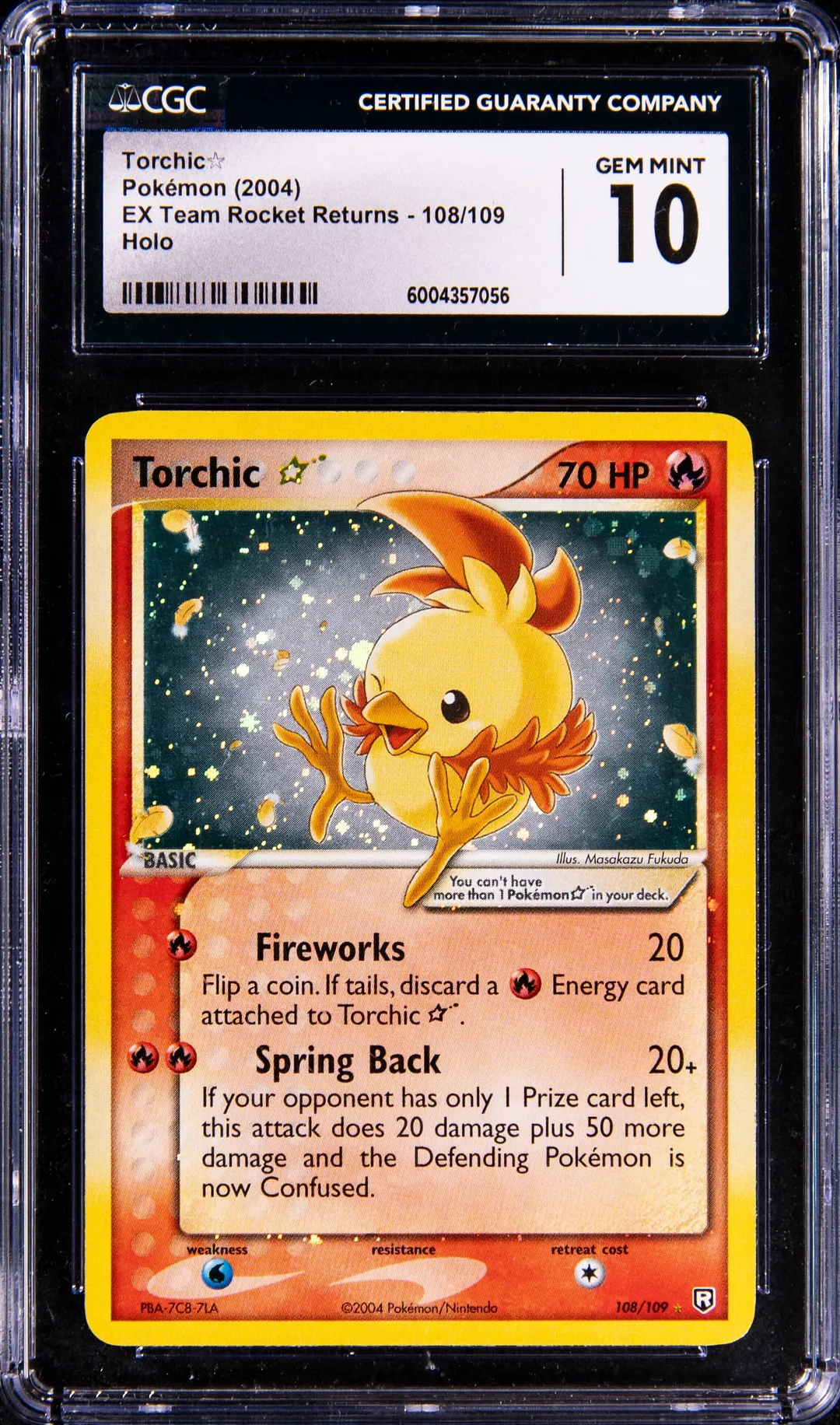
Gold Star Torchic CGC 10 sells for $117,800
A 2004 EX Team Rocket Returns Gold Star Torchic CGC 10 just sold for $117,800 at Goldin. Here’s what the sale means for Pokémon card collectors.
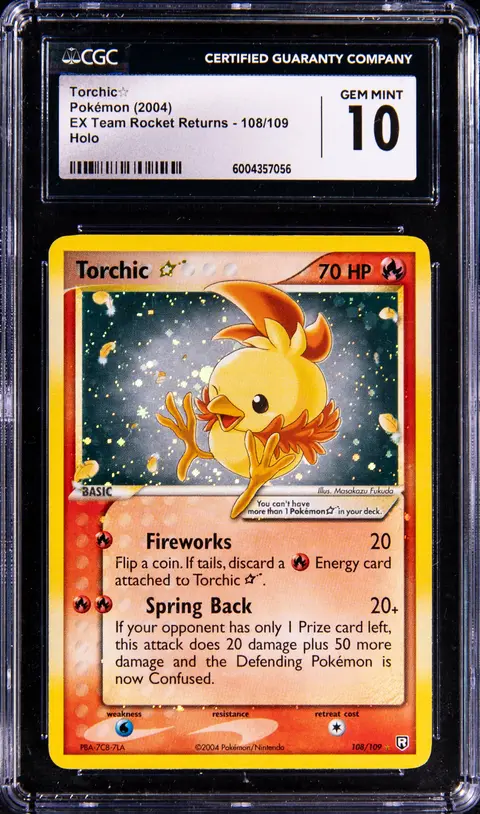
Sold Card
2004 Pokemon EX Team Rocket Returns Holo #108 Gold Star Torchic - CGC GEM MINT 10
Sale Price
Platform
Goldin2004 Pokémon EX Team Rocket Returns Gold Star Torchic in CGC 10 Sells for $117,800
On February 16, 2026, Goldin auctioned one of the most coveted early-2000s Pokémon cards: a 2004 Pokémon EX Team Rocket Returns Holo #108 Gold Star Torchic graded CGC Gem Mint 10. The card realized $117,800.
For collectors who focus on Gold Stars, ex-era sets, or high-end CGC population pieces, this sale is a useful reference point for how the market is currently valuing one of the hobby’s most important non-TCG-tournament staples.
Card overview
- Card: Torchic Gold Star
- Set: 2004 Pokémon EX Team Rocket Returns
- Number: #108
- Foil / Variant: Gold Star Holo (shiny Torchic)
- Era: ex-era (early 2000s)
- Grade: CGC Gem Mint 10
- Auction house: Goldin
- Sale date: February 16, 2026 (UTC)
- Sale price: $117,800
This Torchic is one of the three big starter Gold Stars from EX Team Rocket Returns (alongside Mudkip and Treecko). All three are short-printed chase cards from a historically low-print, notoriously tough-to-grade set. While it is not a “rookie card” in the sports sense, it functions as a key issue for Torchic collectors and for anyone building a high-end Gold Star run.
Why Gold Star Torchic matters
The Gold Star era
Gold Stars are special variants introduced in the ex-era where the Pokémon name has a gold star next to it and the artwork typically features the shiny (alternate color) version of the Pokémon. Pull rates were low compared to the regular holo and EX cards of the time, which gives Gold Stars a reputation for genuine pack scarcity.
EX Team Rocket Returns, released in 2004, is widely regarded as one of the most challenging sets to complete in high grade:
- Lower print runs than contemporary modern sets.
- Tough centering and surface wear, especially on dark backgrounds and holofoil areas.
- Early 2000s storage habits, where many cards were played or kept in less protective conditions.
Within that context, Gold Star Torchic sits at the intersection of:
- A fan-favorite starter line (Torchic → Blaziken).
- A historically important ex-era set.
- One of the more visually recognized Gold Stars due to its color contrast and artwork.
Key issue, not a niche oddity
This card is considered a key issue for several overlapping collector groups:
- Gold Star set builders trying to assemble the full run across multiple ex-era sets.
- Ex-era specialists who see EX Team Rocket Returns as one of the flagship sets of the period.
- Starter collectors (Torchic/Blaziken and Hoenn-region fans) who often prioritize this card as a top target.
Because of that cross-demand, high-grade copies tend to draw attention whenever they surface at major auction houses.
Understanding the CGC Gem Mint 10 factor
Third-party grading companies evaluate a card’s condition (centering, corners, edges, surface) and assign a numeric grade. CGC (Certified Guaranty Company) is one of the major grading companies in the Pokémon space, alongside PSA and BGS.
A Gem Mint 10 from CGC generally indicates:
- Very strong centering within tight tolerances.
- Clean corners and edges with no visible whitening.
- Surfaces free of noticeable print lines, scratches, or dents.
Many collectors still tend to benchmark prices against PSA population and sales data, but CGC has built a strong reputation for strict grading standards, particularly in the Pokémon category. This can make top CGC grades an appealing option for condition-focused collectors who are willing to compare across holders.
Market context and recent sales
When analyzing a big result like $117,800, it helps to look at comps—short for comparables—which are recent sales of the same card or very similar versions (different grades or grading companies). Exact numbers and dates move over time, but the general pattern for Gold Star Torchic has looked roughly like this in the mid-2020s:
- PSA 10 copies have historically commanded a premium, reflecting both brand familiarity and often lower population counts. These have tended to trade above five figures and, in strong hobby periods, well into the mid–five-figure to low–six-figure range when demand spikes.
- High-grade 9.5 / 9 copies (across PSA, BGS, and CGC) have usually filled in the tier below, with softer but still significant prices depending on eye appeal and subgrades (where applicable).
Against that backdrop, a CGC Gem Mint 10 at $117,800 through Goldin fits into the high end of expectations for a top-condition example of this card. It underscores two main points:
- Gem-mint Gold Star Torchic remains a true premium card.
- The market is willing to recognize CGC’s top grade at a serious price level, especially when offered by a major auction house and fully exposed to competitive bidding.
While it is always useful to track trendlines rather than single results, this sale reinforces that high-end ex-era Gold Stars remain firmly established in the upper tier of Pokémon pricing.
Population and scarcity considerations
A pop report (population report) is a tally from the grading company of how many copies of a card exist in each grade. Exact figures change as more cards are submitted, but the broader characteristics of Gold Star Torchic are:
- Total graded population across companies is modest compared with mass-printed modern chase cards.
- The number of true top grades (PSA 10, CGC 10, BGS 9.5+ or 10) is relatively low.
- Many raw (ungraded) copies show typical early-2000s wear: edge whitening, holo scratches, or centering issues that cap their grading ceiling.
These factors help explain why incremental changes in supply—such as a single fresh CGC 10 appearing at a high-visibility auction—can have an outsized impact on recent comps without necessarily indicating a wild market swing.
Why this Goldin sale matters
This particular Goldin result on February 16, 2026 is notable for a few reasons:
- Visibility: Goldin is one of the more widely watched auction houses in the trading card space. High-end sales there tend to be used as reference points by collectors and small sellers when discussing value.
- Grade signaling: Each time a CGC Gem Mint 10 achieves a strong result, it contributes to how the broader hobby perceives CGC’s top grades vs. PSA and BGS.
- Ex-era confirmation: It acts as another data point supporting the idea that ex-era, and specifically Gold Star cards, remain in demand among serious collectors rather than being a passing trend.
None of this guarantees future performance, but it does provide clearer price context for anyone evaluating their own Torchic, planning a Gold Star chase, or deciding whether to send raw EX Team Rocket Returns cards for grading.
Takeaways for different types of collectors
New and returning collectors
- Use sales like this one as anchors for understanding tiers. A six-figure Gem Mint 10 shows where the absolute top of the market can sit, even if your own targets are in more accessible grades.
- Pay attention to set and variant, not just the character. A standard Torchic from a modern set is a very different market than a 2004 EX Team Rocket Returns Gold Star.
Active hobbyists
- Track both cross-grade comps (PSA 9 vs. CGC 9 vs. BGS 9.5) and cross-company pop reports when making your own evaluations.
- Condition sensitivity in ex-era holos means eye appeal can matter as much as the numeric grade, especially in the 8–9.5 band.
Small sellers
- When pricing mid-grade or lower-grade copies, you can use a headline sale like $117,800 as a ceiling reference, but it is essential to scale down based on grade, grading company, and eye appeal.
- Document your cards clearly—front, back, holo area, and corners—so buyers can see how your copy compares to the top-end examples they read about in results like this one.
Final thoughts
The 2004 Pokémon EX Team Rocket Returns Holo #108 Gold Star Torchic in CGC Gem Mint 10 selling at Goldin for $117,800 on February 16, 2026 is another confirmation that ex-era Gold Stars sit firmly among the hobby’s flagship chase cards. For collectors, it is less about chasing the exact number and more about understanding where this card fits within the broader Pokémon landscape: scarce, condition-sensitive, and meaningfully important to multiple collector lanes.
As always, it is best to treat this as one data point among many—use it alongside other recent sales, population data, and your own collecting goals when deciding how Gold Star Torchic fits into your collection or inventory.