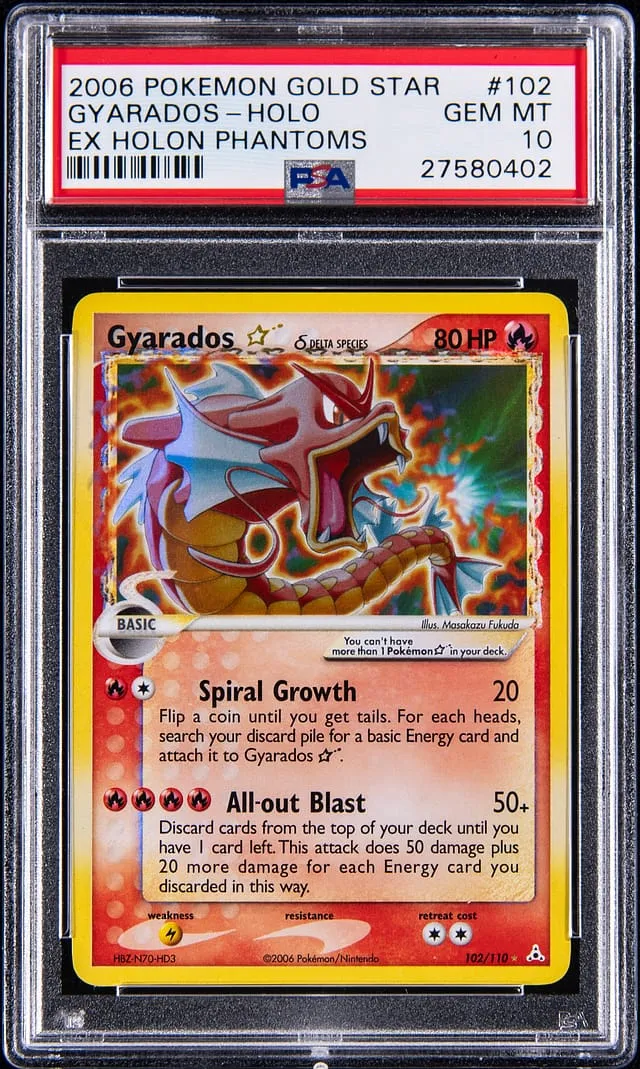
Gold Star Gyarados PSA 10 Sale: EX Holon Phantoms
A PSA 10 Gold Star Gyarados from EX Holon Phantoms sold for $915,000 at Goldin on March 9, 2026. Here’s what that means for Pokémon collectors.
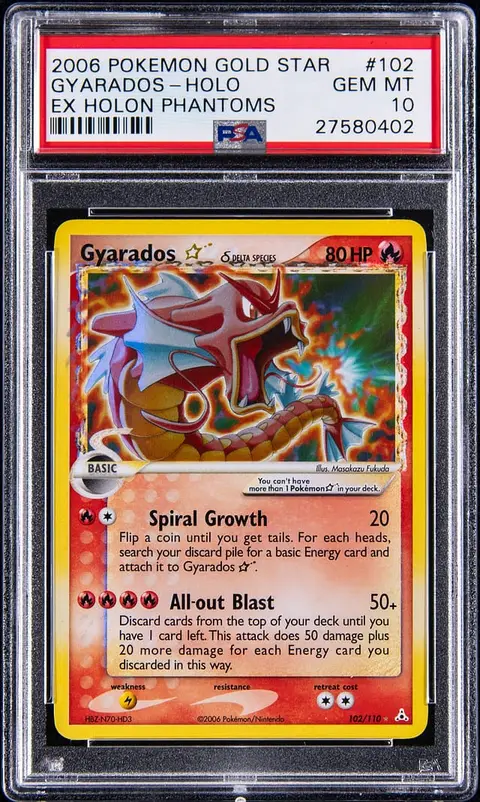
Sold Card
2006 Pokemon EX Holon Phantoms Gold Star Holo #102 Gyarados - PSA GEM MT 10
Sale Price
Platform
Goldin2006 EX Holon Phantoms Gold Star Gyarados in PSA 10 quietly crossed another milestone on March 9, 2026, when a copy sold for $915,000 at Goldin. For a mid‑2000s Pokémon card, that is an attention‑grabbing result and another data point in the long story of Gold Star chase cards.
In this post, we will:
- Pin down exactly what this card is
- Look at recent sales and price context
- Talk about why Holon Phantoms Gold Star Gyarados matters to collectors
- Consider what a sale like this means for the broader Pokémon market
The card at a glance
- Title: 2006 Pokémon EX Holon Phantoms Gold Star Holo #102 Gyarados
- Set: EX Holon Phantoms (Nintendo era, 2006)
- Card number: #102/110
- Variant: Gold Star (shiny Gyarados artwork, Gold Star mechanic)
- Rarity: Ultra‑rare insert, very difficult pack pull
- Era: Mid‑2000s EX era (often seen as low‑print relative to WotC but still pre‑modern)
- Grading company: PSA (Professional Sports Authenticator)
- Grade: GEM MT 10 (PSA’s highest standard grade)
- Attributes: Non‑auto, non‑serial‑numbered, but a key Gold Star issue from a flagship EX set
- Status: Not a rookie (Pokémon don’t have rookies in the sports sense), but absolutely a key issue for Gyarados collectors and EX‑era specialists.
Gyarados Gold Star from EX Holon Phantoms is one of the more recognizable Gold Stars, sitting in the same broad conversation as cards like Gold Star Charizard, Rayquaza, and the Eeveelutions, even if its population and demand dynamics differ.
What makes EX Holon Phantoms and Gold Star Gyarados special?
The EX Holon Phantoms era
EX Holon Phantoms released in 2006, during the Nintendo EX era. Compared with the original Wizards of the Coast (WotC) sets, these mid‑2000s sets were printed in smaller quantities and were overlooked for years. Today, they are viewed as:
- Low‑print, high‑difficulty sets where sealed product is scarce
- Home to Gold Star chase cards that are notorious for low pull rates
- A bridge between vintage WotC nostalgia and more modern card design
Gold Star cards explained
Gold Star cards are a line of ultra‑rare Pokémon cards from the EX era, identified by the gold star next to the Pokémon’s name and usually depicting shiny (alternate‑color) Pokémon. Collectors care about them because:
- They were extremely hard to pull from packs
- Many feature popular or fan‑favorite Pokémon
- They sit firmly in the nostalgia window for today’s adult collectors
Gyarados, already a classic from Base Set days, gets a dramatic, shiny treatment here that has cemented this card as one of the anchor pieces of the Holon Phantoms checklist.
Population and grading context
PSA population reports (often referred to as the “pop report”) show how many copies of a card have been graded at each grade level. While exact numbers evolve over time, Gold Star Gyarados has:
- A modest total population relative to modern ultra‑rare cards
- A very limited number of PSA 10s, with far more copies landing in PSA 8–9 due to edgewear, print quality, and surface issues common to EX‑era foils
For collectors, that means PSA 10 examples sit at the top of an already small pyramid. When a PSA 10 comes to public auction at a major house like Goldin, it becomes a reference point for future negotiations, even in private sales.
Recent sales and market context
The Goldin result:
- Price: $915,000
- Auction house: Goldin
- Sale date: March 9, 2026 (UTC)
To understand what this means, it helps to look at “comps.” In the hobby, comps (short for “comparables”) are recent, verifiable sales of the same or very similar items that buyers and sellers use as reference points.
For Gold Star Gyarados, recent public sales have generally shown the usual pattern:
- PSA 10 copies commanding a large premium over lower grades
- PSA 9 and BGS 9.5 copies trading at a substantial discount to true gem PSA 10s
- Raw (ungraded) copies and PSA 7–8s typically appealing more to character collectors than condition purists
Across major marketplaces and auction houses, you will see a wide range of realized prices depending on grade, eye appeal (centering, print quality), and timing. The $915,000 Goldin sale lands at the very top of that spectrum and should be treated as a high‑end, premium outlier, not a routine comp.
In other words, this sale tells us what one top‑end buyer was willing to pay for a top‑end example at a specific moment in time; it does not automatically reset the entire market for every copy of the card.
Why collectors care about this card
1. Character and nostalgia
Gyarados has been a marquee Pokémon since Base Set. A shiny version, with a distinct and dramatic artwork treatment, touches several collecting lanes at once:
- Base‑era nostalgia (longtime Gyarados fans)
- Shiny Pokémon collectors
- Gold Star completists
- EX‑era set builders
When multiple collector groups converge on one card, demand tends to be durable, especially in the best grades.
2. Set importance
Within EX Holon Phantoms, Gyarados Gold Star sits among the headline chase cards. For people who view the EX era as a “new vintage”—older than modern but more refined than early WotC foils—this card is one of the flagship pieces that define the era.
3. Grade scarcity at the top
Because PSA 10 examples are limited, each public auction becomes a reference moment. Even collectors who own 8s and 9s pay attention, because the ratio between 9 and 10 pricing often shapes how they think about their own cards.
How this sale fits into the broader Pokémon market
The mid‑2020s Pokémon market has been about sorting out which cards have long‑term collector support versus which were more speculative. A high‑end sale like this at Goldin suggests that:
- Deep‑pocketed collectors still prioritize true rarity plus nostalgia
- EX‑era Gold Stars remain at the center of serious Pokémon discussions
- Condition rarity (PSA 10s) continues to matter in established chase cards
It does not mean all copies will follow this price. But it reinforces that certain EX‑era keys, especially in top grade, have found a long‑term lane in the hobby.
Takeaways for different types of collectors
If you are new or returning to Pokémon
- Use this sale as a case study in how rarity, nostalgia, and grade intersect.
- Start by learning about:
- Gold Star cards as a category
- The EX era sets (Holon Phantoms, Deoxys, Dragon Frontiers, etc.)
- How to read and interpret a grading label (company, grade, qualifiers)
You do not need to chase six‑figure cards to enjoy this space. Understanding why they sell for what they do can help you make more informed decisions at every budget level.
If you are an active hobbyist or small seller
- Treat the $915,000 Goldin result as a premium data point, not an automatic price floor.
- When looking at comps, consider:
- Grade and subgrade differences
- Timing (peak hype vs quieter periods)
- Auction house vs fixed‑price marketplaces
Documenting sales like this in your own notes or spreadsheets can help you track how the top of the EX‑era market behaves over time.
If you are an EX‑era or Gold Star specialist
This sale adds another line to the narrative that the EX era is maturing into a core part of the Pokémon canon, not a side chapter between WotC and the modern era. As more population data and long‑term sales history accumulate, it becomes easier to distinguish which Gold Stars are truly scarce and consistently demanded.
Final thoughts
The March 9, 2026 Goldin sale of a 2006 Pokémon EX Holon Phantoms Gold Star Holo #102 Gyarados in PSA GEM MT 10 at $915,000 is more than just a big number. It is another marker in the steady recognition of EX‑era Gold Stars as foundational, long‑term chase cards.
For collectors, the real value in tracking a result like this is not to forecast the next sale, but to better understand how set importance, character appeal, and condition all combine to create a true hobby centerpiece.
As always, these are observations about recent sales and price context, not financial advice or predictions. The best collecting decisions still start with knowing what you love, understanding the data, and moving at a pace that fits your own goals.