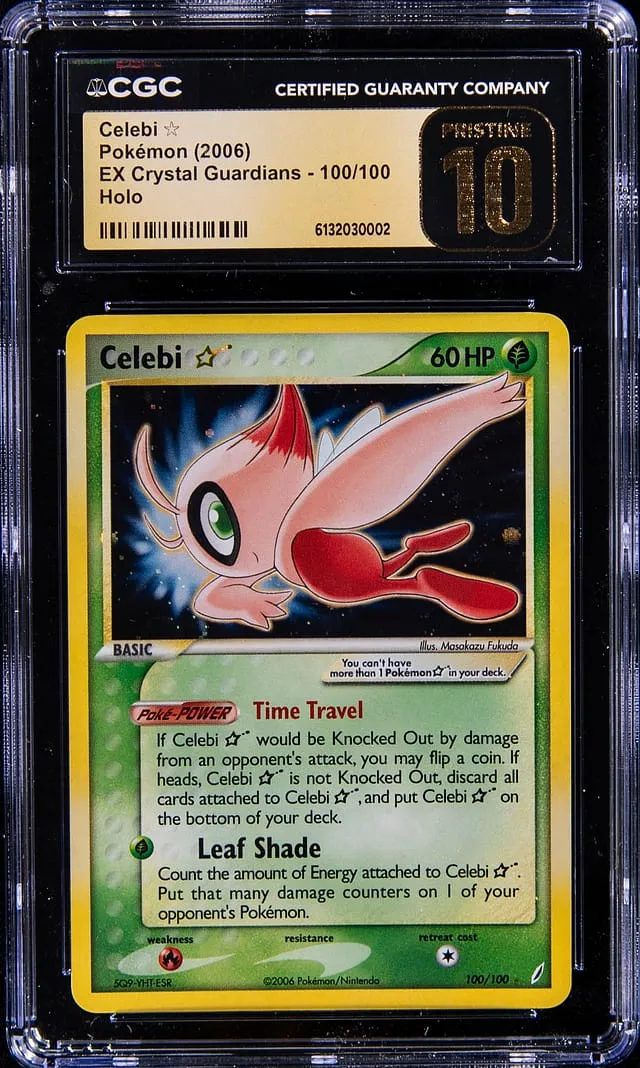
Gold Star Celebi CGC 10: $18K EX Crystal Guardians Sale
A CGC Pristine 10 Gold Star Celebi from EX Crystal Guardians sold for $18,028 at Goldin. A calm look at the comps, context, and collector demand.
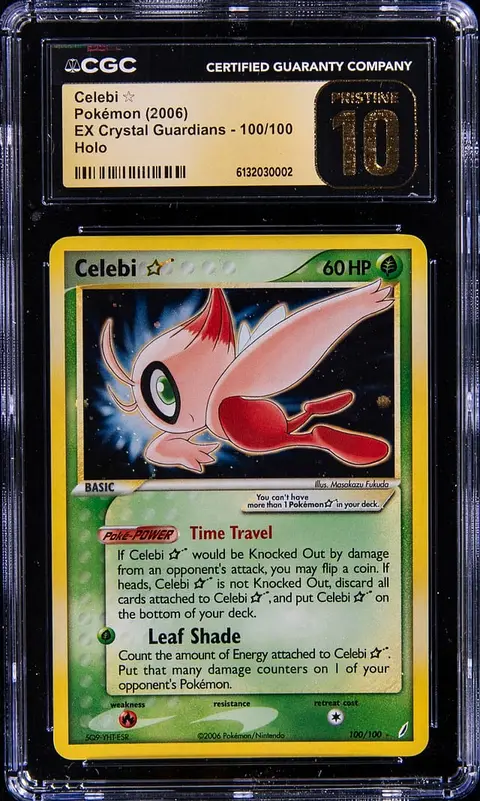
Sold Card
2006 Pokemon EX Crystal Guardians Gold Star Holo #100 Celebi - CGC PRISTINE 10
Sale Price
Platform
Goldin2006 Pokémon EX Crystal Guardians Gold Star Holo #100 Celebi - CGC Pristine 10: A Calm Look at a $18,028 Gold Star Result
On March 30, 2026, a copy of 2006 Pokémon EX Crystal Guardians Gold Star Holo #100 Celebi graded CGC Pristine 10 sold at Goldin for $18,028. For fans of mid‑2000s Pokémon, this is an important data point for one of the hobby’s most respected eras and card types: Gold Stars.
In this breakdown, we’ll walk through what the card is, why collectors care, and how this result fits into recent market context.
Card Snapshot
- Character: Celebi
- Game/Brand: Pokémon TCG
- Year: 2006
- Set: EX Crystal Guardians
- Card Number: #100
- Variant: Gold Star Holo (shiny Celebi artwork)
- Status: Key chase card from the set (not a “rookie,” but a core issue for the character)
- Grading Company: CGC (Certified Guaranty Company)
- Grade: Pristine 10 (CGC’s top tier, below only their ultra‑scarce “Perfect 10”)
Gold Star cards are a specific type of chase card from the mid‑2000s EX era. They feature shiny versions of Pokémon, usually with a Gold Star next to the Pokémon’s name. Pull rates were very low compared with typical holo rares, which is a big part of why they’re so focused on by collectors today.
Why EX Crystal Guardians Gold Star Celebi Matters
Part of the Gold Star run Gold Stars, released across several EX sets between 2004–2007, are widely seen as the top tier of the mid‑2000s Pokémon chase cards. For many collectors, they bridge the gap between early WotC (Wizards of the Coast) sets and the modern ultra‑premium chase era.
Shiny Celebi artwork This card features a shiny (alternate‑color) Celebi, which is different from the standard game color. Shiny legendaries tend to have an extra layer of appeal because they cross over with in‑game hunting culture and nostalgia.
Low pull rates and condition difficulty EX‑era Gold Stars were inserted at very low ratios. On top of that, mid‑2000s English Pokémon holo cards often show edge wear and print defects right out of the pack.
As a result, high grades are scarce. Crossing into a top grade like CGC Pristine 10 adds another layer of rarity over and above the card itself.
Understanding the CGC Pristine 10 Grade
CGC’s grading scale goes from 1 to 10, with:
- 9 or 9.5 often representing very strong copies, and
- 10 reserved for Pristine cards that are extremely clean across corners, edges, surface, and centering.
Above that, CGC has a “Perfect 10” label that is even more demanding. In practice, Pristine 10s for older, holo‑heavy cards from the EX era do not come up often. Many copies plateau in the 8.5–9.5 range due to surface scratches, edge whitening, and factory print lines.
For collectors comparing grading scales, it’s worth remembering that price behavior can differ between grading companies even at the same numerical grade. Market participants tend to look closely at how many top‑grade copies the grading company has in its population report (or "pop report"—a count of how many copies exist in each grade).
Market Context: Where Does $18,028 Fit?
This Goldin sale at $18,028 provides a fresh benchmark for the CGC Pristine 10 level of this card. Exact, same‑grade comps (short for “comparable sales,” i.e., recent sales of similar items used as price references) are relatively thin because:
- EX‑era Gold Star cards do not surface in top grades very frequently, and
- CGC Pristine 10 is an especially small slice of the total graded population.
More commonly, you’ll see:
- PSA 9 and PSA 10 copies, and
- BGS 9.5 and BGS 10 copies for certain key Gold Stars.
Across the broader Gold Star category, there is a familiar pattern:
- Lower grades (PSA 7–8) are accessible to more collectors and show more frequent sales.
- High grades (PSA 9, CGC 9, BGS 9.5) carry a substantial premium but are available often enough to track.
- Top‑end labels (PSA 10, CGC Pristine 10, BGS Black Label) often show fewer, sometimes sporadic sales, and prices can move more sharply when a new result appears.
The $18,028 result at Goldin sits firmly in that high‑end, low‑supply territory. While exact historical comps for CGC Pristine 10 Gold Star Celebi are limited, the price:
- Aligns with the broader trend of strong respect for Gold Stars from serious Pokémon collectors.
- Reflects both card scarcity and grade scarcity, not just one or the other.
Because top‑grade sales for niche, mid‑2000s chase cards can be spread out over months or years, any new auction result tends to reset expectations in a careful, case‑by‑case way rather than defining a simple price “trend.”
Collector Significance and Era Context
EX era (mid‑2000s) The EX era (roughly 2003–2007) sits in a sweet spot between vintage and modern:
- It is no longer considered new or ultra‑modern.
- It still benefits from print runs that were smaller than many contemporary sets.
Within that window, Crystal Guardians is viewed as a standout set, especially for collectors building full Gold Star or EX series runs.
Gold Star chase culture Gold Stars often serve as the centerpiece of an EX‑era binder or graded collection. Completing even a small run of them can be time‑consuming and costly, particularly if you restrict yourself to high grades.
Celebi, while not as universally chased as, say, Charizard, sits in a popular lane of time‑travel/legendary Pokémon that has loyal, character‑focused collectors. Many collectors now collect vertically (multiple key cards of a single character) instead of just horizontally (every card in a set), which gives character cards like Celebi ongoing relevance.
Grade scarcity as a second layer For this card, there are two scarcity stories:
- Print and pull scarcity from 2006.
- Top‑grade scarcity nearly 20 years later.
It’s the combination of both that tends to drive eye‑catching results like this Goldin sale.
How This Sale Fits into the Broader Gold Star Landscape
While exact population counts and private sales are beyond the scope of this article, a few general patterns are clear in the Gold Star market:
- Key characters (Charizard, Espeon, Umbreon, Rayquaza) often draw the most attention, but non‑headliners like Celebi have developed steady niches.
- High‑end collectors have been consolidating into strong, graded examples of mid‑2000s chase cards, often preferring top populations even for secondary characters.
- Auction houses like Goldin increasingly host high‑grade EX‑era cards, bringing them into a more public, documented setting compared with older, more private sales.
This CGC Pristine 10 Celebi result at $18,028 fits neatly into that pattern: a top‑tier grade of a mid‑2000s Gold Star, sold through a major auction house on March 30, 2026, helping to anchor a new reference point for future discussions.
What Collectors Can Take Away
For newcomers and returning collectors:
- This card illustrates how much weight the hobby places on specific eras and card types, not just on the most famous characters.
- It’s a clear example of how condition and grading can multiply the value of a scarce insert.
For active hobbyists and small sellers:
- Tracking occasional high‑end results like this can help frame your expectations for lower grades. For example, a top‑grade benchmark can give context when you’re evaluating raw (ungraded) Celebi Gold Stars or copies in mid‑tier slabs.
- Keep in mind that one high result does not guarantee that every copy will follow. The market tends to differentiate strongly between grades, subgrades, and individual card eye appeal.
Final Thoughts
The 2006 Pokémon EX Crystal Guardians Gold Star Holo #100 Celebi in CGC Pristine 10 that sold for $18,028 at Goldin on March 30, 2026, is more than just a headline sale. It’s a snapshot of how the hobby currently values:
- EX‑era Gold Stars as historical chase cards,
- Character‑driven collecting beyond the biggest mascots, and
- The rarity of top‑tier grades nearly two decades after release.
As more EX‑era collections surface and grading populations evolve, results like this will remain useful reference points for anyone tracking the long‑term story of Gold Star Pokémon cards.