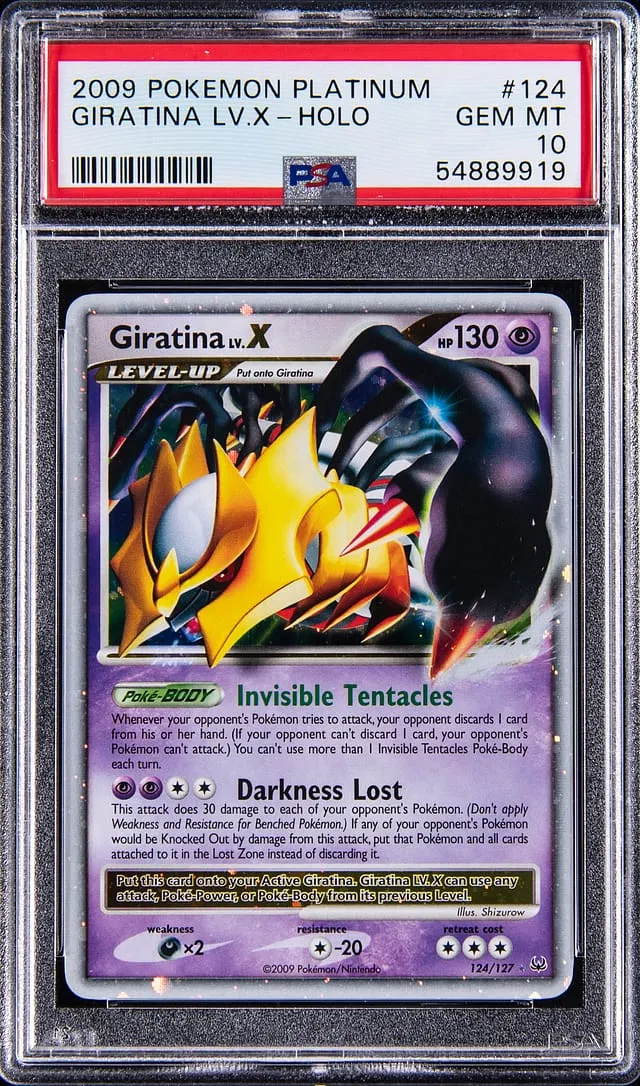
Giratina Lv. X PSA 10 Platinum Sale at Goldin
A PSA 10 Giratina Lv. X from 2009 Pokémon Platinum sold for $29,890 at Goldin. See what this means for Platinum-era collectors and the wider market.
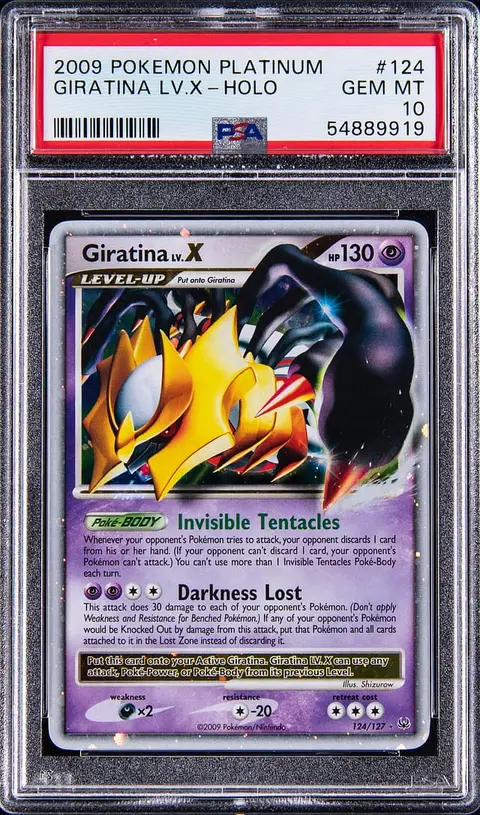
Sold Card
2009 Pokemon Platinum Holo #124 Giratina Lv. X - PSA GEM MT 10
Sale Price
Platform
Goldin2009 Pokemon Platinum Holo #124 Giratina Lv. X in a PSA GEM MT 10 holder just changed hands at Goldin on March 9, 2026 for $29,890. For a late‑2000s era card, that is a serious result and a useful datapoint for collectors who follow Platinum‑era Legendaries and graded Pokémon holos.
Card overview
- Card: Giratina Lv. X (Holo)
- Set: Pokémon Platinum (DP era), English
- Year: 2009
- Card number: #124
- Character: Giratina (Legendary Pokémon from Generation IV)
- Type: Lv. X Pokémon card (mechanic similar to today’s VMAX/EX evolutions)
- Rarity: Holo, late‑set ultra‑rare
- Grading company: PSA (Professional Sports Authenticator)
- Grade: GEM MT 10
- Attributes: No serial number, no autograph – value is driven by set importance, character, and condition
This is not a rookie in the sports‑card sense, but within the Pokémon TCG it is a key Giratina issue from the Platinum era. Lv. X cards were the chase pulls of their time, and Platinum is the namesake set for the whole generation.
Why Platinum Giratina Lv. X matters
Platinum‑era context
The Platinum set (released in 2009) kicked off the Platinum block of the Pokémon TCG. It focused heavily on the Distortion World and Giratina, tying into the Pokémon Platinum video game on Nintendo DS.
Within that context, Giratina Lv. X functions as one of the marquee chase cards of the set:
- It represents Giratina in its elevated Lv. X form, similar to how EX/GX/VMAX cards represent powered‑up versions in later eras.
- Pull rates for Lv. X cards were meaningfully lower than for standard holos, so supply is far thinner than, for example, base‑set rares.
- Platinum is now far enough in the past that sealed product is scarce, so most fresh copies entering grading come from old collections, often with some wear.
All of that means that high‑grade examples are relatively hard to replace. PSA 10s capture the intersection of a popular Legendary, a nostalgic DS‑era game tie‑in, and a chase rarity from a now‑discontinued mechanic.
Giratina’s collector appeal
Giratina occupies a special lane among Legendary Pokémon:
- It is strongly associated with the Distortion World and darker, more "anti‑hero" aesthetics.
- It headlines Pokémon Platinum, which many returning collectors played during their childhood.
- It shows up in modern sets, alternative arts, and premium products, keeping the character in circulation.
That mix gives Giratina a steady collector base, even if it is not quite at the tier of Charizard or Pikachu. For players who grew up with Diamond/Pearl/Platinum, this Lv. X is one of the more nostalgic chase pieces.
Grading and population context
When collectors talk about a pop report (population report), they mean the grading company’s count of how many copies exist at each grade.
For Platinum‑era Lv. X cards, pop reports generally show:
- A moderate number of total graded copies (the era is popular but not mass‑submitted like modern ultra‑modern sets).
- A comparatively small population of PSA 10s, because holo foil and dark backgrounds tend to pick up print lines, scratches, and edge wear.
While exact population numbers for this card can change as more are graded, PSA GEM MT 10 remains the top of the pyramid. Most surviving raw copies from binders and decks fall into PSA 7–9 once submitted.
Market context and recent sales
This Goldin result at $29,890 in March 2026 sits toward the high end for Platinum‑era Giratina cards in gem‑mint condition. Looking across recent public data for related cards and grades (where available):
- Lower grades of this card (PSA 8–9) have tended to sell for a fraction of what top‑end 10s command, reflecting the usual premium for perfect condition.
- Raw or ungraded copies usually trade well below graded examples, especially when surface scratching or edge wear is visible.
- Other Giratina chases (for example, later‑era alternate arts and gold cards) often see more frequent sales but not necessarily this kind of price in a single transaction.
Because Platinum‑era Lv. X cards do not transact at the same high volume as modern chase cards, comps (comparable recent sales) can be sparse and lumpy. A single strong auction can stand out more than it would for a high‑liquidity modern hit.
Within that context, this $29,890 Goldin sale looks like a premium result rather than a routine one. It reinforces the idea that:
- Ultra‑high‑grade copies of key Platinum Lv. X cards can attract focused bidding.
- Demand is strongest for the very best examples with established third‑party grades.
It is also worth noting that this is a PSA 10. Even a one‑grade drop to PSA 9 often leads to a significant price gap, especially for condition‑sensitive foils.
Factors that may support interest
A few structural factors help explain why a card like this can achieve a nearly $30,000 price:
Era scarcity vs. modern print runs
Platinum was printed at a far smaller scale than many Sword & Shield or Scarlet & Violet sets. That means fewer sealed boxes and fewer pack‑fresh Giratina Lv. X cards exist to be graded.Aging of the Platinum generation
Collectors who were kids during the DS era are now adults with disposable income. As they return to the hobby, they often target the chase cards they remember, including Platinum Lv. X Legendaries.Top‑grade consolidation
As more collectors opt to “lock away” their best PSA 10s in long‑term collections, the effective supply of available copies shrinks. That can put upward pressure on auction results when a strong example surfaces.Auction house visibility
Goldin’s platform tends to bring together serious buyers. When two or more determined collectors decide they want the same scarce card, results can step above quieter fixed‑price sales.
How this sale fits the broader Pokémon market
Zooming out, this sale fits into a few broader trends:
- Blue‑chip nostalgia: Collectors are still willing to pay for core nostalgia pieces—early‑ and mid‑generation chase cards tied to major games.
- Shift from purely modern hype: While modern sets with big alternate arts get a lot of social media coverage, there is steady, quieter demand for mid‑2000s to late‑2000s cards that are harder to replace.
- Condition as a primary driver: With a non‑serial, non‑autographed card like this, condition and eye appeal drive the premium. The PSA GEM MT 10 label acts as a shorthand for that.
None of this guarantees what future prices will do, but it does provide helpful price context: serious collectors are still willing to chase elite examples from this era, especially through established auction houses.
Takeaways for collectors and small sellers
If you collect or sell Platinum‑era Pokémon cards, here are a few practical points to consider:
Check condition carefully
On Lv. X foils, look closely for surface scratches, print lines, and edge whitening. These often cap grades at PSA 8–9 even when the card looks strong at first glance.Understand the grade gap
The jump from PSA 9 to PSA 10 can represent a large price difference. When you evaluate comps, make sure you compare the same grade before drawing conclusions.Use multiple data points
One high auction result is informative but not definitive. For a card like this, combine auction data (like this Goldin sale on March 9, 2026) with fixed‑price and private‑sale information where you can find it.Know the set’s hierarchy
Within Platinum, focus on the key Legendaries and chase Lv. X cards if you are building a collection with long‑term appeal. Giratina Lv. X sits near the top of that list.Document provenance on big cards
For higher‑end pieces, recording when and where they sold (for example, “Goldin, March 9, 2026, $29,890”) can add helpful context for future buyers.
Final thoughts
The 2009 Pokémon Platinum Holo #124 Giratina Lv. X in PSA GEM MT 10 bringing $29,890 at Goldin on March 9, 2026 is a clear reminder of how much respect the hobby still gives to mid‑generation chase cards in top condition.
For Giratina fans, it is one of the definitive high‑end options. For Platinum collectors, it is a pillar of the set. And for the wider market, it’s another data point showing that focused demand for scarce, nostalgic pieces remains very much alive.
As always, treat this sale as one piece of the puzzle rather than a guarantee of what every copy will sell for. But if you are holding, hunting, or grading Platinum‑era Lv. X cards, this result is well worth bookmarking in your notes.