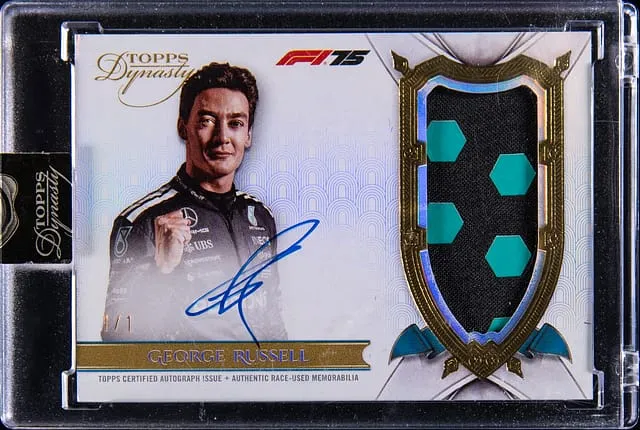
George Russell 2025 Dynasty F1 Gold 1/1 Sells on Goldin
Breakdown of the 2025 Topps Dynasty F1 George Russell Gold 1/1 auto patch that sold for $29,280 on Goldin on March 20, 2026.
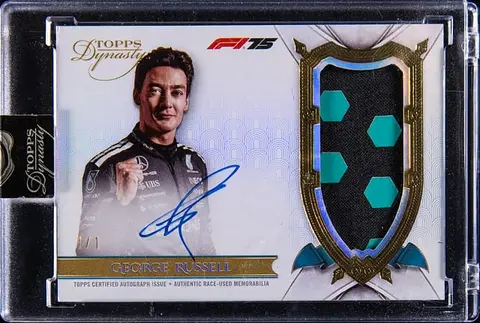
Sold Card
2025 Topps Dynasty F1 Autographed Patches Gold #DAP-GRUVI George Russell Signed, Race-Used Patch Card (#1/1) - Topps Encased
Sale Price
Platform
Goldin2025 Topps Dynasty F1 George Russell Gold 1/1 Sells for $29,280 on Goldin
When a modern Formula 1 card sells for five figures, it’s worth slowing down and asking why. On March 20, 2026, Goldin closed a $29,280 sale for a true hobby trophy:
2025 Topps Dynasty F1 Autographed Patches Gold #DAP-GRUVI George Russell – Signed, Race-Used Patch, 1/1, Topps Encased.
For F1 collectors who focus on premium, low-serial issues, this card sits near the top of the George Russell market. Let’s walk through what makes it important, how it fits into the broader Dynasty F1 landscape, and what this price tells us about demand.
Card at a glance
- Player: George Russell
- Team (at time of issue): Mercedes-AMG Petronas Formula One Team
- Year: 2025
- Brand / Set: 2025 Topps Dynasty Formula 1
- Card: Autographed Patches
- Card number: #DAP-GRUVI
- Parallel: Gold
- Serial numbering: 1/1 (one of one)
- Autograph: On-card (signed directly on the card)
- Memorabilia: Race-used patch (piece of Russell’s race-worn gear)
- Encapsulation: Topps factory encased (original Dynasty magnetic case with Topps seal)
- Grading: None noted – sold raw in Topps encasement
This is not a rookie card (Russell’s first F1 cards arrived in earlier Topps F1 releases), but in the current era of modern and ultra-modern F1, a Dynasty Gold 1/1 auto patch is widely treated as a true cornerstone card for a driver.
Why Topps Dynasty F1 matters
Topps Dynasty is positioned as Topps’ high-end, low-print-run F1 product. Each box contains a single premium hit, usually an autographed patch card with:
- Very low serial numbering (often /10, /5, or 1/1)
- On-card autographs
- Race-used patches from suits, gloves, or other gear
- Distinctive, thick premium card stock and factory encasing
Within any given year of Dynasty, the 1/1 parallels (like this Gold) are essentially the top of the pyramid for individual drivers. Collectors who build “player collections” (PCs) for specific drivers often view:
- Dynasty 1/1s
- Flagship 1/1s / key rookie autos
as their highest-priority chase cards.
The 2025 release continues that pattern, giving each featured driver a limited ladder of patch autos and ultra-short-printed variations capped by 1/1s.
Market context and price positioning
This card sold on Goldin on March 20, 2026 for $29,280. To understand where that sits in the market, it helps to step back and look at Dynasty F1 trends and comparable cards.
Comps and nearby cards
“Comps” is hobby shorthand for comparable recent sales – similar cards that help frame a realistic range of values.
For this specific card – the 2025 Topps Dynasty F1 Autographed Patches Gold #DAP-GRUVI 1/1 – there are no prior identical sales, which is expected: a 1/1 only exists once. Instead, collectors and sellers look to:
- Other George Russell 1/1 Dynasty cards from nearby years
- Lower serial Russell Dynasty autos (/10, /5)
- Comparable Dynasty 1/1s of similarly positioned drivers
Across major marketplaces and auction houses, the pattern on modern F1 Dynasty has been:
- Top-tier stars (Verstappen, Hamilton) at the very top of the price curve
- Next tier contenders (Leclerc, Russell, Norris, etc.) forming the second band of high-end prices, with spikes tied to on-track performance and championship potential
- Team context (Mercedes, Ferrari, Red Bull) adding an additional layer of demand and prestige
On that spectrum, this $29,280 result fits the profile of a strong, but not irrational, outcome for a premium Russell 1/1:
- It sits below record-setting Hamilton or Verstappen 1/1s from the early Topps F1 years, which have reached much higher levels on certain examples.
- It is meaningfully above most non-1/1 Russell cards (including serial /5 and /10 Dynasty autos and early flagships), which is consistent with the scarcity step-up from /5 to true 1/1.
Without an identical prior sale, we can’t call this definitively high or low, but relative to:
- Recent Dynasty 1/1 prices for non-Hamilton/Verstappen drivers, and
- The broader Russell high-end market,
this Gold 1/1 result looks healthy and in line with serious, long-term collector interest.
Why collectors care about this card
1. George Russell’s positioning in the F1 hierarchy
George Russell occupies an important place in the modern F1 hobby:
- Former standout at Williams and a highly regarded junior formula driver
- Promoted to Mercedes, a flagship team with a deep championship history
- Viewed as a long-horizon contender and a possible future multiple–race winner or champion, depending on machinery and team form
For many collectors, that profile—young, proven, and aligned with a historically dominant team—is exactly what justifies chasing top-end cards like this.
2. True scarcity: 1-of-1 and race-used
A serial number of 1/1 means there is literally only one copy of this exact card. In practice:
- Player collectors can’t “wait for another one” if they want this specific design, patch, and autograph.
- Even if other Russell 1/1s exist in the product, each has a unique patch, image, or layout, so they’re not interchangeable.
Paired with a race-used patch, the card connects directly to Russell’s on-track activity. For many F1-focused collectors, that race-worn element is more meaningful than generic player-worn or event-worn material.
3. Autograph quality and presentation
Topps Dynasty emphasizes on-card autographs, which many hobbyists prefer over sticker autos (autographs signed on stickers later applied to cards). On-card signatures:
- Usually look cleaner and more integrated into the design
- Are often perceived as more “premium” because the athlete handled the actual card
The thick stock and elegant layout of Dynasty further push this into the “display piece” category for collectors.
4. Product and era: ultra-modern F1
This card sits firmly in the ultra-modern era of trading cards, where:
- Print runs for base cards can be large, but high-end chase cards are extremely short-printed.
- Condition sensitivity is lower at the top end due to factory encasing, but grading still matters for some buyers.
Ultra-modern F1 is still relatively young compared to vintage and classic stick-and-ball sports. For many collectors, early and mid-2020s Topps F1 products—especially Dynasty—are becoming the de facto premium reference point for this era.
Grading and encasement
This copy sold Topps encased and, based on the listing, not graded by a third-party like PSA, BGS, or SGC.
For modern premium cards:
- Some collectors prefer to keep Dynasty cards in their original Topps case, especially for display and authenticity confidence.
- Others choose to crack and grade, aiming to add a numeric grade to the auto/patch combination.
The fact that this card achieved $29,280 without a third-party grade suggests:
- The buyer prioritized scarcity and player over a slabbed numeric grade.
- For true 1/1s, condition certainly matters, but uniqueness sometimes outweighs everything else.
What this sale might signal for the market
While one result never tells the entire story, this Goldin sale does highlight a few ongoing trends in the F1 card space:
Sustained interest in premium F1
High-end Dynasty cards for key drivers continue to draw serious bidding, even as the broader market has become more selective.Tiered pricing by driver profile
Hamilton and Verstappen continue to define the top of the market, but Russell’s premium cards clearly live in the upper tier right behind them, reflecting collector confidence in his long-term relevance.1/1s as long-term anchors
Among ultra-modern F1 cards, 1/1 autograph patches from a brand like Dynasty are increasingly treated as anchor pieces in personal collections and long-hold portfolios. They are less about quick flips and more about plant-your-flag ownership.Event-driven upside and downside
As always, future on-track performance, team changes, and championship battles will influence how hobbyists feel about Russell’s top-end cards. Recent and upcoming seasons will continue to color how sales like this look in hindsight.
Takeaways for different types of collectors
Whether you are new to F1 cards or already deep into the niche, here’s how to think about a card like this:
- Newcomers: Use this sale as a reference point for what the very top of a driver’s market can look like. You don’t need to chase 1/1s, but understanding them helps you evaluate more accessible cards from the same product.
- Active hobbyists: Watch how other Russell Dynasty autos (/10, /5) track against this result over time. They can offer more frequent comps and a way to triangulate sentiment around the driver.
- Small sellers: If you’re breaking or reselling 2025 Dynasty F1, this sale underlines the importance of documenting patches, maintaining Topps seals, and clearly describing serial numbers and player relevance.
As always, none of this is a prediction. It’s simply a snapshot of where the market stood on March 20, 2026, when one collector decided that owning this exact George Russell Gold 1/1 was worth $29,280.
For figoca, tracking sales like this helps map the contours of the modern F1 landscape—one 1/1 at a time.