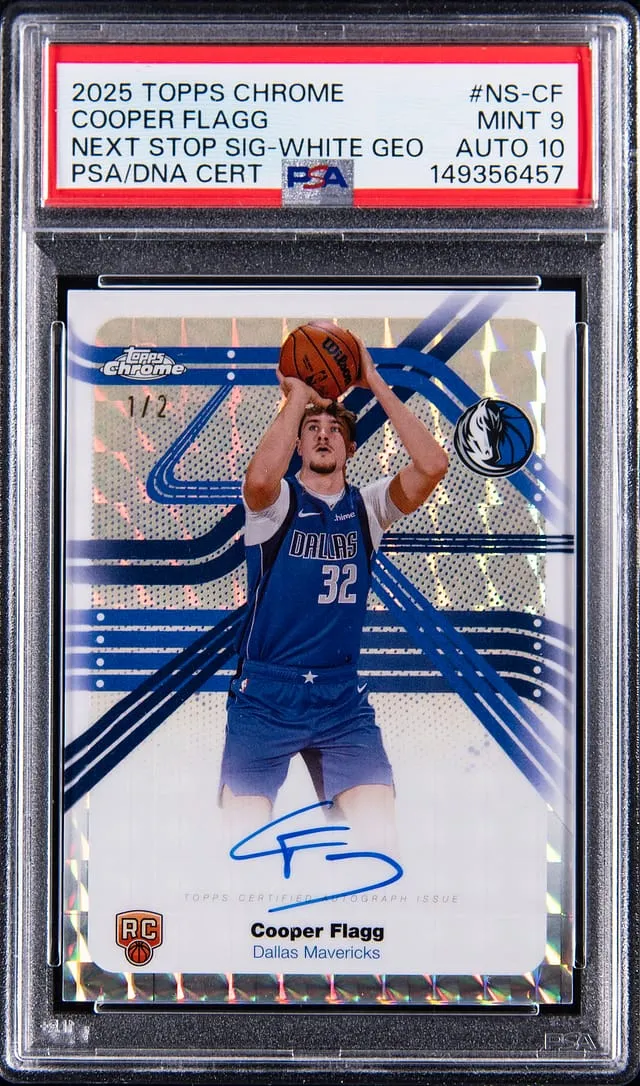
Cooper Flagg Topps Chrome Auto /2 Sells for $19,825
Breaking down the $19,825 Goldin sale of a 2025-26 Topps Chrome Cooper Flagg White Geometric Refractor /2 auto, PSA 9 with GEM MT 10 autograph.
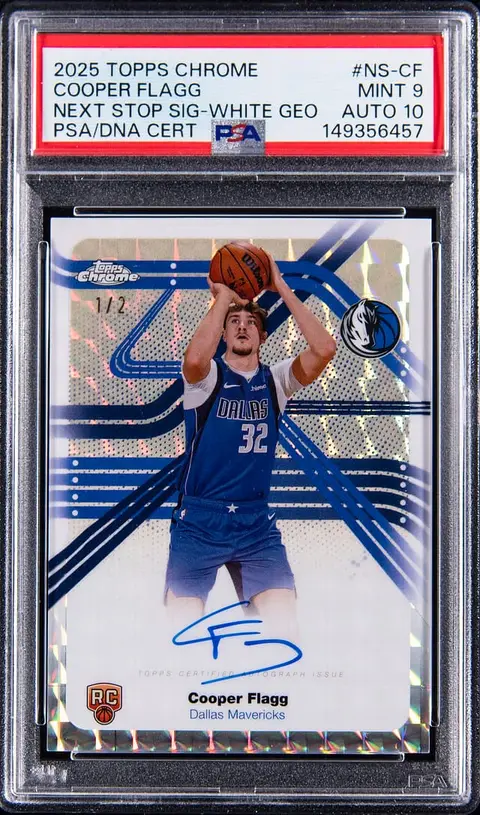
Sold Card
2025-26 Topps Chrome Next Stop Signatures White Geometric Refractor #NS-CF Cooper Flagg Signed Rookie Card (#1/2) - PSA MINT 9, PSA/DNA GEM MT 10 - Pop 1
Sale Price
Platform
GoldinA $19,825 Cooper Flagg Sale That Says a Lot About Early Hype, Low Pops, and Modern Chrome Autos
On March 15, 2026, Goldin closed a notable ultra‑modern basketball sale: a 2025-26 Topps Chrome Next Stop Signatures White Geometric Refractor #NS-CF Cooper Flagg Signed Rookie Card, serial-numbered 1/2, graded PSA MINT 9 with a PSA/DNA GEM MT 10 autograph. The final price: $19,825.
For a player who is still in the very early stages of his career, this sale gives a useful snapshot of how the hobby is currently valuing scarce, graded, on-card chrome autos of high-upside prospects.
Card Breakdown: What Exactly Sold?
Let’s unpack the key details collectors care about:
- Player: Cooper Flagg
- Year/Release: 2025-26
- Brand/Set: Topps Chrome, "Next Stop Signatures" insert/auto set
- Card number: #NS-CF
- Parallel: White Geometric Refractor
- Serial numbering: Hand-numbered 1/2 (two copies exist; this is the first)
- Rookie designation: Treated by collectors as a key early Cooper Flagg Topps Chrome autograph issue
- Autograph: On-card signature (signed directly on the card, not a sticker)
- Grading:
- Card grade: PSA MINT 9
- Autograph grade: PSA/DNA GEM MT 10
- Population (pop): Pop 1 in this specific configuration at PSA at the time of sale
“Pop 1” refers to the population report, a grading company’s count of how many copies of a specific card/grade combo exist in their slabs. A low population, combined with a serial number of 1/2, makes this example one of the scarcest high-end early Flagg autos in the market.
Why This Card Matters to Collectors
Cooper Flagg sits firmly in the "ultra-modern prospect" category. In this era, collectors often focus on a few key traits when they look for long-term pieces:
On-card Chrome Autograph – Topps Chrome (and similar chromium brands) have become a central lane for modern and ultra-modern collectors. Within those runs, hard-signed (on-card) rookie or early-career autos tend to be prioritized over sticker autographs.
True Scarcity: Serial Numbered to 2 – A print run of only two copies is objectively scarce, even by modern standards. While many modern parallels are numbered, print runs as low as /2 leave very little supply to satisfy national and global demand if a player breaks out.
High Grade With Perfect Auto – A PSA MINT 9 card grade paired with a PSA/DNA GEM MT 10 auto is a strong combination. For many player collectors, an autographed card’s eye appeal and ink quality matter as much as corners and edges.
Early Chrome Flagship Representation – While different brands will inevitably compete for the title of Cooper Flagg’s “flagship” rookie, early Topps Chrome autographs, especially rare parallels, are likely to remain reference points when people look back at his early cardboard history.
Market Context: How Does $19,825 Fit In?
In the current ultra-modern environment, price context comes from:
- Exact-card comps (comparable recent sales for the same card)
- Close parallels (different colors or serial numbers from the same set)
- Cross-brand high-end rookie/early autos with similar scarcity
For a serial-numbered 1/2, Pop 1, PSA 9 / PSA 10 auto like this, exact same-card comps are inherently limited—there are only two copies in existence, and the Pop 1 status at PSA narrows it further.
What we can say from recent ultra-modern prospect markets:
- Chrome or Prizm-style on-card rookie autos with serial numbers under /10 and strong grades typically command a meaningful premium over more common parallels and unnumbered base autos.
- Within that range, cards numbered to /5 and /2 often sit in their own tier: they function closer to “centerpiece” cards for high-end player collectors rather than everyday liquidity pieces.
- When there are very few exact comps, sales like this one at $19,825 tend to act as reference points for future negotiations. They don’t set a guaranteed path upward or downward, but they do provide an anchor that buyers and sellers will likely reference.
Because population and serial numbering are so low here, it’s more useful to think in terms of relative positioning:
- This sale prices the card in the range often reserved for a player’s top 1–3 early cards available at public auction at any given moment.
- If other premium Flagg cards surface—such as 1/1s, superfractors, or top-tier RPA-style issues—future results will help clarify whether this $19,825 sale sits at a discount, a premium, or roughly in line with his emerging high-end market.
Scarcity Layers: Serial Number vs. Pop Report
Two different scarcity levers are in play with this card:
Printed Scarcity (1/2)
Only two copies of the White Geometric Refractor Next Stop Signatures were produced. That’s built-in scarcity at the manufacturer level.Graded Scarcity (Pop 1 in PSA 9/10 Auto)
Of however many might be graded across all companies, PSA currently reports this exact card/grade combo as Pop 1. Pop can rise over time as more copies are submitted, but low print runs naturally limit how high that number can climb.
For collectors, knowing both numbers helps frame how replaceable a card actually is. A rare serial number with a common grade is one thing; a rare serial number with a top-end grade and Pop 1 status is another.
Ultra-Modern Prospect Risk and Reward
It’s important to distinguish between what the sale shows today and any assumptions about the future. This $19,825 result at Goldin on March 15, 2026, reflects:
- Current expectations around Cooper Flagg’s ceiling.
- Ongoing demand for scarce, graded, on-card Chrome autos of elite prospects.
- The willingness of some collectors to concentrate significant capital into a very small number of centerpiece cards rather than many mid-range options.
It does not guarantee anything about Flagg’s long-term career or the future value of this or any other card. Prospect markets, especially in basketball, can move quickly in both directions based on performance, injuries, role, and broader hobby cycles.
For collectors and small sellers, the main takeaway isn’t a prediction—it’s the structure of the market:
- Premium modern sales are increasingly driven by scarce, graded, autographed parallels rather than mass-produced rookies.
- Early, rare Chrome autos can become reference points for a player’s entire card market, especially once they reach a certain price threshold and visibility through major auction houses.
What This Means for Different Types of Collectors
New or Returning Collectors
If you’re getting back into the hobby or starting fresh:
- Use sales like this as education, not as a buying target.
- Focus on understanding the terms you’re seeing:
- Comps – shorthand for comparable sales, or what similar items have sold for recently.
- Pop report – a grading company’s public database that shows how many of each card they’ve graded at each grade level.
- On-card auto – signatures written directly on the card surface, often preferred to sticker autos.
- You can still collect Cooper Flagg without chasing a 1/2. Look at more accessible parallels or non-numbered autos from the same or related sets.
Active Hobbyists and Small Sellers
For more active participants in the market:
- This Goldin result provides a high-end reference point when you’re evaluating other Flagg pieces. You can scale expectations up or down based on:
- Serial numbering (for example, /25, /50, /99 vs /2).
- Grade and whether the auto is graded separately.
- Brand strength and set reputation.
- Watch how future auctions of other premium Flagg cards perform. If additional rare Chrome or similar autos surface, the pattern of results will paint a clearer picture of his tier among modern prospects.
Player Collectors
If you primarily collect Cooper Flagg himself:
- A Pop 1, 1/2, PSA 9 with GEM MT 10 auto is realistically a cornerstone card.
- Even if you never intend to buy at this level, tracking these high-end sales can help you prioritize which mid-range and lower-tier cards you want to chase.
How figoca Looks at a Sale Like This
At figoca, we look at individual auctions like this Goldin result on March 15, 2026 less as isolated headlines and more as data points in a longer story:
- Card identity – exact set, parallel, numbering, grading, and auto details.
- Relative scarcity – how many exist and how many have been graded.
- Market structure – how similar cards for comparable players have behaved over time.
The 2025-26 Topps Chrome Next Stop Signatures White Geometric Refractor #NS-CF Cooper Flagg Signed Rookie Card (#1/2), PSA MINT 9 with a PSA/DNA GEM MT 10 auto, Pop 1, closing at $19,825 is a prime example of how ultra-modern, low-pop, on-card Chrome autos can anchor a player’s early cardboard story.
For collectors, the key is not to chase the headline number, but to understand why this particular combination of player, set, scarcity, condition, and timing produced that result—and how that knowledge can guide your own collecting lane, whether that’s high-end, mid-range, or purely for fun.