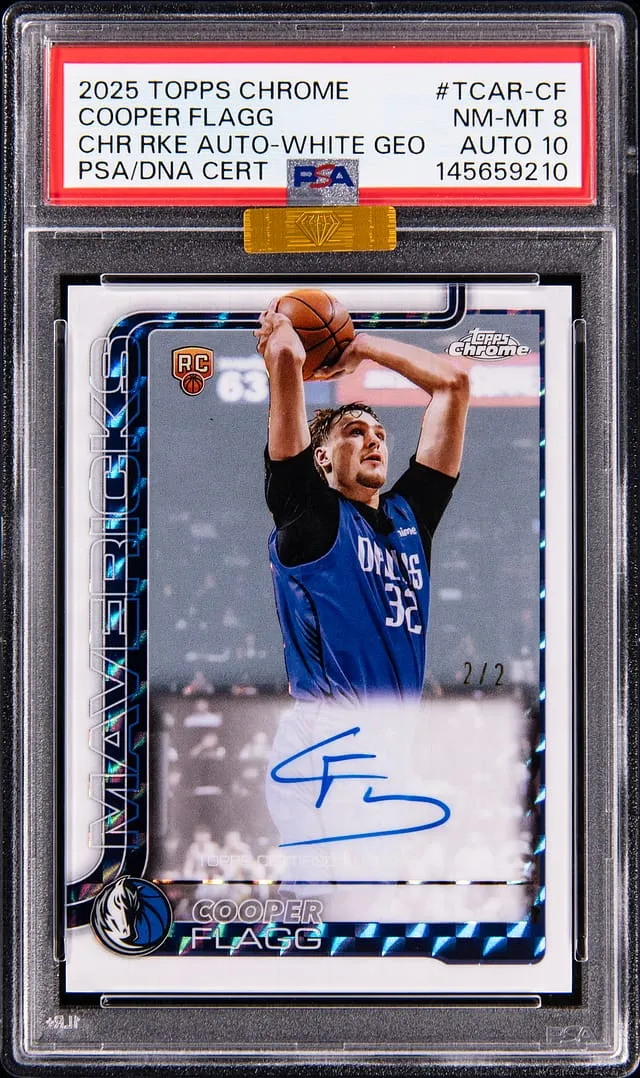
Cooper Flagg Topps Chrome Auto /2 Sells for $103,700
Deep dive into the $103,700 Goldin sale of the 2025-26 Topps Chrome Cooper Flagg Rookie Autographs White Geometric Refractor /2.
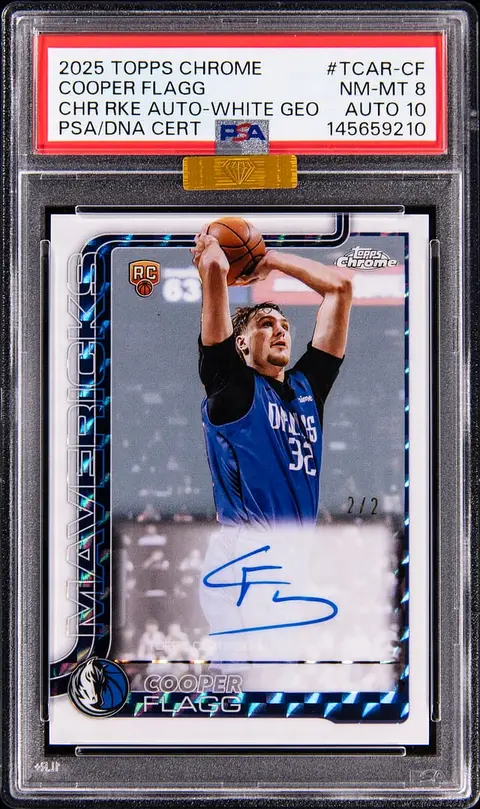
Sold Card
2025-26 Topps Chrome Rookie Autographs White Geometric Refractor #TCAR-CF Cooper Flagg Signed Rookie Card (#2/2) - PSA NM-MT 8, PSA/DNA GEM MT 10 - MBA Gold Diamond Certified
Sale Price
Platform
Goldin2025-26 Topps Chrome Cooper Flagg Auto /2 Sells for $103,700
On March 8, 2026, Goldin closed a notable ultra‑modern basketball sale: a 2025-26 Topps Chrome Rookie Autographs White Geometric Refractor #TCAR-CF Cooper Flagg, serial‑numbered 2/2, sold for $103,700.
The card is graded PSA NM-MT 8 for the card itself, with a PSA/DNA GEM MT 10 grade on the autograph and MBA Gold Diamond certification. For collectors who follow early‑career modern prospects and rare parallels, this is an important data point for how the hobby is valuing Cooper Flagg’s top‑end rookie ink.
Card breakdown
Let’s unpack what this card actually is and why it matters.
- Player: Cooper Flagg
- Season: 2025-26
- Product: Topps Chrome Basketball
- Subset: Rookie Autographs
- Card number: #TCAR-CF
- Parallel: White Geometric Refractor
- Serial numbering: 2/2 (only two copies produced)
- Type: Signed rookie card (key early issue)
- Grading:
- PSA card grade: NM-MT 8 (Near Mint–Mint)
- PSA/DNA autograph grade: GEM MT 10
- MBA Gold Diamond Certified (third‑party eye appeal/verification)
While “rookie card” definitions can get technical, this card functions in the hobby as a premium rookie autograph: it’s from a flagship chromium set, it’s a pack‑pulled signed card, and it carries one of the rarest parallels in the checklist.
The “White Geometric Refractor” is an extremely low‑print, visually distinct parallel. Being numbered out of 2 makes it essentially a “super chase” in the product—similar in spirit to a 1/1 or a top‑tier color match parallel in other sets.
Grading and attributes
A few details matter for how collectors look at this copy:
- PSA 8 card grade – Near Mint–Mint means the card shows minor flaws under close inspection (slight corner or edge touches, or small surface issues) but still presents well. For ultra‑modern high‑end cards, some buyers strongly prefer 9s and 10s, but for a 2/2, the rarity can outweigh a non‑gem grade.
- PSA/DNA 10 autograph – A GEM MT 10 auto grade confirms the signature is strong, clean, and well‑inked. For autograph‑focused collectors, this often matters as much as (or more than) the card grade on ultra‑low serial cards.
- MBA Gold Diamond Certified – MBA (Memorabilia Brokers/Authentication) evaluates eye appeal beyond just technical flaws. Their “Gold Diamond” label signals that this copy is among the stronger‑looking examples for its grade, which can help marketability, especially in photo‑driven online auctions.
It’s also important that this is an on‑card autograph (signed directly on the card stock, not on a sticker). On‑card autographs tend to be favored long‑term over sticker autos, especially for key rookies.
Market context and recent sales
Because this card is numbered to just 2 copies, you will not see frequent, repeatable sales data (also known as “comps”—short for comparables). For truly scarce cards, we often look at:
- Other grades of the same parallel (if they exist)
- Other parallels from the same autograph checklist
- Other premium Cooper Flagg rookie autos in similar products
As of this sale:
- Public auction results for this exact White Geometric Refractor /2 are naturally limited or nonexistent; a 2/2 might not change hands often.
- Recent sales for Cooper Flagg rookie autographs from early chromium or premium sets have tended to cluster in tiers:
- Higher‑print refractors and base autos at the lower end
- Golds, oranges, and similar mid‑tier colors in the mid‑range
- 1/1s and ultra‑low‑serial parallels (like /5, /2) in the top tier.
Within that landscape, $103,700 for a /2 rookie autograph from a recognizable chrome line and a major auction house fits into the high‑end prospect/early‑star segment of the basketball market. It’s in the same general territory where the hobby has previously valued very scarce early autos of heavily followed young players.
Because Cooper Flagg’s professional résumé is still developing, the sales history for his very best cards is relatively short. That makes this sale an early benchmark, rather than a mature “average price.”
Why collectors care about this card
Several overlapping factors make this card important to follow:
1. Cooper Flagg’s prospect profile
Cooper Flagg has been one of the most closely watched basketball prospects of his generation, with extensive attention from both NBA scouting circles and hobby media. When the hobby identifies a player as a potential future franchise cornerstone, their first chromium autos and low‑serial parallels tend to become the long‑term reference points.
If Flagg’s on‑court performance, awards, and team situation continue to trend positively, cards like this can become the “poster cards” people reference when they talk about his early market.
2. Topps Chrome as a platform
“Flagship” is a hobby term people use for a company’s primary, core set—something that tends to return every year and serve as a reference for a player’s cards. For basketball, Topps Chrome is positioning itself as a key chromium (shiny, refractor‑based) line.
Historically, chromium rookie autos have functioned as:
- Highly liquid cards among active buyers and sellers
- A visual match for how modern collectors like their cards (color, shine, parallels)
- A common “yardstick” for comparing different players’ markets
This specific White Geometric Refractor sits near the very top of the hierarchy within that product. For player‑collectors and set‑builders, it’s a true grail.
3. Extreme scarcity (2 copies)
Ultra‑modern cards are often criticized for high print runs, but that does not apply to this tier:
- Only two copies exist.
- Distribution is random in packs, so there is no guarantee both copies ever even surface publicly.
- Once a copy lands in a long‑term player collection, it may effectively leave the marketplace for years.
With this kind of scarcity, even a single auction can heavily influence how people talk about “market value,” because there are no weekly or monthly sales to average out.
4. Graded and authenticated at multiple levels
Layered verification—PSA card grade, PSA/DNA auto grade, and MBA eye‑appeal certification—makes this a relatively “friction‑free” card to trade in high‑end circles. Buyers in the five‑figure and six‑figure range often prefer:
- Third‑party confirmation that the card is genuine
- A clearly stated assessment of condition
- An autograph quality grade, when ink is a major value driver
This card checks all of those boxes, which supports confidence in both private and auction sales.
How this sale fits into the broader hobby
From a market‑watching point of view, this Goldin result on March 8, 2026 offers a few useful signals:
Confidence in early‑career ultra‑modern – Even as collectors debate print runs and prospect risk, there is still meaningful demand for the very top of the rarity pyramid when it comes to highly followed young players.
Autograph quality continues to matter – The PSA/DNA 10 auto grade and the on‑card signature are central to the appeal here. For many modern collectors, a strong autograph can offset a non‑gem card grade on ultra‑scarce parallels.
Auction houses vs. fixed‑price platforms – A sale like this at Goldin, a well‑known auction house for high‑end sports cards, adds visibility. That can influence how sellers on other marketplaces (fixed‑price or best‑offer) approach their asking prices on related Flagg autographs and parallels.
Benchmarks for future Flagg sales – As more of Cooper Flagg’s key cards reach the market—different parallels, higher or lower grades, and cards from other major sets—collectors and small sellers will likely use this $103,700 result as one of several reference points when talking about his “top card market.”
Takeaways for different types of collectors
A few practical, non‑advisory observations depending on where you sit in the hobby:
Newcomers and returning collectors – Use this sale as an example of how the hobby values a combination of: player expectation, brand (Topps Chrome), rarity (/2), and autograph quality. You do not need to buy at this level to enjoy the hobby; instead, it’s a helpful case study in how the top of the market behaves.
Active hobbyists – When looking at Cooper Flagg or similar prospects, pay attention to the full context: parallel level, print run, grade, autograph grade, and where the card sold. Ultra‑low serials like this often behave very differently from higher‑print refractors or base autos, so comps are not directly interchangeable.
Small sellers – If you’re listing Flagg cards, you can reference high‑end sales like this for narrative context, but be careful not to treat a 2/2 auction result as a direct comp for higher‑print cards. Instead, think of it as a ceiling indicator and focus on closest‑possible matches in set, parallel, and grade when you price or accept offers.
Summary
The 2025-26 Topps Chrome Rookie Autographs White Geometric Refractor #TCAR-CF Cooper Flagg, serial‑numbered 2/2 and graded PSA 8 with a PSA/DNA 10 autograph and MBA Gold Diamond certification, realized $103,700 at Goldin on March 8, 2026 (UTC).
For the modern basketball card market, this sale stands as an early, high‑end benchmark for Cooper Flagg’s top chromium rookie autographs and a clear example of how the hobby continues to reward extreme scarcity, strong on‑card signatures, and recognizable flagship brands.