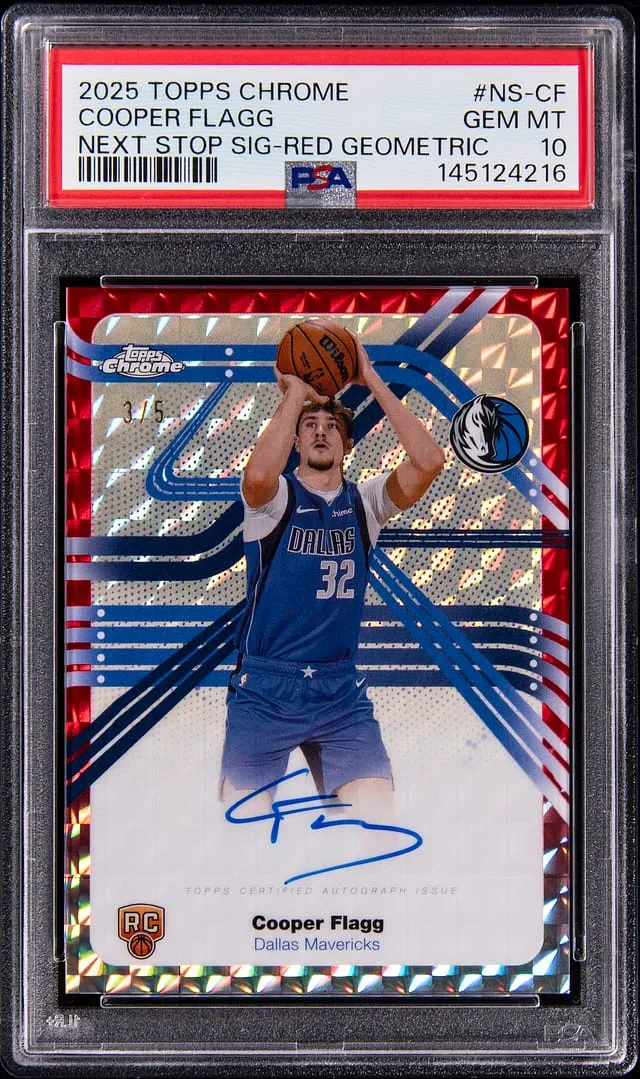
Cooper Flagg Topps Chrome /5 PSA 10 sells for $19K
Breakdown of the $19,520 Goldin sale of a 2025-26 Topps Chrome Cooper Flagg Next Stop Signatures Red Geometric /5 PSA 10 Pop 1 auto.
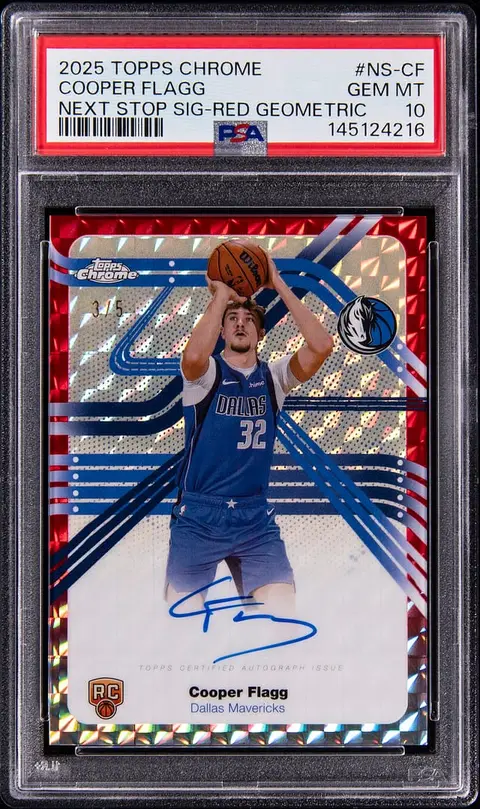
Sold Card
2025-26 Topps Chrome Next Stop Signatures Red Geometric Refractor #NS-CF Cooper Flagg Signed Rookie Card (#3/5) - PSA GEM MT 10 - Pop 1
Sale Price
Platform
GoldinA $19,520 red refractor Cooper Flagg autograph in March 2026 tells you a lot about where the modern basketball market’s attention is right now.
Below is a collector-focused breakdown of the card, the sale, and how it fits into the broader ultra‑modern landscape.
The Card at a Glance
Card: 2025-26 Topps Chrome Next Stop Signatures Red Geometric Refractor #NS-CF Cooper Flagg
Serial Numbering: Hand-numbered 3/5
Autograph: Signed rookie card (sticker or on‑card depending on final checklist; either way, a certified auto)
Set: 2025-26 Topps Chrome Basketball – Next Stop Signatures insert
Parallel: Red Geometric Refractor (low‑serial, premium insert parallel)
Grading: PSA GEM MT 10
Population: Pop 1 (only PSA 10 of this exact card at the time of sale)
Era: Ultra‑modern prospect / early career
This is a signed, low‑serial Cooper Flagg rookie-year insert parallel from a chromium (chrome-finish) product, graded in the top possible condition by PSA. For many collectors, those ingredients—Topps Chrome, autograph, /5, PSA 10—put the card firmly in “centerpiece” territory for a Flagg-focused collection.
The Sale: $19,520 at Goldin
- Auction House: Goldin
- Sale Date (UTC): 2026-03-15
- Final Price: $19,520 (price provided: 1,952,000 cents)
Goldin has become a common venue for high‑end modern and ultra‑modern basketball cards, so seeing a top‑tier Cooper Flagg parallel sell there fits the current pattern: serious prospect and early‑career pieces are increasingly going through major auction houses rather than only peer‑to‑peer marketplaces.
A PSA 10 Pop 1 /5 parallel from a key early autograph insert is exactly the type of card Goldin’s audience tends to chase—limited supply, clear headline, and strong brand recognition across the slab (PSA), card maker (Topps Chrome), and the player.
Why “Next Stop Signatures” Matters
For collectors newer to the hobby:
- Insert set: "Next Stop Signatures" is an insert subset inside 2025-26 Topps Chrome, built around signatures that highlight a player’s next step in their journey—often rookies or breakout names.
- Chrome platform: Topps Chrome is a chromium-finish, glossy product. In modern basketball, chromium cards are often where the most visually striking and most chased parallels live.
- Refractors and parallels: A refractor is a shiny variant of a base card that reflects light differently. Parallels are versions of a card with different colors or patterns, often with serial numbering. “Red Geometric” is one of the more visually distinctive and more limited patterns in this insert line.
Within that framework, a Red Geometric Refractor /5 is a high‑tier parallel—not a mass‑produced insert, but a short‑printed, serial‑numbered chase card.
Rookie Status and Collector Appeal
Flagg’s status as an early‑career or rookie‑year subject is crucial here. In basketball, the hobby often anchors value around:
- Flagship rookie issues (for example, base rookie cards from main sets), and
- Premium rookie parallels and autographs, especially when serial‑numbered and graded highly.
This card checks the second box:
- Rookie‑year autograph: Among autograph collectors, early‑career signed cards often become long‑term references for a player’s market, even if later “grail” cards emerge.
- Low serial (/5): Only five copies exist of this specific Red Geometric Refractor. Scarcity is built in from day one.
- Short‑run premium insert: Being from an autograph insert set rather than a base rookie line means it’s more niche, but often more visually and structurally premium.
For Flagg collectors who want something beyond a standard rookie, this sort of card sits in an important lane: not a 1/1, but close enough to feel genuinely scarce.
PSA 10 Pop 1: Why the Grade Matters
When we talk about pop report (short for population report), we mean the count of how many copies of a specific card have received each grade from a grading company.
At the time of this sale:
- Grade: PSA GEM MT 10 (PSA’s highest standard grade)
- Population: Pop 1 – this is the only PSA 10 example on record.
For a card that only has five total copies printed, the pop report will always be small, but a Pop 1 PSA 10 adds another layer of scarcity:
- Condition premium: On low‑serial ultra‑modern cards, the difference between PSA 9 and PSA 10 can be substantial, especially for investors and high‑end collectors who specifically target 10s.
- First‑mover advantage: The first confirmed PSA 10 to hit a major auction often sets an early benchmark that future sales are measured against.
This doesn’t guarantee any future price outcome, but it helps explain why a Pop 1 PSA 10 surfaces at a large auction house rather than quietly in a private sale.
Market Context and Comps
In the hobby, “comps” (comparable sales) are recent, similar sales we look at to get a sense of how the market values a card.
For this specific card—2025-26 Topps Chrome Next Stop Signatures Red Geometric Refractor #NS-CF Cooper Flagg /5, PSA 10—there are a few factors that shape its price context:
- Limited sample size: With only five copies printed, and only one graded PSA 10, the number of public auction results is naturally tiny. Each sale can sit far apart in time and price.
- Parallel hierarchy: In many chromium products, red parallels and low‑serial color refractors sit near the top of the non‑1/1 ladder (below superfractors or other 1/1s, but above higher‑serial colors like /50 or /99).
- Grade scarcity: Pop 1 in PSA 10 means there are no direct one‑to‑one graded PSA 10 comps at the moment of sale.
Based on the structure of recent ultra‑modern basketball sales:
- Lower parallels and lower grades (for example, /25 or /50 versions, or PSA 9 copies of similar Flagg autographs) generally transact at noticeably lower levels than this $19,520 result.
- Higher‑end Flagg pieces (such as 1/1s, logo patches, or top‑tier brand RPAs if/when they surface) can exceed this price tier, especially when graded and authenticated by the same major companies.
Because this is a first‑wave Pop 1 PSA 10 /5 sale in a premium chromium autograph insert, it likely sits toward the upper band of public Flagg parallel autograph results to date, though not at the very top of his emerging market.
The important point: the price is consistent with how the hobby has been valuing ultra‑scarce, early‑career autographs of high‑profile prospects, without leaning into any extreme outlier territory.
Why Collectors Care About This Card
For active hobbyists and small sellers, here’s why this specific card is noteworthy:
- Early proof of demand: A nearly $20K realized price at a respected auction house for a numbered‑to‑5 autograph shows that Flagg’s high‑end market has real, active bidders behind it.
- Chrome + Auto + Color: The combination of Topps Chrome, an autograph, and a low‑serial color parallel is a familiar formula from other stars’ markets. It’s a format collectors already understand and track over time.
- Condition ceiling: With PSA 10 Pop 1 status, this example occupies the condition “ceiling” for this specific parallel at the time of sale, which matters to registry collectors and high‑end set or player chasers.
- Reference point for future sales: Even if it doesn’t become a long‑term record, this Goldin sale will likely be cited when future copies (or similar parallels) come to market.
For Newer Collectors: How to Read a Result Like This
If you’re just getting into prospect or rookie‑year basketball cards, a sale like this can feel very distant from everyday collecting. A few practical takeaways:
- Ultra‑scarce cards behave differently: With only five copies, individual auctions can jump around based on who shows up to bid that week. Don’t expect the price to be as stable as a base rookie that sells every day.
- Grading matters most at the top: Condition premiums are steepest on ultra‑modern, high‑end cards. The difference between raw (ungraded), PSA 9, and PSA 10 can be much larger here than on lower‑end inserts.
- Use comps as a range, not a promise: A $19,520 result tells you how at least two bidders valued this card at that time and place. It doesn’t guarantee that another copy would fetch the same number next month.
- Think in tiers, not exact matches: When exact comps don’t exist, look at nearby pieces: same player, similar scarcity (/5, /10), similar brand tier, and similar grade. That gives a rough “tier” instead of a single target price.
Where This Fits in the Cooper Flagg Market
As more of Flagg’s rookie‑year and early‑career cards hit grading and auction pipelines, the market will likely sort itself into a rough hierarchy:
- Super‑premiums: 1/1s, key shield/logo patches, and centerpiece RPAs from the most established brands, especially in PSA/BGS/SGC 9.5/10 equivalents.
- Low‑serial chrome autos (like this /5): Red, gold, or similarly scarce refractor parallels from recognizable chromium lines, graded highly.
- Mid‑tier autos and color: Higher‑serial color (/25, /50, /99) autos and non‑auto parallels across Chrome and other mid‑ to high‑end products.
- Mass‑market rookies: Base and widely available parallels from mainline products.
This Next Stop Signatures Red Geometric Refractor /5 PSA 10 Pop 1 clearly sits in the second tier—a premium, short‑printed, early autograph that serious player collectors and high‑end modern buyers track closely.
Takeaways for Collectors and Small Sellers
- Document notable comps: If you hold another Flagg /5 or /10 auto from a comparable product, this Goldin result is worth bookmarking as part of your comp set, even if it’s not a perfect match.
- Watch the population reports: As more of these are submitted to PSA and other graders, Pop 1 status may change. Population growth can affect how people view relative scarcity.
- Separate player outlook from card specifics: Prospect sentiment can change quickly. The printing run, brand tier, and grade of a card remain fixed. When you evaluate any high‑end card, look at both the player’s trajectory and the card’s intrinsic traits.
For now, this $19,520 Goldin sale on March 15, 2026 stands as an early marker of how the hobby is treating Cooper Flagg’s scarce, signed chromium rookies—measured, serious interest from collectors who understand what they’re buying.
If you track modern and ultra‑modern basketball markets, it will be worth watching how future copies of this card—or comparable Flagg /5 and /10 autographs—compare to this Goldin benchmark over the next few release cycles.