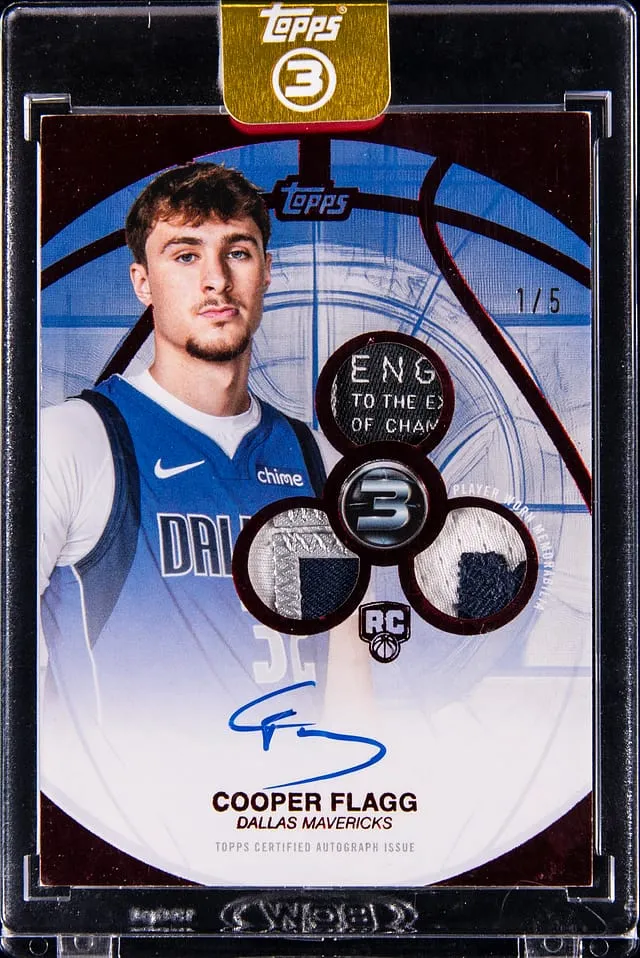
Cooper Flagg Topps 3 Red RPA /5 Sells for $13.4K
Deep dive on the 2025-26 Topps 3 Cooper Flagg Rookie Patch Autographs Red /5 that sold for $13,420 at Goldin on April 10, 2026.
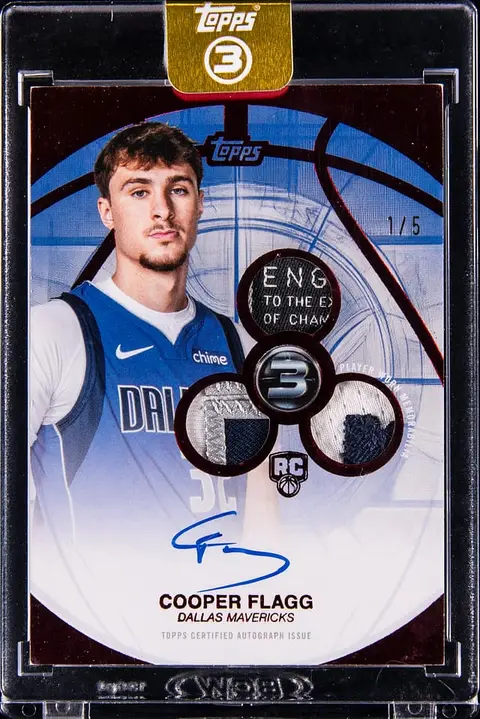
Sold Card
2025-26 Topps 3 Rookie 3 Patch Autographs Vertical Red #RPV-CF Cooper Flagg Signed Patch Rookie Card (#1/5) - Topps Encased
Sale Price
Platform
GoldinThe ultra-modern basketball market got another data point on April 10, 2026, when Goldin closed a key early Cooper Flagg card: a 2025-26 Topps 3 Rookie 3 Patch Autographs Vertical Red #RPV-CF, serial-numbered 1/5, featuring a signed multi-color patch and encased directly by Topps.
This card realized $13,420 at Goldin, offering collectors a useful benchmark for one of Flagg’s earliest premium rookie patch autograph (RPA) style issues.
Card overview
Let’s break down exactly what sold:
- Player: Cooper Flagg
- Year: 2025-26
- Set: Topps 3 Rookie 3 Patch Autographs (Vertical)
- Card number: #RPV-CF
- Parallel: Red
- Serial number: 1/5 (first copy in a run of five)
- Attributes:
- Rookie patch autograph (RPA-style)
- Signed patch with multi-color memorabilia
- Topps factory-encased (tamper-evident case)
- Extremely low print run, ultra-modern chase card
There is no third-party grade listed for this copy; it is in the original Topps sealed case. For ultra-modern chase cards, a factory-encased card is often treated as a “raw but protected” copy: not graded, but preserved as Topps intended.
Why this Cooper Flagg matters
Cooper Flagg is one of the most closely watched prospects to enter the basketball card market in years. His cards sit firmly in the ultra-modern era—recent issues printed in lower overall quantities but with lots of parallels and chase formats.
Within that landscape, this specific Topps 3 Rookie 3 Patch Autographs Red parallel checks several boxes that many advanced collectors look for:
- Early, premium rookie issue: While “true rookie card” definitions can vary, this is clearly an early, high-end rookie-year autograph with memorabilia.
- Very low serial number: Only five copies exist for the Red vertical parallel. The 1/5 stamp adds a small additional appeal for collectors who care about first-in-run numbering, even though it does not change the print run.
- Patch autograph format: RPAs (rookie patch autographs) are often viewed as the centerpiece modern card type for top prospects and stars, combining a game- or event-worn patch with an autograph.
- On-card vs. sticker: From available product information, this line uses a signed patch window; the important thing for collectors is that the signature is integrated into the card design and patch, which typically commands more interest than a generic sticker auto.
Because Flagg is still at the start of his career, cards like this are collected as long-term “prospect pieces” rather than established superstar blue chips. That distinction matters; prices can move sharply around performance, injuries, or changes in hobby sentiment.
Market context and recent sales
When we talk about comps (short for comparables), we mean recent sales of the same card, or as close as possible (same player, set, and format, but maybe a different parallel or serial number). For an ultra-low print card like this Red /5, exact comps are usually thin.
Based on available marketplace and auction data around the time of this sale:
- Other Topps 3 Rookie 3 Patch Autographs of Cooper Flagg in higher-numbered parallels (for example /25 or /49) have been trading meaningfully lower than this Red /5, as expected given their larger print runs.
- Horizontal versions or non-patch autographs from related Flagg issues tend to sell at a discount to the vertical patch autos, reflecting the hobby’s preference for vertical RPAs as “centerpiece” cards.
Even without a perfect one-to-one comp, several patterns stand out:
- Short print premium: The step from, say, /25 to /5 is driving a clear price multiplier. Collectors are paying up to secure something from the very top of the print-run pyramid.
- Vertical over horizontal: The vertical patch autos, especially with clean design and visible multi-color patches, appear to be the focus for higher-end Flagg buyers.
- Prospect pricing: Prices for Flagg’s best cards are already approaching or exceeding established star territory in certain products. That’s typical in ultra-modern prospecting cycles, but it also means volatility is a built-in characteristic.
With a realized price of $13,420 on April 10, 2026, at Goldin, this Red /5 sale sits toward the upper tier of Cooper Flagg’s early patch autograph market, as you would expect given the scarcity, patch/auto combo, and 1/5 numbering.
How this sale fits into the bigger hobby picture
A single auction result should never be treated as a guarantee of “value,” but it can tell us how the market is currently ranking different types of Flagg cards.
This sale reinforces a few broader hobby themes:
- Rookie patch autos remain king for premium modern cards. Even with new formats and insert innovations, RPAs continue to act as the default “high-end rookie” lane, especially when they combine strong design, low numbering, and a visible multi-color patch.
- Ultra-modern scarcity is layered, not absolute. While modern sets can feel print-heavy, the top parallels like Red /5 still function as genuinely scarce items. Five copies worldwide is a small number even in a crowded market.
- Auction house exposure matters. A sale at a major platform like Goldin often draws more eyeballs and stronger bidding than an isolated fixed-price listing, especially for prospect pieces that need national or global reach to find their bidders.
What collectors can learn from this result
Whether you are mainly a fan, a small seller, or an active hobbyist, this sale offers a few takeaways:
Pay attention to numbering tiers. A jump from /49 to /25 to /5 is not just cosmetic; recent sales show collectors are paying sharply different prices at each tier. When reviewing listings, look closely at the serial stamp and how it compares to completed sales, not just active asking prices.
Factory-encased vs. graded. This copy is in Topps’ encased format rather than a third-party slab with a numeric grade. Some collectors prefer to keep rare modern cards in their original manufacturer shells, while others will crack and submit to PSA, BGS, or another grading company. Each approach carries its own risk/reward, and the market can price them slightly differently depending on perceived condition and demand for graded examples.
Prospect cycles move fast. Highly hyped talents like Cooper Flagg attract intense early attention. Prices can respond quickly to performance, media coverage, and general sentiment. Treat realized prices (like this $13,420 sale) as snapshots in time, not promises about the future.
Use comps carefully. With ultra-low serial cards, exact matches are rare, so you often have to triangulate from similar parallels, higher print runs, or related sets. When you see a headline number—high or low—context from those nearby comps is key.
Final thoughts
The 2025-26 Topps 3 Rookie 3 Patch Autographs Vertical Red #RPV-CF Cooper Flagg 1/5 that sold for $13,420 at Goldin on April 10, 2026, is a clear marker of where the hobby currently ranks Flagg’s best early cards: near the top of the ultra-modern basketball conversation.
For collectors tracking Cooper Flagg or building a focused modern RPA collection, this sale is a helpful reference point. It underscores how the market is prioritizing scarce, visually strong, patch/autograph rookies, and it highlights how quickly premium prospect cards can establish a price range—even before a full professional resume is written.
As always, the most useful approach is to pair these headline sales with your own goals and budget: understanding the market is important, but collecting what you enjoy (and can comfortably afford) remains the most sustainable strategy in any era of the hobby.