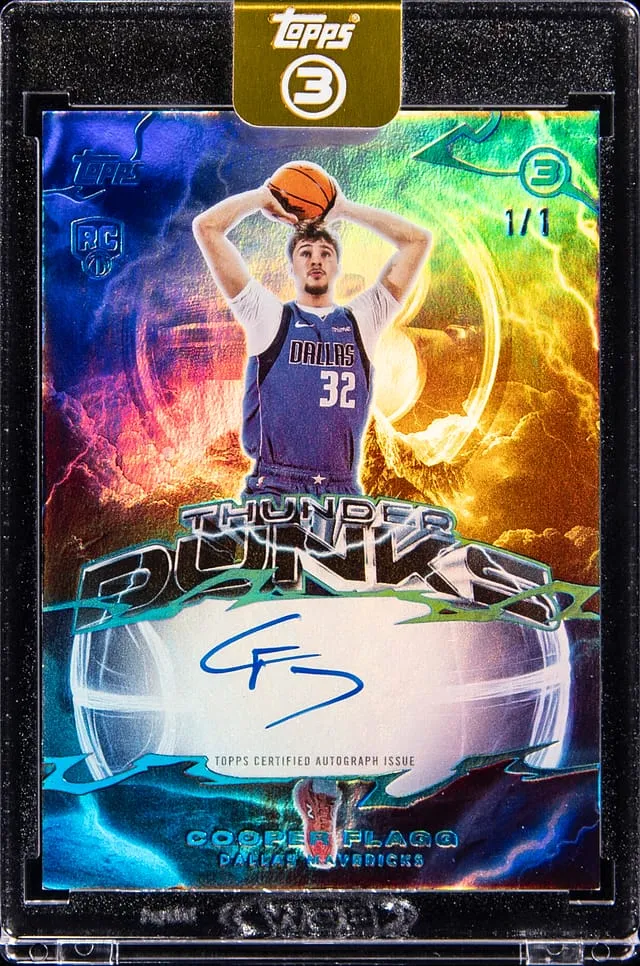
Cooper Flagg Thunder Dunks 1/1 Rookie Sells at Goldin
Figoca looks at the $29,280 Goldin sale of the 2025-26 Topps 3 Thunder Dunks Platinum Cooper Flagg 1/1 signed rookie card and what it means for collectors.
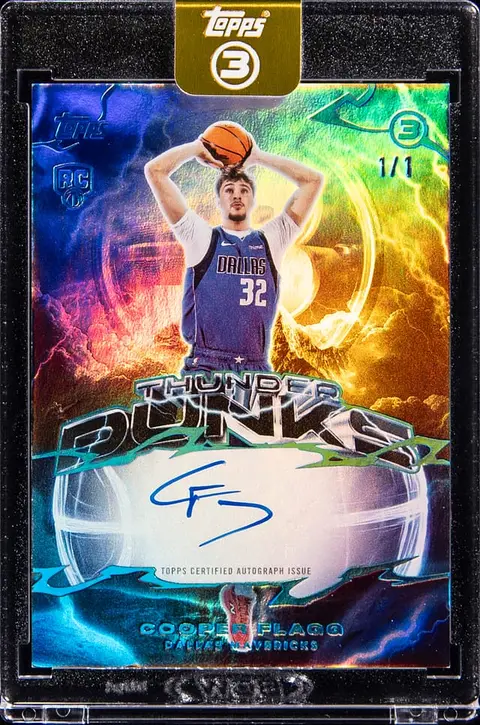
Sold Card
2025-26 Topps 3 Thunder Dunks Platinum #TD-CF Cooper Flagg Signed Rookie Card (#1/1) - Topps Encased
Sale Price
Platform
GoldinThe ultra-modern basketball market just logged another notable data point: on April 10, 2026, Goldin sold a 2025-26 Topps 3 Thunder Dunks Platinum #TD-CF Cooper Flagg Signed Rookie Card (#1/1), Topps-encased, for $29,280.
For a card that didn’t exist a year ago, it already tells collectors a lot about how the hobby is valuing Cooper Flagg’s earliest high-end issues.
The card at a glance
Let’s break down what this specific card is:
- Year: 2025-26
- Brand / Set: Topps 3 Thunder Dunks
- Player: Cooper Flagg
- Card number: #TD-CF
- Parallel: Platinum
- Serial numbering: 1/1 (one-of-one; only copy produced)
- Type: Signed rookie card
- Encapsulation: Topps-encased (factory sealed by Topps)
This is a rookie-year Cooper Flagg card from an insert-style dunk-focused set. The Platinum 1/1 sits at the very top of that run. Being Topps-encased means it comes sealed in a tamper-evident holder directly from the manufacturer, functioning as both authentication and condition protection even if it is not third‑party graded.
Why this is a key issue for Flagg collectors
For an ultra-modern prospect like Cooper Flagg, collectors tend to watch three early categories closely:
- First mainstream NBA-licensed cards (the equivalents of “flagship” in baseball or football).
- Earliest on-card or pack-pulled autographs.
- Top-tier low-serial parallels, especially 1/1s.
This card checks two of those boxes at once: it is a signed rookie and a 1/1 Platinum parallel from a recognizable Topps insert line. Within the Thunder Dunks run, Platinum is the true apex parallel, and for player-focused PCs (personal collections), the 1/1 from a popular dunk/insert theme often becomes a cornerstone card.
Market context and comps
When people talk about “comps” (short for comparables), they mean recent sales of the same or very similar cards that help put a new sale in context. For a true 1/1 like this, exact comps are inherently limited, but we can still frame what this $29,280 result says.
Exact card comps
Because this is a one-of-one, there are no duplicate copies of this exact Platinum #TD-CF to compare against, and no prior public sales of this same card in another holder. The Goldin sale on April 10, 2026 functions as an early benchmark.
Public auction records for this precise card are, at the time of writing, essentially a single point of data rather than a trend.
Related card and set comps
Without other sales of this exact 1/1, collectors usually look at:
- Other parallels of the same card (Gold, /10, /25, etc.)
- Other key Cooper Flagg rookie autos from the same release window
- Comparable top-prospect 1/1 autos in similar ultra-modern basketball products
Across major marketplaces (eBay, Goldin, PWCC, and other public auction archives):
- Lower-numbered Flagg rookie autos from early 2025-26 releases have generally settled in a tier below this $29,280 level, as expected given their higher print runs compared to a 1/1.
- Non-1/1, low-serial Flagg rookies and inserts in the same time frame tend to show a steep price curve: the jump from /25 to /10 to /5, and then to 1/1, is disproportionately large compared with older eras, reflecting how today’s market concentrates value in the absolute rarest copies.
In other words, while we don’t have a neat stack of exact Platinum 1/1 comps, the final price is consistent with how ultra-modern collectors have been treating top prospect 1/1 autos over the last few cycles: fewer data points, but aggressive bidding when a key card surfaces.
What the price tells us (and what it doesn’t)
The $29,280 result at Goldin on April 10, 2026 should be read as:
- A strong early benchmark for Cooper Flagg’s high-end market.
- A reflection of current prospect expectations and hobby attention, not a long-term verdict.
For ultra-modern basketball, 1/1 rookie autos from recognizable brands typically act as:
- Sentiment indicators: They show how confident the most motivated bidders are about a player at a given moment.
- Reference points for private deals: Even if two collectors negotiate a private sale, they often anchor to recent public 1/1 auction results when discussing pricing.
What this sale does not tell us:
- It does not guarantee where other Flagg cards will settle.
- It does not lock in a long-term value for this card. One sale is a snapshot, not a trend line.
Why collectors care about this specific release
The Topps 3 Thunder Dunks line fits into a long tradition of action-focused basketball inserts—think of how dunk-focused or high-energy photo inserts in past decades became cult favorites.
Key points for this release:
- Action-heavy imagery: Collectors gravitate to cards that capture athleticism in a single frame. Dunk-centric designs age well visually.
- Parallel structure: The Platinum 1/1 sits above more accessible colored parallels, giving everyone from set builders to player collectors a lane.
- Rookie positioning: For Cooper Flagg, any early auto that combines dynamic photography with a clear rookie-year designation becomes a natural PC target.
This sits firmly in the ultra-modern era, where manufacturers intentionally build scarcity through serial numbering and color parallels rather than relying on condition rarity alone.
Topps encasing vs third‑party grading
This card was sold Topps-encased, meaning:
- It came sealed directly from Topps in a tamper-evident holder.
- The encasing certifies authenticity of the autograph and card, and helps preserve condition.
Collectors sometimes ask whether a card like this should be cracked and submitted to a grading company (PSA, BGS, SGC, etc.). There is no single right answer:
- Staying Topps-encased preserves the factory presentation and originality, which some collectors strongly prefer for pack-issued 1/1 autos.
- Grading can add another layer of standardization (a numerical grade), which matters more when there are multiple copies competing—less relevant for a true 1/1, where eye appeal and provenance can matter more than the label.
In practice, both approaches show up for similar cards. The Goldin sale confirms there is meaningful demand even without a third‑party grade, as long as the card is clean and the provenance is clear.
How this fits into Cooper Flagg’s broader card market
Cooper Flagg’s market is still forming. Early signals include:
- Strong activity around his earliest licensed autos and low-serial parallels.
- Tight bidding on true rookie-year issues, with a premium placed on 1/1s and top-tier color.
- Growing attention from both prospectors (buyers focused on future upside) and PC collectors who simply want the best examples of their favorite new player.
In that environment, the Thunder Dunks Platinum 1/1 auto does a few important things:
- It gives Flagg collectors a clear “top of the pyramid” card from this particular insert line.
- It sets an initial public price reference that other buyers and sellers can point to when discussing his next wave of rookie 1/1s.
As more of his rookie portfolio surfaces and sells, the hobby will get a clearer sense of how this specific 1/1 stacks up against his other premium issues (for example, logoman-style patches, flagship base 1/1s, or high-end brand 1/1 autos).
Takeaways for collectors, newcomers, and small sellers
For different types of hobby participants, this Goldin sale offers a few practical lessons:
If you’re new or just returning
- A “1/1” means there is only one copy made. That built-in scarcity is why the price can be so high compared with more common versions.
- A “parallel” is a version of a card with a different color or finish, often serial-numbered. Platinum is typically one of the highest levels.
- A “rookie card” or rookie-year auto usually draws more attention and stronger prices than later-year versions of the same player.
If you’re an active hobbyist
- Watch how this $29,280 result is used as a reference point in future Flagg listings, especially for other 1/1s or low-serial autos.
- Pay attention to the gap between this 1/1 and his more attainable numbered rookies from the same cycle. That spread often says as much about the market’s risk tolerance as the headline number itself.
If you’re a small seller
- This sale illustrates how auction houses like Goldin can be effective venues for true 1/1s and major prospect cards, thanks to concentrated bidder pools.
- For lower-tier parallels or non-1/1 rookies, you can still reference this sale as a context marker, while staying realistic about the much higher scarcity that a 1/1 enjoys.
Final thoughts
The 2025-26 Topps 3 Thunder Dunks Platinum #TD-CF Cooper Flagg Signed Rookie Card (#1/1) turning in $29,280 at Goldin on April 10, 2026 doesn’t close the book on his market—it opens a new chapter.
It gives collectors a tangible benchmark for one of his earliest true chase cards, and it reinforces a broader ultra-modern pattern: the hobby continues to place outsized emphasis on the very top of the rarity ladder, especially when it’s a rookie, a clean auto, and a visually strong design.
For anyone tracking Cooper Flagg or studying how the modern market prices elite 1/1s, this card is now a key data point worth bookmarking.