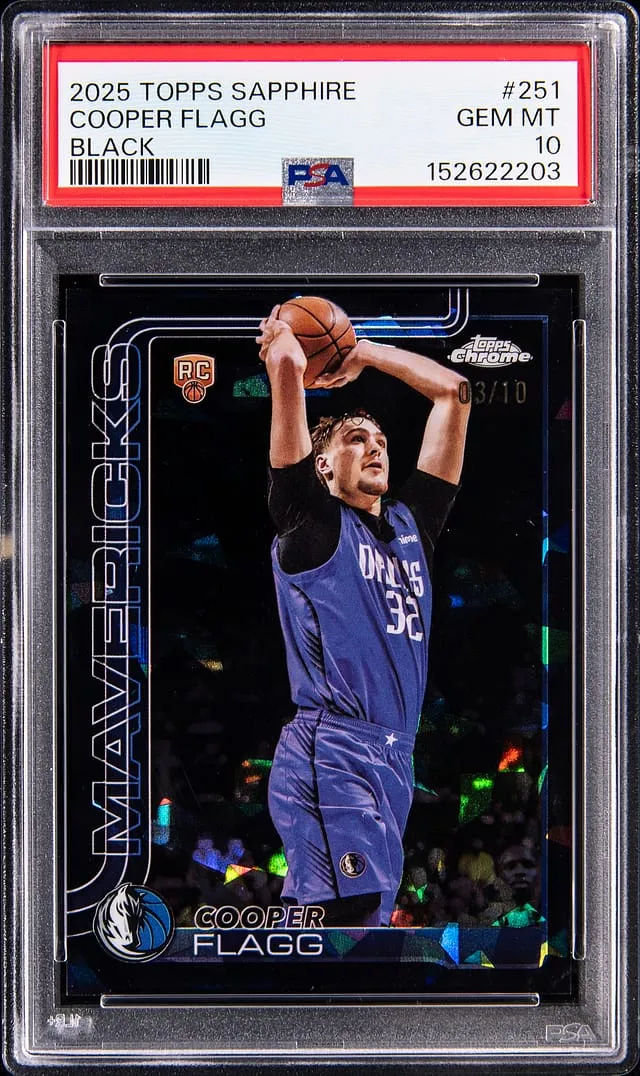
Cooper Flagg Sapphire Black /10 PSA 10 Sells for $29k
Goldin sold a 2025-26 Topps Chrome Sapphire Black /10 Cooper Flagg RC PSA 10 Pop 1 for $29,280. Here’s what it signals for his ultra-modern market.
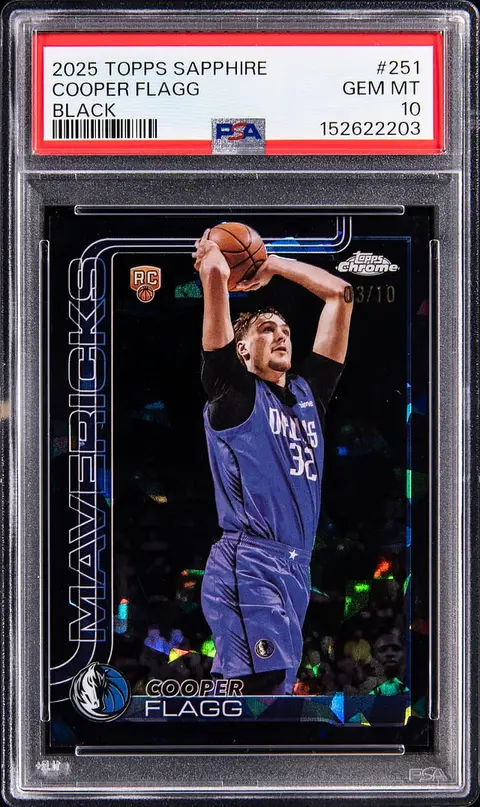
Sold Card
2025-26 Topps Chrome Sapphire Black #251 Cooper Flagg Rookie Card (#03/10) - PSA GEM MT 10 - Pop 1
Sale Price
Platform
Goldin2025-26 Topps Chrome Sapphire Black Cooper Flagg /10 in PSA 10: What This $29,280 Sale Tells Us
On April 17, 2026, Goldin closed a notable ultra‑modern basketball sale: a 2025-26 Topps Chrome Sapphire Black #251 Cooper Flagg Rookie Card, serial‑numbered 03/10, graded PSA GEM MT 10, population 1. The final price was $29,280.
For an unproven NBA prospect, that is a serious number. Let’s break down what this card is, why it matters to collectors, and how this sale fits into the early Cooper Flagg market.
Card overview: what exactly sold?
Card details
- Player: Cooper Flagg
- Year: 2025-26
- Brand / set: Topps Chrome Sapphire
- Card number: #251
- Parallel: Sapphire Black
- Serial numbering: #03/10 (only 10 copies produced)
- Card type: Rookie card (RC)
- Grading company: PSA (Professional Sports Authenticator)
- Grade: GEM MT 10 (PSA’s highest standard numerical grade)
- Population: Pop 1 (only one copy has received a PSA 10 grade at the time of sale)
Key points for collectors:
- Low serial numbering (/10): Only 10 copies of this parallel exist, so even before grading it’s an inherently scarce card.
- PSA 10, Pop 1: Among any graded copies of this specific Sapphire Black parallel, this is the only one at a perfect 10 as of the sale date. That “top of the census” status often attracts set builders and high‑end player collectors.
- Rookie status: For modern players, the rookie year is typically the cornerstone of any PC (personal collection). High‑end parallels from that first year tend to be long‑term reference points for a player’s card market.
There is no autograph, patch, or memorabilia component here—this is a pure chromium parallel play: condition sensitive, visually strong, and extremely low print.
What is 2025-26 Topps Chrome Sapphire, and why do collectors care?
Topps Chrome Sapphire in basketball follows a well‑established pattern seen in baseball and soccer:
- Premium parallel version: Sapphire takes the core Topps Chrome card design and overlays it with a cracked-ice, “sapphire” style finish. It is not a separate rookie; it’s a higher‑end parallel of the base Chrome rookie.
- Shorter print run: Sapphire products are typically produced in much lower quantities than regular Chrome, and the numbered parallels (especially /10 and below) sit at the high end of scarcity.
- Ultra modern era: 2025-26 firmly sits in the ultra‑modern window (roughly late 2010s onward). In this era, collectors are very aware of parallels, grading, and serial numbers. That usually means:
- More competition to land low‑numbered color.
- Faster grading turnaround for key rookies.
- Sharp separation between “true” rookies and later-year cards.
For Cooper Flagg, whose hype cycle has been building since high school, a Topps Chrome Sapphire rookie serves as one of the cleaner, non-auto, non-patch flagship‑style plays: recognisable brand, chromium stock, and distinct parallel hierarchy.
Market context: how does $29,280 fit in?
This sale closed at $29,280 at Goldin on April 17, 2026.
When we look at ultra‑modern basketball markets, a few factors tend to frame a number like this:
Print run and scarcity
- A /10 parallel from a premium chromium product usually falls in the “upper‑tier” bucket for non‑auto rookies.
- The combination of /10 plus PSA 10 Pop 1 is exactly the kind of setup that can create outlier results when at least two bidders decide this is a must‑have.
Grading spread
- Early in a product’s life cycle, PSA population reports tend to be thin. A Pop 1 doesn’t always mean the card is truly unique forever—it often means grading is still in progress.
- That said, ultra‑low print runs like /10 cap just how much the population can expand over time.
Comps and nearby benchmarks
In April 2026, the direct comp history for this exact card—2025-26 Topps Chrome Sapphire Black #251 Cooper Flagg /10 PSA 10—appears very limited or non‑existent. That’s not unusual for a Pop 1 /10 parallel this early.Instead, collectors usually look at:
- Other Cooper Flagg rookies in lower-numbered parallels (for example, Gold /10 or /50 equivalents in other premium sets).
- Different grades of the same parallel (raw or PSA 9) if any have surfaced.
- Comparable prospects from prior years (high‑profile rookies with premium /10 refractors or Sapphire parallels in PSA 10) to get a directional sense of where the market has supported prices historically.
Across those categories, this $29k+ result sits on the aggressive side for an ultra‑modern prospect, but within a pattern we’ve seen for hobby‑anointed names at the start of their NBA careers. Early high‑end rookie parallels for top‑tier prospects can and do attract headline prices in their first year.
Because this is a Pop 1 PSA 10 and a very thinly traded /10 parallel, there isn’t a deep sales history to say this result is “typical.” For now, it stands more as a marker sale—a first strong data point for this exact card—than as a stable price range.
Why Cooper Flagg matters to collectors right now
Without rehashing every scouting report, it’s enough to say:
- Flagg entered the NBA with a rare level of attention for a modern prospect, fueled by high‑school and pre‑NBA performances and extensive media coverage.
- The hobby tends to focus hard on players who combine upside, highlight‑friendly games, and an early label as a potential franchise cornerstone.
For card collectors, that usually translates into:
- Fast grading: Key rookies hit PSA and other grading companies very quickly after release.
- Concentration in top parallels: Collectors who believe strongly in a prospect try to land the best possible version—/10s, 1/1s, or the cleanest color matches—rather than only base rookies.
- Early “marker” sales: First‑to‑market copies of premium rookies sometimes command a premium simply because they set the early reference point for the card.
This Sapphire Black /10 ticks all those boxes: visually distinct, very low print, and the current best‑graded copy.
Understanding the pop report and PSA 10 premium
The pop report (population report) is essentially a public count of how many copies of a card have received each grade from a grading company.
Here, the key label is “Pop 1” in PSA 10:
- There may be raw (ungraded) copies and other graded copies out there, but as of this sale, only one example has reached PSA’s top grade.
- Collectors often pay a premium for “finest known” examples, especially when the total print run is already tiny.
In ultra‑modern chrome products, gem rates can be strong, but Sapphire surfaces are not immune to edge, corner, or surface issues. A 10 on a /10 is never guaranteed, even in new‑release condition.
For small sellers and newer collectors, this is an important lesson:
- Raw vs graded: A raw /10 might look like the same card, but the market often values a PSA 10 at a substantial premium over PSA 9 or ungraded copies, particularly when pop reports are small.
- Timing: Submitting early and hitting a 10 on a key rookie parallel can significantly change the card’s liquidity and price point versus selling it raw.
How this sale fits the broader ultra‑modern basketball trend
A few broader takeaways from this Goldin sale:
Flagship chromium still matters
While there are RPAs (rookie patch autos), on‑card autos, and 1/1s in other products, the hobby continues to treat clean, low‑numbered chromium parallels from recognizable sets as core pillars of a player’s rookie market.Color and numbering hierarchy is well understood
Collectors are increasingly specific about which parallels they target. A Black /10 from Sapphire sits high in that hierarchy for non‑auto rookies, and this sale reflects that.Early demand is concentrated
In the first year or two of a prospect’s career, the most aggressive prices tend to cluster around:- True rookie cards from flagship or flagship‑adjacent sets (like Topps Chrome, Prizm, etc.).
- The rarest and most aesthetically appealing parallels.
- The best grades on the toughest cards.
This Cooper Flagg PSA 10 Sapphire Black /10 checks all three boxes.
What collectors and small sellers can take from this
If you’re a collector or investor in Cooper Flagg:
- This Goldin sale gives you a top‑end reference point for one of his scarcer non‑auto rookies.
- It does not mean every Flagg rookie is a five‑figure card, but it does underline the market’s willingness to pay for rarity + grade.
If you’re a small seller or breaker:
- Pulling a low‑numbered parallel of a hyped rookie from a product like Topps Chrome Sapphire should trigger a careful inspection and likely a grading conversation.
- Market data from sales like this support the idea that grading can be a major value unlock on ultra‑modern chromium cards, especially when they appear clean.
If you’re a newcomer:
- Terms like “comps” (recent comparable sales used for pricing), “pop report,” and “flagship” are not just jargon—they’re tools to help you decide what to pay and what to grade.
- You don’t need to chase /10s to enjoy the hobby, but understanding how the top of the market behaves helps you make more informed decisions even at lower price points.
Final thoughts
The $29,280 sale of the 2025-26 Topps Chrome Sapphire Black #251 Cooper Flagg Rookie Card (#03/10) – PSA GEM MT 10 – Pop 1 at Goldin on April 17, 2026, is an early statement result for one of Flagg’s key non‑auto rookies.
With:
- An ultra‑low print run (/10),
- A perfect PSA 10 grade,
- A Pop 1 status at the time of sale, and
- A major auction house platform,
this card now sits as a reference point in the Cooper Flagg market and a useful case study in how ultra‑modern scarcity, grading, and prospect hype intersect.
As always, prices in this part of the hobby can move quickly in either direction as more copies surface and as on‑court performance evolves. For now, this Sapphire Black PSA 10 stands as one of the defining early Flagg pieces in the market.
figoca will continue tracking future sales of this card and related parallels so collectors can see how this early marker compares to what comes next.